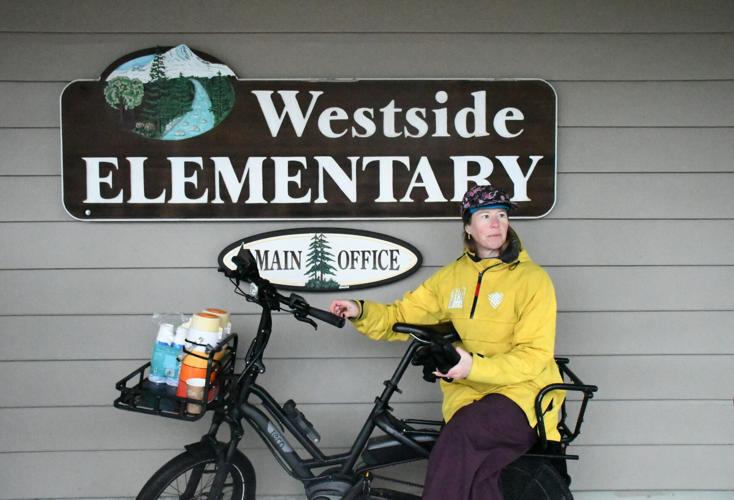
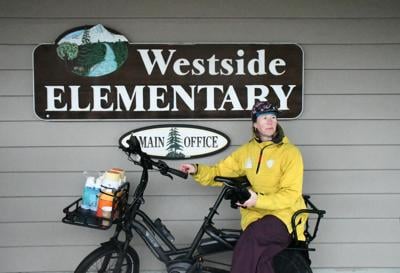
Local soft mobility advocate and Hood River County School District's Safe Routes to School Manager Megan Ramey outside of Westside Elementary on April 15, offering kids hot chocolate for "Dolores Huerta Walk to School Day." Sean Avery photo.
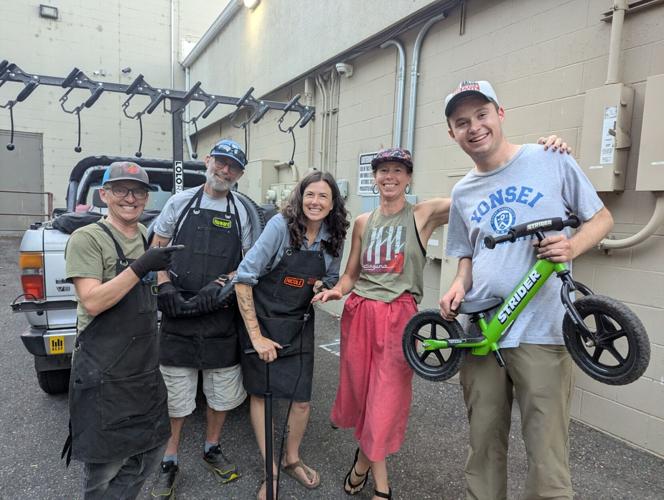
The Bike Buddies crew with Anson before he moved to Korea for college. From left to right: Kyle Ramey, Howard Cohen, Nicole Bassett, Megan Ramey, Anson Pulk. Contributed photo.
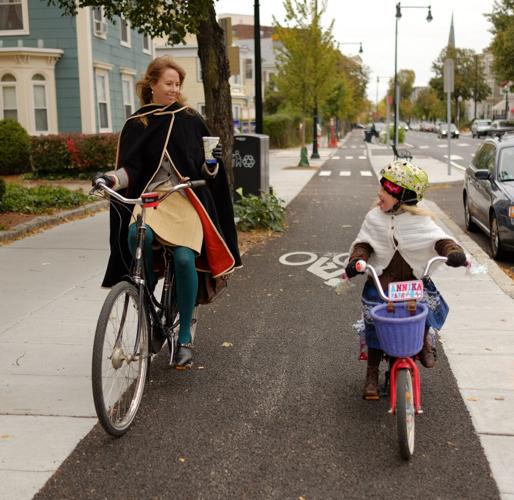
Ramey and her daughter Annika biking the Western Avenue cycle track in Cambridge, MA, after she spoke at a ribbon butting as a Cambridge Bike Committee member in 2015.
Local soft mobility advocate and Hood River County School District's Safe Routes to School Manager Megan Ramey outside of Westside Elementary on April 15, offering kids hot chocolate for "Dolores Huerta Walk to School Day." Sean Avery photo.
HOOD RIVER — Born in Madison, Wisconsin, the Midwest’s unofficial cycling capital, Megan Ramey had biking infused in her DNA before she could walk. Now at the helm of several bike-forward initiatives, including Hood River County School District’s Safe Routes to School program, the all-star advocate is charting a new, more sustainable path for Gorge youth rooted in soft mobility.
Ramey’s lifelong attachment to bikes first blossomed during early childhood, cruising around her not-so-pleasant-smelling paper mill town in Northern Wisconsin, where kids led a free-range, “Goonies-esque” life of adventure. Even during harsh winters, she would bike to school.
“I don’t know what came first, the bike or the independence, but they seemed to breed off each other,” Ramey said. “Biking in Wisconsin was normal.”
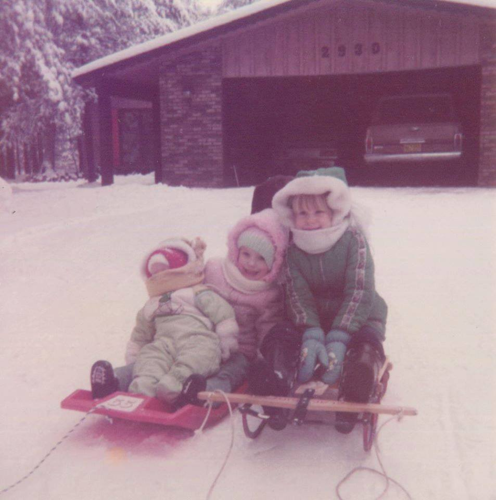
A young Ramey and her siblings sledding during a snowy, Northern Wisconsin winter.
At 14, Ramey’s family moved to Peachtree City, just outside of Atlanta, where golf cart paths wound through idyllic suburban neighborhoods. Her hometown had taken a more laissez-faire approach to biking and outdoor exploration; Peachtree was explicitly built around it. Here, comparing two childhood stomping grounds, Ramey caught her first glimpse of how cities are designed for, or against, their people.
Teenage transportation was a different story, though; with 16-year-olds being handed cars left and right like candy — resembling a rite of passage — biking to school was no longer cool. Ramey’s route to class became strictly auto-dependent.
College, or colleges in Ramey’s case, would forever shift her trajectory towards a car-free lifestyle. First up: Auburn University in rural Alabama, where football culture rules all. Although able to pedal around campus, Ramey didn’t jive with the environment at large and missed the big city, so she transferred to Georgia State University in Atlanta after a quarter. Again, it wasn’t a match, leading her to the University of Georgia in Athens — a place she could finally set up camp and would quickly fall in love with.
In her second year, Ramey experienced a life-changing car crash — a true Robert Frost, “The Road Not Taken” moment, where two paths diverged in front of her: one, a typical, car-centric American lifestyle; the other, a life of soft mobility and advocacy. She chose the path less traveled.
After the crash, her dad gave her his old Trek road bike, which became her primary mode of transportation for the remainder of college. “My life was instantly transformed,” Ramey said. “I lost weight without even trying. I became healthier and happier.”
A chance encounter with a magazine at a coffee shop, Athens’ The Flagpole, illuminated a path back to her birth city. Ramey read a two-page article that broke down Madison, neighborhood by neighborhood, as the “Athens of the North,” topped by an epic picture of the bike-friendly state capital’s unique geography, situated on an isthmus.
“It was a sign I needed to move back,” she said.
The freshly graduated fashion major explored where she wanted to work and eventually selected the apparel company Lands’ End, which prides itself on quality. Alongside her then-boyfriend, now husband, Kyle Ramey, she returned to Madison and quickly embraced its bike and transit-centric culture, which had been brewing since the mid-1970s.
“Taking the bus everywhere was not only super easy, but welcomed,” Ramey said. “Kind of like when you go to Europe, and everybody’s walking in the middle of the street.”
In 2008, the Rameys moved to Boston — ranked in the bottom five in the world for biking at the time — where their daughter, Annika, entered the picture and a life of advocacy would officially commence. “Taking care of myself and biking around Boston was already very harrowing,” Ramey said. “Adding an infant into that changed everything.”
She would tow her sleeping 6-month-old in a burly trailer, lane-splitting, unaware whether cars could see them. “I didn’t realize I was in the thick of postpartum depression,” Ramey said. “When my husband rigged that trailer on the back of the bike, that’s when I felt like I walked out of the fog. I started getting my headspace back.”
But the streets were undeniably awful for biking parents. Even for someone like Ramey, who was comfortable on two wheels, situationally aware, and understood the etiquette, Boston was demonstrably dangerous. “It doesn’t entice the bike curious at all,” she thought. “If I’m going to live here with [Annika], the city has to be on a trajectory towards the Madison level, and I’m going to have to become an advocate.”
Ramey became the treasurer of Boston’s LivableStreets Alliance, akin to The Street Trust in Portland, and a member of the Boston Bikes Advisory Board, attending meetings and delivering public testimonies with her daughter on her chest. “She was always there,” Ramey said. “Centering her and children in the discussion of what our streets are supposed to be designed for.”
Ramey and her daughter Annika biking the Western Avenue cycle track in Cambridge, MA, after she spoke at a ribbon butting as a Cambridge Bike Committee member in 2015.
Uncoincidentally, this period (2008-2016) marked a renaissance for Boston’s bike infrastructure. For example, the city introduced its first bike lane in 2008, the Hubway (now BlueBikes) bicycle-sharing system in 2011, and the Boston Bike Network Plan in 2013. “What we accomplished was pretty unbelievable,” Ramey said.
During her stint in the Northeast, Ramey was additionally a sustainability consultant, helping big companies reduce their wastewater, electricity, and transportation emissions. But in this work, she described, there were too many sticks involved to motivate everyday people to change their behavior.
She began thinking of ways to expose folks to the carrots of biking, namely convenience and joy. “You leave when you want to, you arrive when you want to. There’s no traffic, no parking,” Ramey said. “And the joy of being outside — you have run-ins with neighbors, health benefits, and get to stop for ice cream, coffee, or beer.”
Enter Bikabout, Ramey’s free online bike-tourism and travel-planning guide, centered on North American cities and designed for the bike-curious. “It’s meant to be an advocacy platform, but also a seed in people’s brains for sightseeing cities and towns by bike — the best way to do it,” she said. “It’s more immersive, and you can see so much in a short period of time.”
Among her core memories, gallivanting across the states and beyond, Ramey recounts riding along the Great Allegheny Passage Trail from Pittsburgh to Washington, D.C., and cruising around Manhattan with her daughter. “These experiences made me want to make my community the best,” Ramey said. “It was a shining example of what life can be like, and how we welcome guests into our community.”
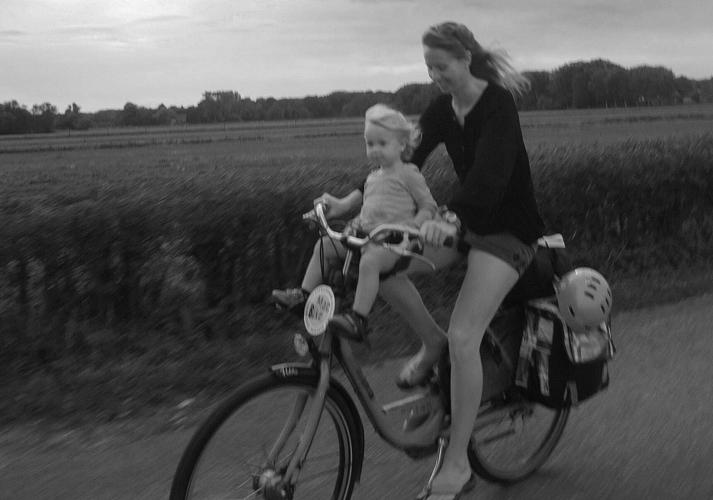
Ramey and her daughter enjoying a two-week biking vacation in Belgium and the Netherlands, 2011.
From here, one might ask, how does this globetrotting journey end up in dainty Hood River, Oregon? In the latter years of Boston life, Ramey experienced a road rage incident: a driver tried to run her and her family over, and got off scot-free. “That was a giant punch to the heart,” she explained. “People can do terrible things in our streets, and it doesn’t matter because courts have motor-normativity in their heads.”
Thus, she created an Excel spreadsheet called the “Oxymoronic Utopia,” ranking the top 60 American cities on car-free livability and access to nature — a challenging dichotomy in an infamously car-pilled country.
Hood River ranked sixth overall on the list, behind Seattle, Portland, San Francisco, Port Townsend, and Madison, but ultimately prevailed, propped up by its small, quickly traversable layout, the CAT Bus, and immediate access to trailheads.
Upon arrival, Ramey, shell-shocked from turning a dream move into reality, took a year off from advocacy. From that point forward, it became a head-on commitment to improving the city and county’s car-free livability, particularly for local kids. Early connections included former Thrive Executive Director Heather Staten and former city council member Becky Brun, who have since become mentor figures.
Ramey’s first material step into local advocacy work was Streets Alive, an event in which city streets were temporarily shut down for car-free enjoyment. In 2018, she joined the Hood River Planning Commission, where she served for nearly four years. “There were a lot of lessons learned,” she said. “I couldn’t be a big city advocate here.”
Come 2020, the beginning of the COVID-19 pandemic, Principal Kelly of May Street Elementary called on Ramey to help shorten the drop-off queue, predicted to be longer with fewer students riding the bus.
Inspired by Kiel Johnson’s “bike train” concept, spotlighted in a Streetfilms feature on Portland’s neighborhood greenways, Ramey had 100 kids rolling to school for a one-day “bike parade.”
Pleased, Kelly wanted more kids riding to school daily. Ramey scored a $25,000 grant from ODOT to help pay for her time and became the Hood River County School District’s Safe Routes to School Manager.
In Hood River County, Ramey noticed, there are three primary barriers impacting kids’ ability to walk or bike to school. First, by a wide margin, is the “Big I” (infrastructure): the county lacks viable routes to its nine schools. “Parents don’t feel comfortable walking or biking as a family unit,” she said. “It’s one scary intersection after another.”
The second is education: parents and authorities aren’t privy to the benefits, or don’t know if their kids are skilled enough to handle complex street situations. The third is the topography: the county’s steep inclines are challenging for some bikes and riders.
Although there is still ample work to be done, Ramey has spent the last several years working to address such barriers, leading youth via the Walk and Roll to School program while fighting for a safer tomorrow at City Hall.
Initially an everyday occurrence, the “bike train,” interchangeable with “bike bus,” returns for specific events throughout the school year. For instance, on April 22, county schools participated in the “Bike Bus 4 Earth Day,” which challenged them to generate the largest turnout. Ramey holds a strong relationship with Sam Balto of Portland’s Bike Bus, which has gone viral on social media, hosted numerous celebrities, and spurred similar events nationwide.
Additionally, from April 13-17, Hood River County students participated in “Dolores Huerta Walk to School Week.” Since February, fifth-through-eighth graders have enjoyed the 80s Walk and Roll Afterschool Bike Club.
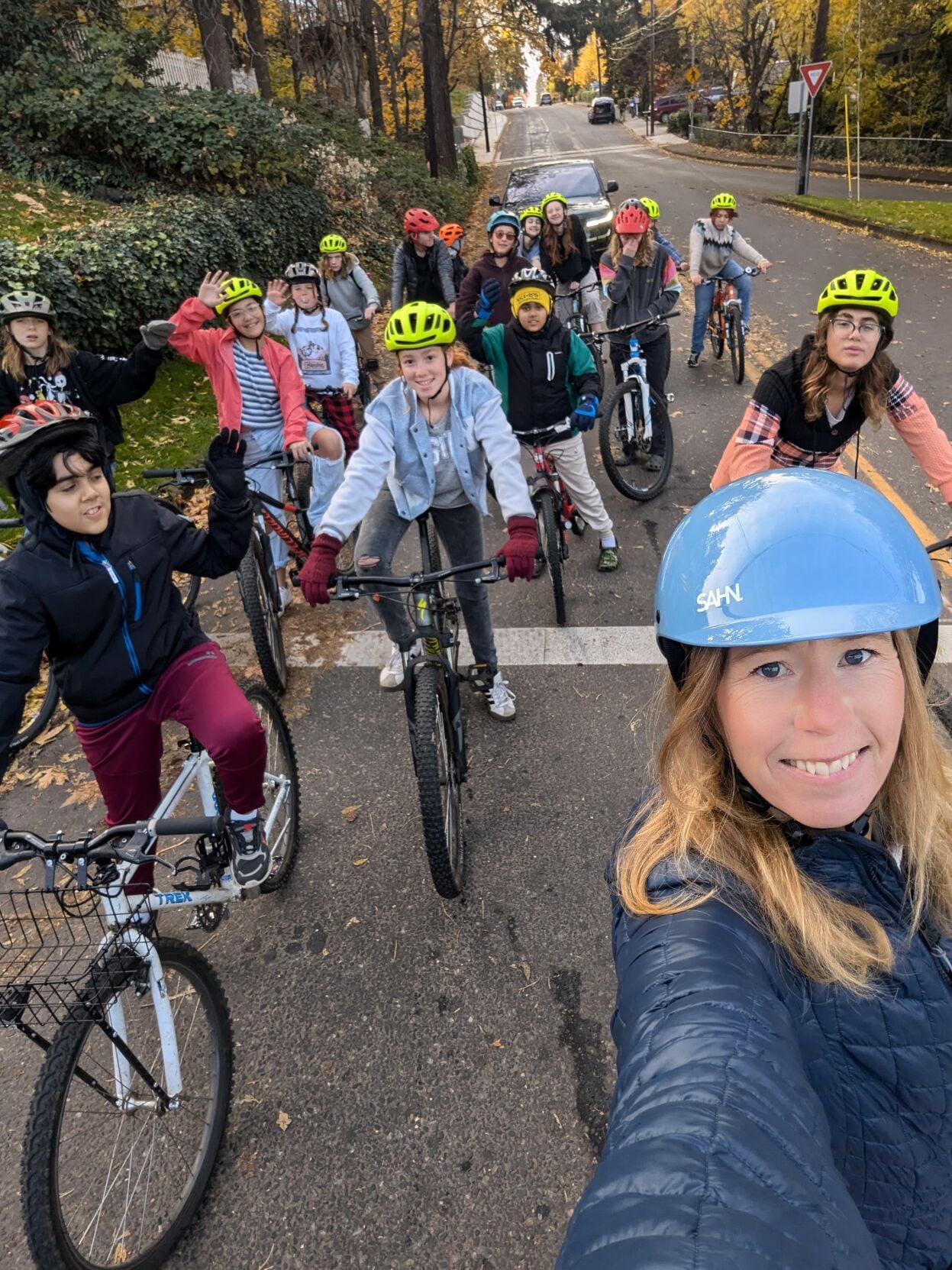
Megan Ramey leads a group of students from the 80s Walk and Roll Afterschool Bike Club, 2024.
Last week, Ramey returned to teaching “bike confidence” at district schools, which encompasses etiquette and ability. For high school students, classes are essentially biking field trips; anyone who can ride a bike in PE class gets to go on a five-to-six-mile bike ride.
During the chillier months, Ramey’s head is down, writing grants to win as much money for the city and school district as possible. She recently won $100,000 from Pacific Power to fund an E-bike lending library and a rebate program starting this summer, bringing her total winnings to more than $10 million since joining the district.
Ninety-nine percent of the progress made thus far has been supported by the city and the community — with caveats. Since the city juggles several competing budget priorities, financial constraints are a natural obstacle. When progress slows or stalls, Ramey looks to the Netherlands for motivation — a country widely recognized for its biking culture that was once just as car-intensive as America, she explained. “You have to start from somewhere. I’m an optimist and long-term thinker.”
Another impetus is feedback. “I’ve written down quotes from moms that tell me how life-changing what I’m doing has been for their kids,” Ramey said. “They can see their children rapidly discovering their independence, building confidence, and becoming happier, more well-rounded kids … like what happened to me in Athens.”
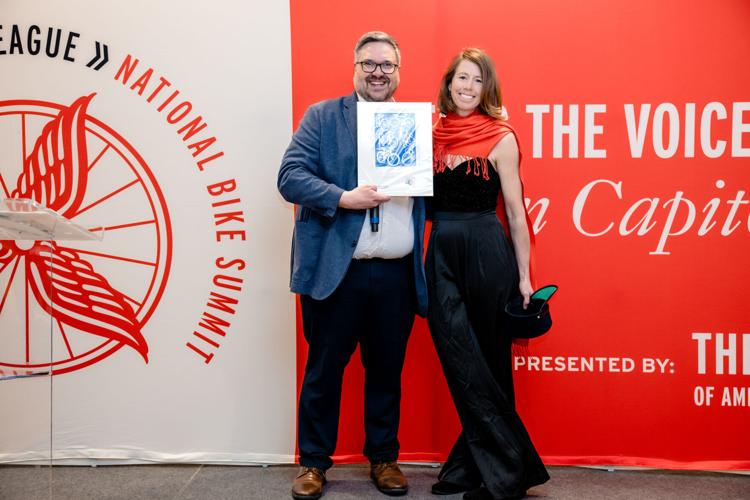
Such recognition reached a full-circle peak last year, when Ramey was named the 2025 Educator of the Year at the National Bike Summit in Boston, in front of familiar faces. “I was taken aback,” she said. “To be recognized from a town with less than 10,000 people for the work I’m doing.”
Ramey accepts the 2025 Educator of the Year Award at the National Bike Summit in Boston.
Kelly Loss Photography
In Ramey’s perfect future, Gorge youth will be able to walk out their door and bike to their best friend’s house or the playground. If an adult lives in Parkdale, they can reach Hood River car-free with little thought. “Kids would drop their devices if they could play free outside,” she said.
The Bike Buddies crew with Anson before he moved to Korea for college. From left to right: Kyle Ramey, Howard Cohen, Nicole Bassett, Megan Ramey, Anson Pulk. Contributed photo.
Ramey and her husband are currently working to secure a retail space in The Heights for their non-profit bicycle repair shop, Bike Buddies (formerly Anson’s Bike Buddies), to provide access to maintenance and a welcoming, DIY community center for local youth.
When she’s not hard at work, advocating for safe and sustainable outcomes for future commuters or riding to school with students, you can find Ramey biking about, with a friend, and something good to eat, enjoying the Gorge’s unbeatable beauty.






Commented