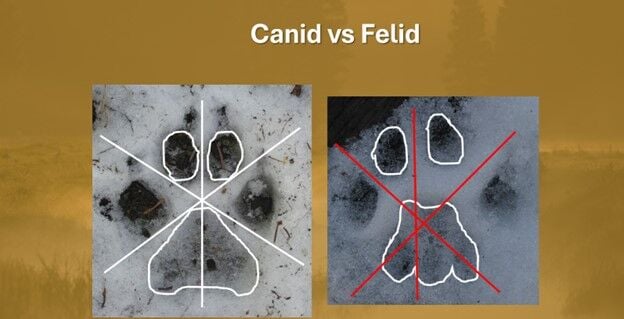
Canid vs. felid: The cougar has three curved lobes on the lower edge of the main pad, but a dog’s center pad is smooth edged. You can draw an X through his pawprint. The cougar’s print is not symmetrical.
WHITE SALMON — Joy Markgraf is in her 11th year as the organizer of the Wild About Nature Series. The White Salmon Community Library, Friends of the White Salmon, and the Suksdorf Native Plant Society lend support.
The first meeting was held at the library to celebrate the opening of the nature centered art show by Randye Jensen. As the meetings have become so popular, the rest of the series will be held at the larger Mountain View Grange on Main Street in White Salmon, each Friday at 6:30 through the month of April.
Markgraf is a talented artist, rancher, and author of a recent book, “Panakanic,” about the lively history of her ranch since 1878. Pat Arnold, of Friends of the White Salmon, introduced this year’s series with a brief bio of Markgraf, and then she spoke about her own advocacy for the White Salmon River and the western gray squirrel. Klickitat County has one of the few remaining strongholds of this endangered squirrel.
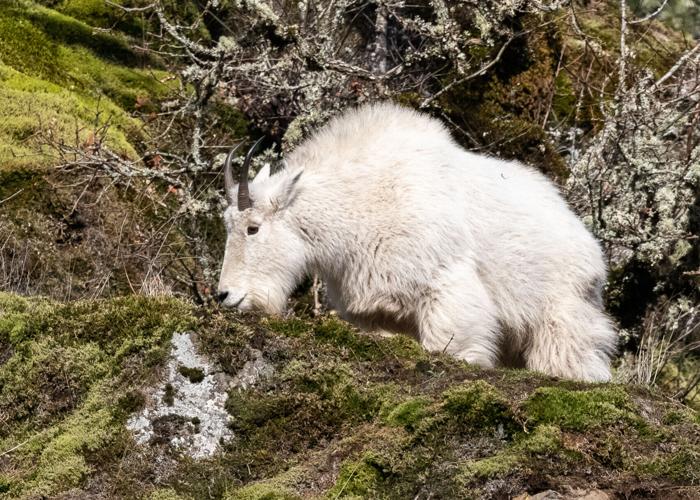
Mountain goats
Better news was delivered by Stefanie Bergh, District Wildlife Biologist, about a population of mountain goats on Mount St. Helens. Long ago there were goats on the mountain, but they were over-hunted and had been absent for some time. They were re-introduced on the mountain in the early 1970s and were starting to take hold. Then the 1980 eruption happened. Were they wiped out? Turns out some did survive and there are now more than 300.
Bergh compared mountain goat and mule deer reproduction. During her lifetime, a goat mom averages only two surviving offspring while a mule deer produces six. While the St. Helens population is doing well, other areas in the state are not. Historically there were about 10,000 mountain goats statewide. Currently there are less than 3,000 due to overhunting in the past and habitat loss. Now the state sells less than 20 mountain goat hunting licenses statewide per year. The fees from that fund research, which includes an aerial survey to monitor population numbers. Licenses are only sold for areas with more than 100 goats.
Mountain goats are only found in North America and are well adapted to life in the high mountains. Mountain goats are now found in their namesake Goat Rocks Wilderness, as well as Mount Rainier, Mount St. Helens, Mount Adams, and even a few in Klickitat County. A locally famous one, Sweeny, was named after Sweeny’s corner near Carson, and surprised admirers by turning out to be a female. Both sexes have horns, but the females’ horns are thinner and less curved.
Wildlife tracking
Coming across clear tracks in the snow or dirt, most of us non-experts would probably bend down for a closer look. Natural Area Manager Adam Liebert says it’s the last thing he does. He admits he has holes in the knees of all his jeans, so he definitely gets around to it as his last step. His first step is to take the 30,000 ft. view. That is the environment? Is it stream side riparian, or dry shrub steppe? What sort of animal might live here?
Next, what is the pattern of the tracks? He can quickly narrow down whether the animal is a member of the rodent, weasel, canid, ungulate, or cat families by the way it walks, bounds, or trots. Do the back feet land right on top of the front feet? How big the animal is can be determined by the width of the tracks, called straddle, and the length of stride. Liebert was great at audience interaction. He had us hold up our hands to guess different animals’ lengths of strides and he measured our guesses. One audience member had a hand spread of 48 inches as a guess for a cougar’s stride. “Possible, but that would be one king sized cougar. Don’t tell you-know-who about it.” That brought a chuckle to the audience.
Canid vs. felid: The cougar has three curved lobes on the lower edge of the main pad, but a dog’s center pad is smooth edged. You can draw an X through his pawprint. The cougar’s print is not symmetrical.
Canid vs. felid: The cougar has three curved lobes on the lower edge of the main pad, but a dog’s center pad is smooth edged. You can draw an X through his pawprint. The cougar’s print is not symmetrical.
Contributed graphic
Finally, Liebert looks closely at the tracks themselves. “What’s the difference between a cougar and a dog track?” he asked us. Toenails on the dogs, not on the cougar, was the first guess. True, cats can retract their claws, but they don’t always do it. The cat’s claws may be narrower than a dog’s, but it is not always an easy distinction. Easier to see are the three lobes on the lower edge of the main pad on the cougar, where the dogs’ is smooth.
A dog’s paw is symmetrical, two toes on each side. You can draw an X through its pawprint. The cougar’s print is not symmetrical. (See illustration above.)
The Wild About Nature free series continues on Friday nights, April 19th and April 26th, at 6:30 at Mountain View Grange in White Salmon.



Commented
Sorry, there are no recent results for popular commented articles.