Once again we have two full Moons in the month of March. Sadly, neither features a lunar eclipse, but the second full Moon of the month is called a “blue Moon,” similarly to the blue Moon in January.
Alas, the term “blue Moon” has nothing to do with the Moon’s color. According to Philip Hiscock, a professor at the University of Newfoundland, the term was first used by a Cardinal Wolsey, an advisor to Henry VIII. Per Hiscock, “Cardinal Wolsey writes about his intellectual enemies who ‘would have you believe the Moon is blue.’”
From there, the blue Moon was eventually linked with the occasional fourth full Moon in a quarter year. Then, in 1946, an article in “Sky and Telescope” magazine erroneously referred to it as the second full moon in a month. That description has stuck. The Moon’s color will be no different than any other full Moon, but it makes for an interesting story.
We will be starting to see bright planets return to the evening sky in March, beginning with Venus and Mercury visible low in the west after sunset, just above the horizon. Look for the two planets right next to each other on the evening of March 3. As the month progresses, both will climb higher into the western sky.
By the middle of the month, Mercury will be as high as it gets, about 18 degrees above the horizon; brighter Venus will be below and to the left of Mercury.
By March 21, they will again be at about the same height in the sky, with Venus continuing to climb and Mercury beginning to drop toward the Sun. As the month comes to a close, Mercury will get lost in the Sun’s glare, but Venus should still be an easily visible “evening star.”
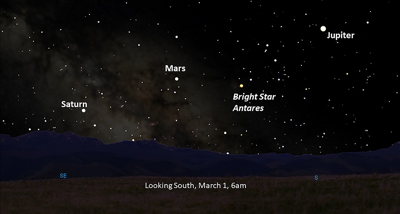
Jupiter, Mars, and Saturn will still be visible in the morning sky. Look to the south before sunrise and you’ll find the three of them forming an almost-straight line. Jupiter will be pretty much due south, with Mars and Saturn in the southeast.
The Moon will join them March 7-10, making the planets easier to locate. On the 7th, look for the Moon just above Jupiter. It will be above Mars on the 9th, between Mars and Saturn on the 10th, and to the left of Saturn on the 11th. Later in the month, you may notice that Mars is approaching Saturn; by the 31st, Mars will be very close to Saturn in our sky. It will move past the ringed planet in early April.
A relatively faint, but familiar, constellation graces our northern skies for the entire year – Ursa Minor. The “Little Bear” or “Little Dipper” lies near its more famous cousin, Ursa Major or the “Great Bear,” which includes the Big Dipper.
Ursa Minor contains a very important astronomical landmark — the north star, Polaris. Polaris sits almost exactly at the north celestial pole, above the Earth’s North Pole. If you were standing at the North Pole, Polaris would be directly overhead. Its location means that it doesn’t appear to move as the Earth rotates; instead, the rest of the sky appears to rotate around it as our planet spins on its axis.
This gives it great value for navigation. In addition to helping locate due north, Polaris can assist navigators in determining latitude.
At the equator (zero degrees latitude), Polaris is on the horizon.
At the North Pole (90 degrees latitude), Polaris is directly overhead, 90 degrees from the horizon.
Here in our area, about halfway between the Equator and North Pole, Polaris is about halfway up in the sky.
Sailors can determine their latitude by measuring how high Polaris is above the horizon.



Commented