Welcome to September, when we transition from summer into fall. The autumnal equinox, marking the start of fall, comes on Sept. 22. Darkness comes earlier, allowing more time to view celestial delights. September is probably my favorite month for stargazing because of the earlier darkness, because the weather is still mostly clear, and nights are still relatively warm.
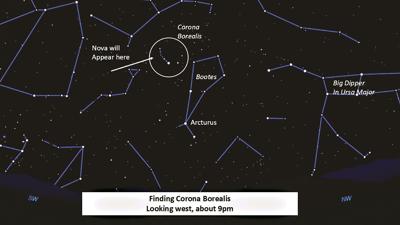
An interesting phenomenon that may come in September is a Nova in a star that is in the constellation Corona Borealis, the Northern Crown. The crown is easily seen in our night sky as a semi-circle of stars, high in the southwest on September evenings. The nova is caused by two adjacent stars, one a white dwarf, the other a red giant star. We see them as one, a star called T Corona borealis. The white dwarf pulls material from the nearby red giant, and about every 80 years, amasses enough to cause an explosion — the nova. The faint star, normally hard to see even with binoculars, suddenly becomes much brighter, about as bright as Polaris, the north star.
How to see it? First, familiarize yourself with Corona borealis (use the picture with this article). Watch for a fairly bright star to “appear” just to the left of the Corona’s stars. That’s it! Scientists think there is a 95% probability of the nova occurring before the end of the year, and something like 70% that it occurs in August or September. As I write this in late August, it has not yet appeared. It may only be bright for a few days when it does occur. Familiarize yourself with the constellation and keep an eye out for it!
September’s new Moon will fall on the 2nd, Labor Day, with full Moon following on the 17th. The Moon will be low in the southern sky during September, and will be the 2nd of four straight “supermoons” we will have for 2024, with the Moon being a bit closer than average on those months. On the 16th, the waxing gibbous Moon will lie just to the right of Saturn. On Sept. 22, early in the morning, the Moon will pass in front of the bright star cluster Pleiades. That will happen between about 2:30-5 a.m.
Saturn moves into the evening sky in September. Look for the ringed planet low in the east after about 8pm in early September and by 6 p.m. at the end of the month. Saturn will be hard to mistake, the brightest object in that part of the sky. With a telescope, you can see that the planet’s set of rings are now hard to see, as they are almost “edge-on” from our viewpoint. But the planet is still worth a look in a telescope. To the naked eye, Saturn appears a soft white-yellow to me. Like all of the naked-eye planets, it will not twinkle as much as nearby stars.
Our other gas giant planet, Jupiter, begins to peek above the eastern evening horizon late in September, located right between the “horns’ of Taurus the bull. On Sept. 30 Jupiter will rise at about 10 p.m.
Venus remains in our evening sky, again lurking low in the west just after sunset. On Sept. 5, look for the thin crescent Moon just to the right of bright Venus. It should make a nice sight.



Commented