
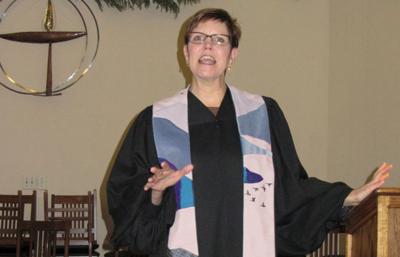
Judy Zimmerman will be installed as the first “settled” or permanent minister of the Mid-Columbia Unitarian Universalist Fellowship on Saturday, March 7 in Hood River.
The ceremony will be held from 3 to 5 p.m. at the Rockford Grange, 4250 Barrett Dr., in Hood River, where MCUUF holds its services on Sundays at 10 a.m.
Light refreshments will follow the installation service. Children are welcome to attend. Spanishtranslation will be provided.
Zimmerman, a long-time psychology professor at Portland Community College, has moved to Parkdale, and now teaches online classes.
She said she is part of a growing wave of newer ministers who, given the changing religion landscape in America, are “bi-vocational.”
“It’s more common now for congregations to call ministers part-time and that’s what this congregation has done,” she said. While the congregation has had short-term ministers before, she is the first to be here on a permanent basis. “I’ll be there until we decide we’re done with each other,” she said.
She likened the installation to a wedding, where she is the bride and the groom is the church. She likened it to a covenant between the two. She said the event was “less about me and more about the congregation because the power and authority to call a minister rests with them.”
MCUUF traces its history to the Rev. W.G. Eliot, Jr., who founded the First Society of Unitarians in Hood River in 1903. The original church building, at 9th and State streets, is now a private home. Rev. W.G. Eliot, Jr. is the son of Rev. Thomas Lamb Eliot, a Unitarian minister, for whom the Eliot Glacier on Mt. Hood and Eliot Dr. in Hood River are named.
The First Society of Unitarians disbanded in 1918. The society was reborn as the Mid-Columbia Unitarian Universalist Fellowship in 1986.
The congregation itself planned the event and two inter-faith guest speakers are invited.
Rev. Vicky Stifter with Riverside United Church of Christ, and current chair of Gorge Ecumenical Ministries, will speak, as will Rev. Kozen Sampson, the priest at Mt. Adams Zen Center in Trout Lake and a representative of the Mt. Adams Ministerial Alliance.
Unitarian Universalism traces its roots to the Puritans who settled America and broke with the Church of England.
“Today, we would consider ourselves to be a post-Christian denomination,” she said. “What that means, if you think of a house, Christianity is the bottom floor because we definitely draw from Christianity, but we are a faith community that believes you can’t understand the holy in any one way.”
The denomination, then, “allows for as much diversity of theological perspectives as is possible,” she said.
Some consider themselves atheists, and she herself, having grown up Roman Catholic, first discovered Unitarian Universalism in graduate school. She was an atheist and heard that Unitarian Universalists “made space for atheists.”
She said, “You can be atheist and be deeply religious. An atheist means you just don’t believe in a supernatural deity. There’s a lot of people who can resonate with that concept of atheism.”
“Buddhism is deeply religious but there’s no God in Buddhism either,” she said.
“God doesn’t have to be a deity for us, that is what makes us truly unique,” she said. The holy “can be understood as love, and the will to the good. Those are processes, not people. God can be a verb.
“The holy, or God, for us is what’s present in all, but greater than each,” as one minister phrased it, she said.
“I wanted to be religious, but not with the idea of a personal god -- and a male god, I have to say, at that,” she said. She’s an ardent feminist, she said, “so that was a problem for me.” “I want a religion where I see God as like me.”
She said most Unitarian Universalist ministers are women.
While she has her own personal theology, she said she’s not there to impose her views on anyone. “We’re not there to religiously dominate anybody. Religious matters are personal experience. Who is it for me to tell you how to understand ultimate reality? Our job as a minister is to help you discover that for yourself.”
Unitarian Universalism has seven core beliefs, including universal worth and dignity. “What that means is we don’t do baptisms, we don’t do original sin. We don’t believe it was necessary for Jesus to die on the cross to save us from sin because we wern’t born with sin. We’re born holy; we’re born blessed.”
She has a master’s degree in psychology and also has a masters of divinity from the Meadeville-Lombard Theological School in Chicago. She also served as a chaplain and underwent psychological testing as part of her ordination into the ministry.
“We get a lot more training in our seminary training in world religions than most other Christian clergy do because we have to draw from a wider array of things to nurture our congregation,” she said.
“We’re a big tent. We talk about drawing a wide circle of inclusion,” she said.
Because the denomination draws from so many other faiths, Zimmerman, as minister, does just two of every four sermons, though she oversees the other lay speakers.


Commented
Sorry, there are no recent results for popular commented articles.