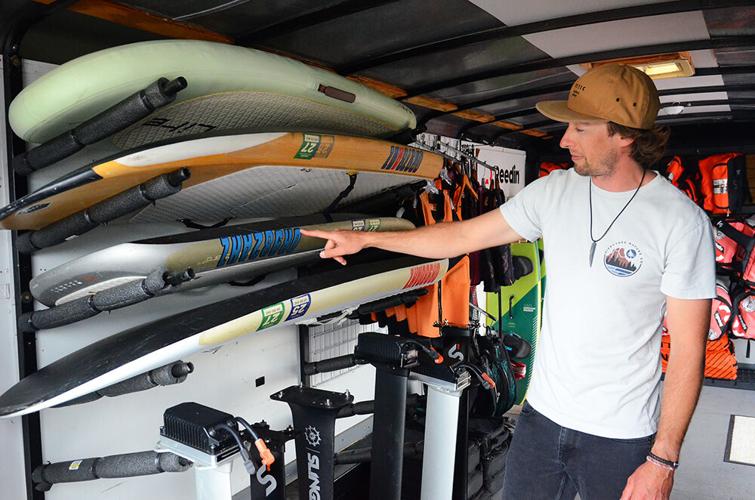
Sail Schechter points out the registration needed on e-foils, which are considered a motorboat — an Oregon hull identification number and a biannually purchased Oregon State Marine Board validation sticker.
Sail Schechter points out the registration needed on e-foils, which are considered a motorboat — an Oregon hull identification number and a biannually purchased Oregon State Marine Board validation sticker.
THE GORGE — Along the Hood River Waterfront, businesses are preparing for a busy summer of lessons and rentals in the Columbia River Gorge. However, at Doug’s Water Sports, there’s one piece of equipment absent from the lineup — stand-up paddleboards.
Sail Schechter, who purchased the business earlier this year and plans to rename it West Wind Water Sports, explained that SUP boards were no longer worth the space, especially with the recent update to the Waterway Access Permit (WAP).
In 2026, the Oregon State Marine Board (OSMB) began requiring non-motorized boats under 10 feet long to display the permit for lakes and rivers in Oregon. Paddleboarding is not the only sport impacted; any multi-air chamber device is considered a boat, including hardshell kayaks, packrafts and rafts.
Innertubes, pool noodles, kiteboards and wingboards are not included. Nor are innertubes tied together, as previously clarified by OSMB.
OSMB says the new 10-foot rule only impacts a small portion of previously exempt users, but for many businesses and recreation users, it’s another permit to purchase.
“We always want to follow every rule we need to follow and make sure permits are prominently displayed,” Schechter said. “It definitely comes to a point where it seems like there’s just more fees every year and another hoop to jump through.”
He explained how they used to rent out seven paddleboards. “We had to go through and register each one with OSMB, which was $75 for the year, and that’s not bad, but multiply it by seven.”
The additional WAP cost for rental fleets led Schechter to conclude that renting SUPs was no longer financially viable. Income only totaled around $1,000- $1,500 a season.
“It was kind of just a fun little freebie for if your wife’s taking a kite lesson and you and your kid want to go out and paddle around in Nichols Basin,” Schechter explained. “You could rent it for 25 bucks and go have some fun.”
For individuals, a one-year permit is $20. Failure to show the permit while on the water, either digitally or printed out, is a Class D violation that comes with a $115 fine. Thirty county sheriff’s offices and Oregon State Police have been contracted to enforce boating laws, including compliance checks for the permit.
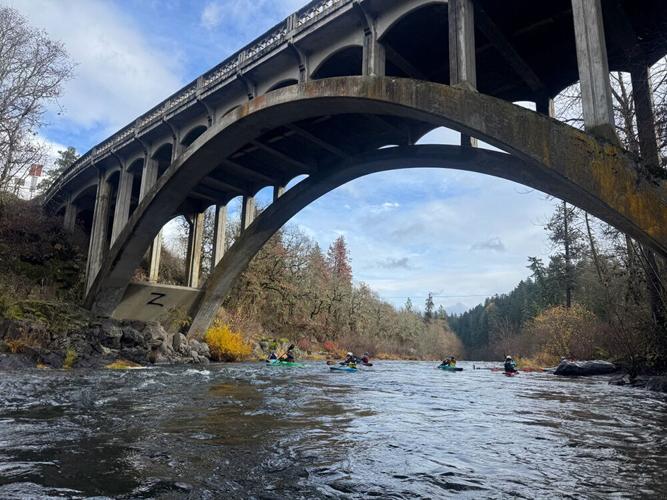
Kayakers paddle down the Class III section on the Hood River, which now requires a Waterway Access Permit.
Josh Barza photo
OSMB says individuals impacted by the changes will primarily be educated on the permit requirement, but that law enforcement has discretion on enforcement actions.
The permit system first began in 2020; $8 of the $20 of an annual permit goes to the Aquatic Invasive Species Prevention Fund, and the rest goes to the Waterway Access Fund.
So far, between Cascade Locks and The Dalles, one grant has been awarded from the Waterway Access Fund since 2020, to Wylde Wind & Water’s bilingual summer camp for kids that operates out of Nichols Basin in Hood River.
OSMB noted there is significant interest in using the funds to improve nonmotorized boating access at the Port of Cascade Locks’ Government Cove and Hood River County’s Powerdale site, but permits can take several years to obtain and no action has begun.
Exemptions from WAP include Class IV and V technical river runs — the state legislature specifically requested OSMB work with the whitewater community to create these.
In the Gorge, that’s the East Fork, Middle Fork, West Fork and Lake Branch of the Hood River, as well as Eagle Creek and Fifteenmile Creek. Alan Hanson, policy and environmental program manager, said that since the majority of these sections have limited boating use and because of remote accessibility, the areas would not be an effective use of law enforcement resources.
However, OSMB will not use waterway access funds to upgrade the put-ins and take-outs on exempt sections of rivers, and Class III boaters still need a WAP. It’s caused some concern about accessibility for beginners.
“When you’re getting into a sport that already has a lot of expenses to start, even a small fee, or the inconvenience of getting that fee, might be enough to put people off,” said Max Martin, a whitewater kayaker based in Mill A. “I learned to paddle on the Mackenzie River in Oregon, and that’s going to be a stretch that requires a permit now.”
He also pointed to the Class III section on the Hood River. During heavy rainfall, the river swells and becomes a much more difficult whitewater run. Martin questioned whether the WAP will be needed when higher flows change the rating to Class IV or V.
Hanson confirmed: “Once we exempt a section of river, it is exempt regardless of the current flow rates.”
PAC formed
In protest of the new permit fees, a political action committee (PAC) named Let Us Paddle formed to repeal the bill, stating there is no credible scientific evidence that human-powered boats bring invasive species to Oregon.
If organizers gather enough valid signatures — “wet ink” from registered Oregon voters — by July 2, the measure will qualify for the 2026 ballot in the November Oregon general election.
“This is about more than paddling,” said Chief Petitioner Kari Goodheart in a press release to Columbia Gorge News. “It’s about saying ‘no more’ to endless new taxes, fees and burdensome regulations.”



Commented
Sorry, there are no recent results for popular commented articles.