
It is hard to believe that November is already here.
On the 4th of the month, Daylight Savings Time comes to an end. Remember to “fall back” and set your clocks for one hour earlier.
Darkness already comes early with the change of seasons. Sunset is at 5:51 p.m. on November 1, but on November 4, with the change to standard time, it will come at 4:47 p.m. At least you get an extra hour of sleep on the morning of the 4th.
Our bright planets have mostly left the evening sky this month.
Saturn, Jupiter, and Mars are technically still above the horizon after sunset in early November. But both Jupiter and Saturn will be very low in the southwestern sky, and both will set quickly.
Mars will be about 75 million miles from us at the start of November, much farther than in August (when it was only about 35 million miles distant.) Saturn and Jupiter are also more distant than they were earlier in the year.
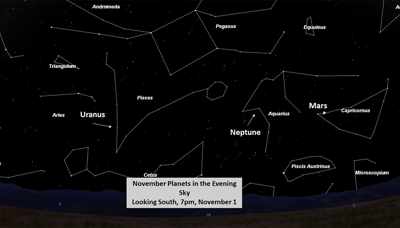
Two planets that will show up in the evening sky are the outer planets, Uranus and Neptune. They are very distant — Uranus is about 1.75 billion miles from Earth, Neptune roughly 2.75 billion miles.
Uranus is located in the faint constellation Pisces, low in the eastern sky. It is technically visible to the naked eye, but it is so faint it looks like another star. Neptune is in the south, in the constellation Aquarius, to the left of Mars. It is fainter than Uranus, and a telescope is required to pick it up.
At the start of the month, the waning crescent Moon will be in the morning sky, between the constellations Leo and Cancer.
November’s new Moon will fall on the 7th, followed by the full Moon on Nov. 23. Some call November’s full Moon the “Beaver Moon,” because around this time beavers are busy preparing for winter.
On Nov. 11, the Moon will be a good way to find Saturn. The ringed planet will be just to the right of the Moon. On the 15th, the first-quarter Moon will lie just to the right of Mars.
Near the month’s end, on the 29th, the third-quarter Moon will lie just to the left of the bright star Regulus, once again in the constellation Leo.
The advance of the seasons means we’ll see new constellations in the eastern sky as the summer constellations sink into the west.
At the start of November, Andromeda will be high in the east, with Triangulum, Aries the Ram and Auriga the Charioteer visible above the horizon by 8 p.m. Hercules and the “northern crown”, Corona Borealis, will be low in the west. Ursa Major, home of the Big Dipper, lies low in the north this month.
By the end of the month, Taurus the bull will be above the eastern horizon, and Orion the hunter will have begun to appear.
Orion will be totally above the horizon by 9 p.m. standard time. Orion’s neighbor, Gemini, will also be in the eastern sky.
In the west, Cygnus the swan, which lies high overhead through the summer, will be dropping out of sight.
November brings one of the most famous meteor showers, the Leonids, which peak on about November 18.
The shower occurs when the Earth passes through the orbital path of the comet Tempel-Tuttle.
Particles from the comet fall into Earth’s atmosphere, producing bright streaks in the sky as they burn up.
Tempel-Tuttle has an orbital period of 33 years, and roughly every 33 years it produces an unusually intense shower. The last such peak, in 1999, 2001, and 2002, produced as many as 3,000 meteors every hour. But the king was the meteor storm of 1833, which is estimated to have produced as many as 100,000 meteors per hour and been visible in the eastern United States. Some thought the world was coming to an end!
This year’s meteor shower will not be so impressive, but check out the Leonids if skies are clear in mid-November.


Commented