
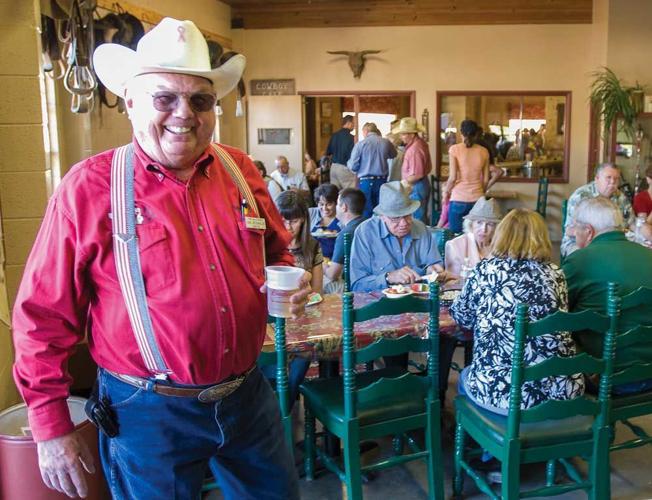
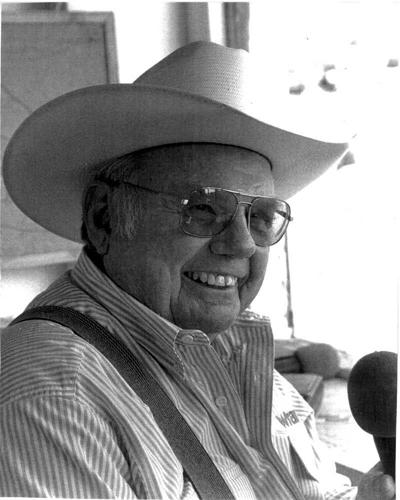
Jake Grossmiller, a legendary rodeo announcer known to generations of rodeo fans throughout the Northwest and particularly at the Fort Dalles Rodeo, died at his home Aug. 19. He was 80.
Delene Durfey of Condon grew up knowing Grossmiller. Her father produced rodeos, and Grossmiller—and his father before him—announced them.
“He was at the top of his game when he was younger,” Durfey said. “He was the announcer that everybody wanted.”
He announced rodeos all over Oregon and Washington, she said, and even did events back East.
Top announcers “have to have a good voice and they have to understand the rodeo and the lingo and kind of know the cowboys and cowgirls so they can give the crowd information to let them know the cowboys are normal people; they have lives and families.”
Grossmiller had several sayings, and one Durfey particularly remembered was, “Hang on to your hat Hilda,” which was his way of saying there was “always something going on that was going to be exciting.”
According to a guest article in the Chronicle in 2018, which discussed Grossmiller being named grand marshal of the Spray Rodeo in honor of his 30 years of announcing it, he began working at rodeos at age six. His father, who was the announcer, gave him the job of selecting and playing the music before the rodeo and during the grand entry.
By age 10, Grossmiller was announcing slack rodeo, the overflow contestants that did not fit into the evening main event. Then, he and his father became the first dual announcers, with his father, Kenny, announcing rough stock from the stands and Jake announcing timed events from the roping chutes.
At 18, he did his first solo rodeo in Umatilla.
Durfey said at each rodeo, before Grossmiller began announcing, “he’d play ‘Adeline’ and that means you have 15 minutes before showtime. And my son was a pickup man, and he said, ‘When Jake quit coming I didn’t know when to get on my horse and get ready.’”
In the early days, rodeos were different, and all the contestants and workers would camp at the event the whole weekend. “So everybody became a big family.”
She said Grossmiller was “very happy go lucky, very caring, was very serious about his job as announcer, but was very friendly to everybody.”
She’s known him all her life and said, “He might get frustrated, but I never saw him get angry.”
As well as announcing rodeos, Grossmiller followed in his dad’s footsteps by becoming a car salesman. He was also a radio personality and a local history buff who contributed regularly to the Chronicle’s History Mystery feature.
“He liked old cars, and he could tell a helluva story,” said his step-daughter, Crystal Ross.
Grossmiller lived on his own, but Ross and Grossmiller’s daughter, Susan Logan, had been preparing to move him into an assisted living facility, Ross said. “He was looking forward to it.”
“He just loved talking to people everywhere he went. He was just a people person,” Ross said. “He loved to tell them things that were going on and what was happening.”
He was known for his sense of humor, and “loved talking about the old days like when his dad was a rodeo announcer and when he was a kid, and places. ‘This is where this store was.’ He knew that kind of stuff. The history of the town,” Ross said.
Grossmiller was a longtime member of the Fort Dalles Rodeo Association, and was also on the board of The Dalles Mural Society and served as president of the Mid-Columbia Car Club.
Damon Hulit knew Grossmiller both from the car club and from their work together at the Fort Dalles Rodeo. “He had a big grin and was driving his red Ford pickup through Neon Nights Friday and was at the car show Saturday and to have him gone a week later kind of adds to the shock factor.”
Hulit said Grossmiller “always had a big smile, always involved and interested with everybody’s goings on. He remembered people’s names and their backgrounds and their stories. He paid attention to details and knew them, and that’s what makes a good rodeo announcer.”
Durfey said if anything bad happened at a rodeo to contestants or animals, “He kept the crowd calm and tried to take it away from what was happening out there, tried to divert their attention, which is hard to do, to let them know that everything possible was being done for either the animal or the person and everybody was going to be fine.”
She said of Grossmiller, “He always was friendly. I don’t think he ever knew a stranger. He just talked to people. It was easy for him. He liked new adventures and challenges.”
He always had energy, she said, and was always organized. “He knew what was going on and was very good with the queens. He was a stickler to have enunciation. He wanted enunciation and everything announced right. If you had a difficult name, he would ask, ‘How do you pronounce that?’ And a lot of guys don’t do that; they just look at it and slaughter it and go on. But I can remember him saying, ‘Dad always wanted me to speak clearly and pronounce everything correctly.’”
Durfey posted on Facebook about Grossmiller’s passing, and she got comments from people who had only been to a rodeo or two, but they still remembered Grossmiller. “That speaks a lot if you’re going to just go and watch a rodeo and you remember Jake. You know, that’s a legacy that a lot of us don’t have.”
She said, “He was a very great man, and he was a big part of my brothers’ and I’s lives, and all the cowboys’ lives, forever.”
Dr. Wally Wolf was on the rodeo association board with Grossmiller. “He liked everyone. He couldn’t go anyplace that he didn’t come home with new friends. That was his personality. He just fit in wherever he was,” Wolf said. “He made himself useful and was just a nice guy.
“He never was a person that was trying to see how rich he could be. He had enough to eat and a place to sleep, and he was happy. As long as he had enough to keep going and make people happy, he was fine.”
Wolf added, “He gave way more than he probably ever took from our community, for sure, and for that we’re all grateful.”


Commented