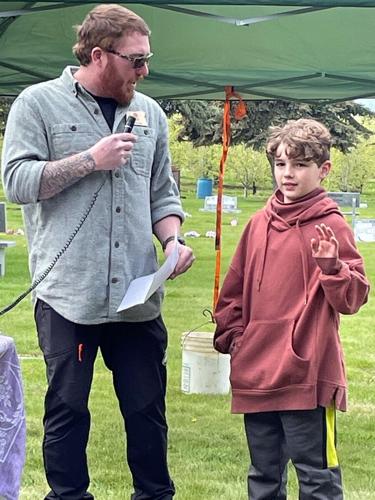
Tyler and Roam Roth also spoke at the event — Tyler is a Hood River arborist and coordinated the program, as well as cared for the ginkgo seedlings at his home, and Roam spoke of helping with the project, and what peace means to him.
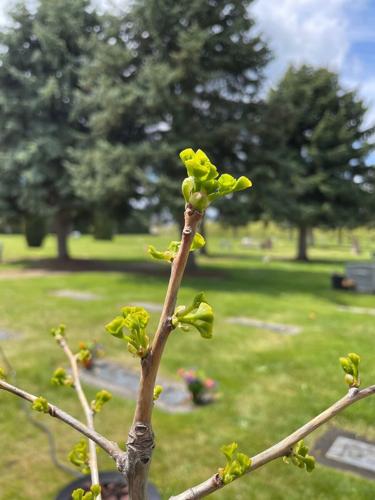
Two ginkgo peace tree seedlings were dedicated at Idlewild Cemetery in Hood River on April 30.
These aren’t ordinary trees; they were grown from seeds from a tree that survived the 1945 bombing of Hiroshima during World War II.
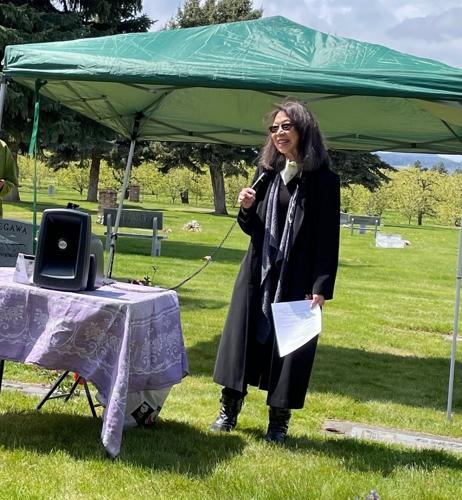
The program was emceed by Linda Tamura, a third generation Japanese American (Sansei) who grew up in the Hood River Valley on her parents’ apple and pear orchard. She is the author of “The Hood River Issei: An Oral History of Japanese Settlers in Oregon’s Hood River Valley” (1993) and “Nisei Solders Break Their Silence: Coming Home to Hood River” (2011).
Emceeing the event was Linda Tamura, at right, author of two books who grew up in the valley.
Photo courtesy of Betty Harry
“Gorge Tree Surgeon” and Hood River arborist Tyler Roth, who coordinates the Peace Tree Dedication program, cared for the seedlings in his home before transferring them to Idlewild. The trees were planted last year and dedicated Arbor Day weekend this year.
The seedlings were made possible through a combined effort of the Oregon Department of Forestry, Oregon Community Trees, Green Legacy Hiroshima and One Sunny Day initiative, the latter of which was founded by Hiroshima survivor and Oregon resident Hideko Tamura Snider.
Tyler and Roam Roth also spoke at the event — Tyler is a Hood River arborist and coordinated the program, as well as cared for the ginkgo seedlings at his home, and Roam spoke of helping with the project, and what peace means to him.
Photo courtesy of Betty Harry
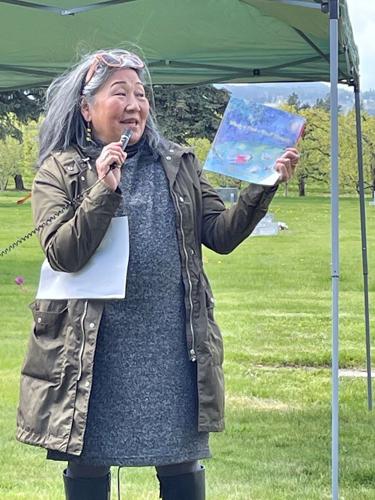
Roth’s son, Roam, helped plant the trees and spoke about peace and what the trees mean to him; also speaking were Kristin Ramstad, Oregon Department of Forestry and Setsy Sadamoto Larouche, president of Hiroshima Club of Oregon, whose members are descendants of Japanese Americans born in Hiroshima. Chisao Hata read an excerpt from “When a Peace Tree Blooms,” a children’s book by Tamura Snider. Hata also read a statement from the author, who was 10 when the atomic bomb hit Hiroshima. Her mother died; she now lives in Medford and founded the One Sunny Day Initiative, so named because the day of the bombing was a sunny day, said Betty Harry, a third generation Japanese American whose family from Parkdale is buried at Idlewild. “The mission of the initiative is to educate the public about the consequences of nuclear weapons and to plant seeds of peace, hope and reconciliation among the people of the world,” said Harry.
Chisao Hata reads an excerpt from a children’s book titled “When a Peace Tree Blooms,” written by Hiroshima bombing survivor Hideko Tamura Snider.
Photo courtesy of Betty Harry
In all, there are about four dozen Hiroshima peace trees in 32 Oregon communities.
The Hood River Valley was home to one of the earliest and largest settlements of Japanese in Oregon, and many Japanese American families are buried at Idlewild Cemetery, said a press release.



Commented