
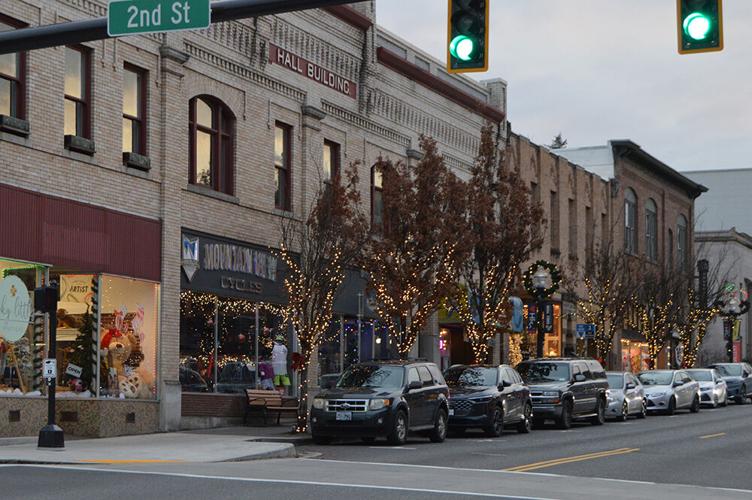


THE GORGE — Open the creaking door, listen to the doorbells cut through the silence, and watch as a shop owner pops their head out from behind a desk to greet you — a sign that you were the first customer in a while to walk through the door of a local shop.
This is what happens when you walk inside many stores on the Oregon side of the Gorge.
“I think people would rather spend money on food or housing than books right now,” said Cheryl Arnold, who works at Klindt’s Booksellers in The Dalles. “Tariffs don’t help.”
Across the street, at Yesterday & Today Music, owner Mark Thomas put it simply: “This year has sucked.”
Even though inflation has been high ever since the pandemic, many shopkeepers said that business was much better in 2023 and 2024.
During and after the pandemic, people were traveling less, allowing them to save money on gas or vacations and spend more on books, music, and crafts.
Now that those pre-pandemic demands have come back and the prices have not fallen to pre-pandemic levels, customers have less money to spend at retail shops. The Consumer Price Index, a representation of how much a single basket of goods costs, shows a 65% increase in costs since right before the pandemic, nearly three times the increase compared to the same number of months before the pandemic.
Store owners said that the foot traffic is still there, but the price per customer has fallen. Many blamed the tariffs imposed by the Trump administration. Tariffs on Canada, a major importer of paper, could be a reason why books are more expensive.
Maureen Donald, owner of Pacifica Gifts in Hood River, said that one of her best sellers (a stress ball in the shape of a breast) increased in price by half thanks to tariffs. A popular Australian air freshener is no longer being sold in the U.S. because of the tariffs, Donald said.
Some local policy decisions have also hurt business. When the Oregon State Legislature banned reusable plastic bags this year, Jill McDonald, who owns Urban Paper in The Dalles, had to switch to more expensive paper bags. Stores can still use these plastic bags until Jan. 1, 2027.
“It’s a hard time for small businesses,” McDonald said. “I think the state thinks of small business as a company of 500 or 200 employees.”
Buying online or not buying at all is cheaper. Some stores have closed. Others, including Klindt’s, have cut staff or reduced their hours.
Shop owners were not complaining. They expressed deep sympathy with their customers — those who were buying less or not at all this year. Cuts to food stamps during the government shutdown and ever-increasing grocery prices have squeezed people, they said.
But some stores are pleasantly surprised by the year they’ve had — especially those that benefited from the summer travelers. Ahnauna Andrews, owner of Precious Drab Vintage, and artist Nick Male said that a torrent of bridal parties and vacationers bought clothes and art in Hood River this summer.
Capitalizing on a trend also benefited some shops. The pandemic increased the popularity of biking and cooking. That drove business for Calvin Lepinski, owner of SPR Bicycle Shop in the Dalles, and Arome, a spice and kitchenware store in Hood River.
Lisa Farquharson, the president of The Dalles Area Chamber of Commerce, said that tourism is also fluctuating a lot, leaving businesses struggling just to stay afloat.
“We’ve seen fewer visitors at times, and when you layer in wildfire concerns, it can discourage travel altogether,” Farquharson said. “Add to that a community with a higher percentage of fixed or lower incomes, and the margin for error becomes very slim for small businesses.”
Another store that was thriving was Red Wagon Antiques in The Dalles. While the owner of Antiques & Oddities in Bingen told Columbia Gorge News that business was down because of tariffs, Red Wagon said it was a great year.
“We sell a lot of books,” said Cary Miller, the co-owner of Red Wagon, along with his wife, Sue. “You don’t have to pay a tariff if you come in here.”
•••
Hank Sanders has been a reporter for The New York Times, Chicago Tribune, and Willamette Week. He grew up in rural Oregon and thinks it’s the best place in the world, though it also faces immense challenges. He talks about the challenges and solutions here. Reach him at hankcsanders@gmail.com.


Commented