A pest-host relationship describes the interaction between an organism (the pest) and its host, where the pest benefits at the expense of the host. This relationship can be symbiotic, meaning both organisms are involved, but can also be parasitic, where the pest harms the host. The specific nature of the relationship depends on the organisms involved and their evolutionary history.
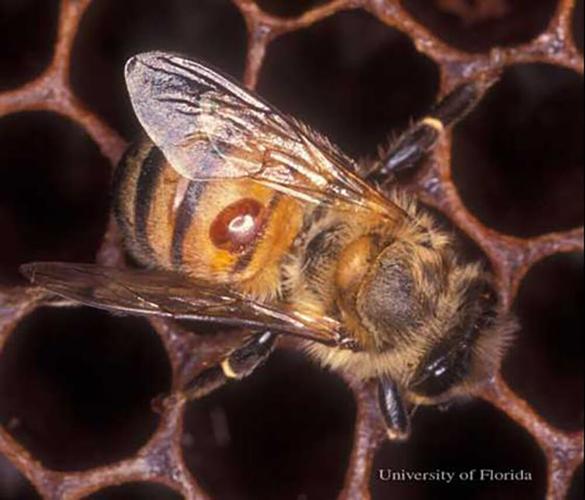
Honey bees and pests engage in a dynamic pest-host relationship, where parasites like Varroa destructor mites weaken and transmit diseases to honey bees, impacting colony health and survival. The Varroa mite, since 1987 has become the number one killer of the honey bee.
For years researchers relied on a Russian research paper that was mistranslated, suggesting the Varroa destructor mite nourished on the bee’s hemolymph (blood) of the bee. Yet, Dr. Samuel Ramsey in 2019 undertook as his PhD thesis to uncover the actual nourishment.
Through extensive research, Dr. Ramsey documented that the actual nourishment was from the honey bee’s fat body. Fat bodies store energy as food becomes plentiful and release energy as the bee needs it. The energy stored within the fat body is critical during the larval stage of brood growth as its becomes the sole source of nutrition stage, the pupal stage of brood (baby) evolution, when all organs and the body are created. It also serves as a source of energy during winter months.
The metabolic action of the fat bodies is often compared to the human liver as it stores nutrients and synthesize proteins, lipids and carbohydrates that circulate throughout the body. Similar to human physiology the fat body detoxifies nitrogenous waste products which are extracted from the hemolymph of the bee.
Why is this shift in knowledge so vital to the future of the honey bee? The fat body contains Vitellogenin, an egg yolk protein, that serves several critical functions for the honey bee. It’s involved in immune responses, antioxidant protection, social behavior, and even lifespan regulation in worker bees.
Consider Vitellogenin similar to the human white blood cells. In humans, the white blood cells circulate throughout the blood system moving to areas of infection or injury to fight off pathogens like bacteria, viruses, fungi and in identifying and destroying abnormal cells, such as cancer cells.
The Vitellogenin in honey bees serves similarly to combat bacteria, viruses, fungi and detoxify pesticides.
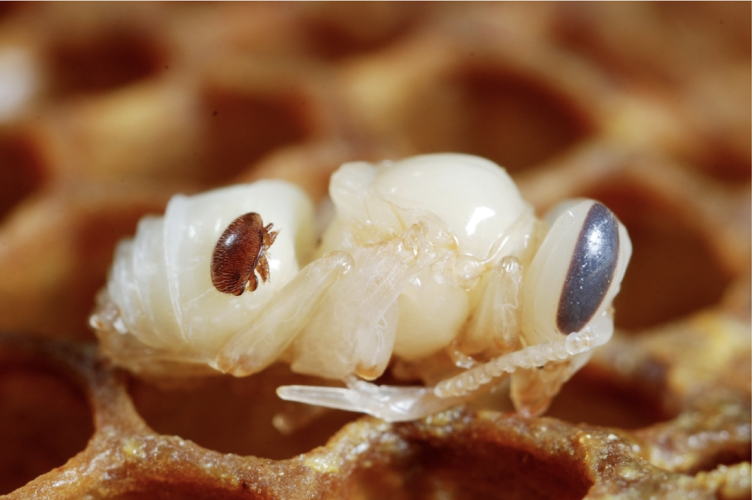
As the Varroa create a hole in the larvae of the bee nourishing on the fat body, this directly diminishes the vital levels of Vitellogenin rendering immune system of the bee.
A more significant issue of the pest host relationship comes from the vectoring (transmitting) of viruses. Consider the mosquito, which vectors malaria, dengue fever, West Nile virus, yellow fever, Zika Virus and chikungunya. The mosquito regurgitates its saliva into the host human prior to sucking up the nourishing blood, thus transferring viruses from itself to the host human.
Similarly, the Varroa mite vectors viruses from previous host bees. Although the Varroa’s anatomical damage weakens the bee, it is the virus injection which ultimately results in the demise of the honey bee.
The Foundress (mother) mite senses a signal from the honey bee larvae intended to alert worker bees to seal the brood cell with a wax capping, thus motivating the mite to jump into the brood cell to begin its creation of offspring.
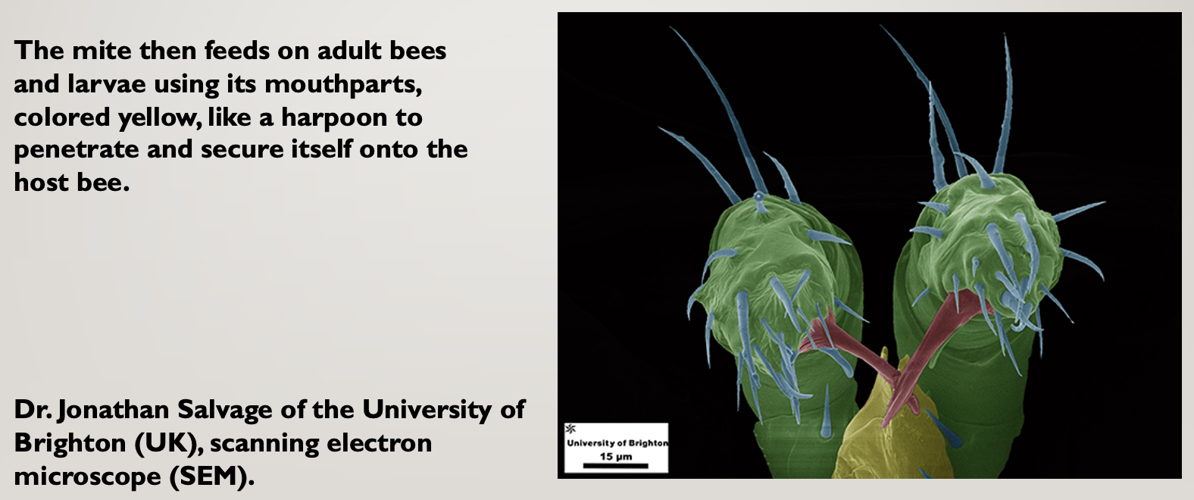
The Foundress pierces the outer skin (cuticle) of the larva to feed on the fat body. Her offspring use the same puncture hole for their food source. The saliva of the mite contains enzymes
which prevent the wound from healing.
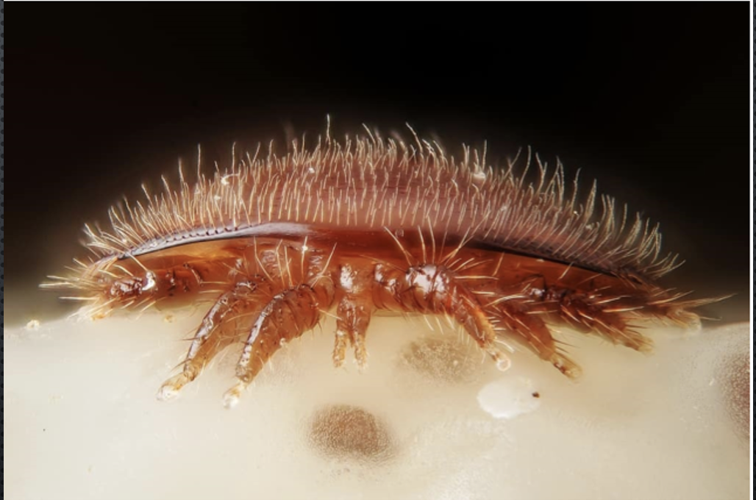
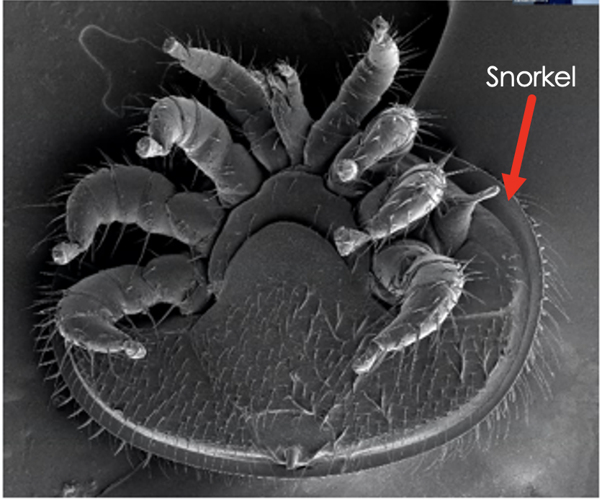
Honey bee workers are able to detect disease and mites. Nature has afforded the mite the means to dive into brood cells to hide on its back beneath the larvae and preventing workers from sensing the mite’s presence. There is a pool of liquid the bee larvae rests in for its own nourishment. The Varroa mite has a snorkel breathing tube it is able to stick above the liquid, allowing it to remain concealed until the brood cell is capped.
The war against the Varroa destructor mite continues, wreaking havoc annually to the vital pollination role of the honey bee.
Thus, nature often evolves a wrong into a more positive solution, but in the current pest host relation between the Varroa destructor mite and the honey bee the pest continues to win the battle.
Consider spending a few dollars toward Project Apis m in support of their funding (www.projectapism.org/partners/#give).
The Columbia Gorge Beekeepers Association meets on the third Wednesday of each month, www.gorgebeekeepers.org, at the Hood River Extension, 2990 Experiment Station at 6 p.m. A different subject is presented by an Entomologists or experienced beekeeper. All are welcome. Visitors may attend in person or
via Zoom. You may reach out to the club for login information -



Commented