
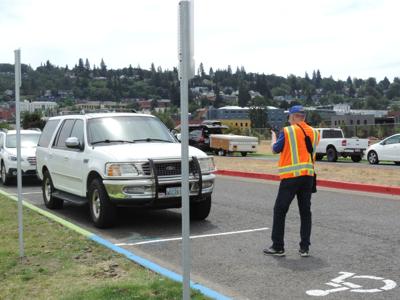
Apart from confusion caused by inadequate signage, the Port of Hood River reports that the first full year of the Waterfront Parking Plan was a success.
The plan, which establishes paid-parking zones along port-owned sections of the waterfront, was first implemented in June 2018 as one way for the port to pay operating costs for its recreational properties.
“This was the first year that the parking plan was fully operational for an entire summer season, by far the heaviest period of waterfront use to date,” said Port Executive Director Michael McElwee in a written statement to the Port Commission.
Port staff assessed the plan’s performance after one full year of operation, and McElwee presented their findings, and suggested changes going into 2020, to the Port Commission on Dec. 17.
In total, the port made approximately $288,900 in parking revenue between Jan. 1 and Sept. 30, 2019. Of that, $85,912 came from street parking payments, $105,237 came from Event Site season passes, $56,355 came from Event Site daily passes, and $7,914 came from parking fines. The port had approximately $193,047 in expenses related to the parking plan, and the port ended the year with a net revenue of approximately $95,853.
Staff reported that the most common reason people asked for parking complaints to be dismissed was that they failed to display their season pass. “Such tickets were universally dismissed for this year,” McElwee said.
Compared to this time last year, public awareness and understanding of paid parking on the waterfront has significantly improved, McElwee said, as has both daytime and overnight enforcement. While overnight parking on port-owned streets was reduced, overnight parking did increase significantly on city-owned streets.
The City of Hood River owns North Second and North Eighth streets and the center blocks of Portway Ave., so those streets are not included in the port’s Waterfront Parking Plan. While the city has put up signs establishing time limits for parking on its waterfront streets, parking is still free.
The port has set up six distinct parking zones along the waterfront: Nichols Basin (Zone 1), North First Stree (Zone 2), East Portway Avenue (Zone 3), the Event Site (Zone 4), Jensen Beach (Zone 5) and West Portway Avenue (Zone 6). All zones had the same passenger vehicle rate and the same general hours, but each zone has different rules and parking restrictions (see sidebar for details).
Complaints about inadequate signage for each of the zones was common this year, particularly regarding the rules in Zone 6 — the only zone where truck parking is allowed. Staff also reported that there was a lot of confusion surrounding paid parking enforcement and event pass usage during major waterfront events.
Port staff recommended improving the visibility of signage in all zones, changing the wording of “No Overnight Parking” signs to read “No Parking 11 p.m. to 6 a.m.,” and, specifically in Zone 6, painting the curb green and installing more signs informing passenger vehicles that they cannot park there on weekdays or after 11 p.m.
Eliminating free parking for special events was also a recommendation, as was keeping Lot 1 (part of Zone 3) open all week during the summer season.
The port isn’t making any substantial changes to parking rates for 2020. Pre-season passes are currently on sale on the port’s website and will be available until May 22. Season passes will be valid at the Event Site, West Jensen Lot and Lot 1.
For more information on waterfront parking, visit portofhoodriver.com/waterfront-recreation/waterfront-parking.


Commented