


Terray Harmon contributed to this report.
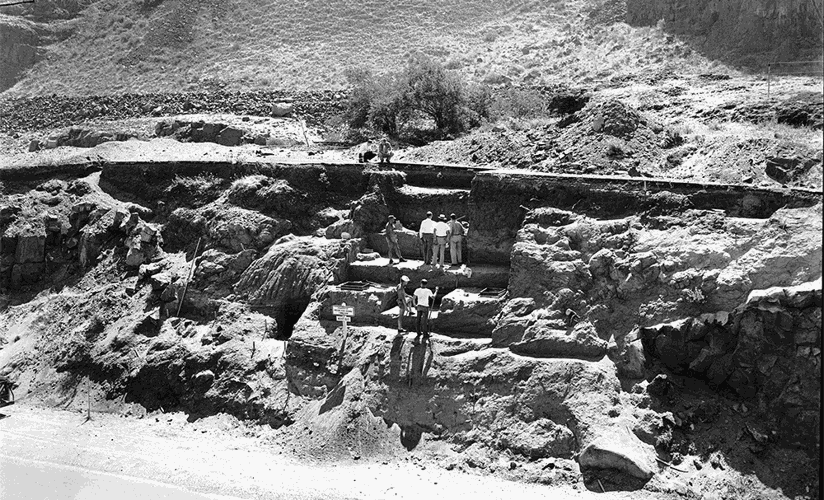
Last week’s History Mystery, above, was scanned from a 4- by 5-inch black and white negative from the archives of The Dalles Chronicle/The Dalles Optimist. It was taken July 30, 1954. Information on the envelope reads, “Archaeologists, U of O.”
Terray Harmon recognized the location as being between The Dalles and Celilo Falls, along old Highway 30.
The site was known as the “Roadcut Site near Celilo,” as well as the “Fivemile Rapids Roadcut” site, and was investigated by University of Oregon archaeologists in the early 1950s prior to flooding of the site with the completion of The Dalles Dam in 1957. Study of the artifacts in context demonstrated human occupation between 5,600 and 9,300 years ago.
According to Portland State University archaeologist Virginia L. Butler, writing in a paper titled “Relic hunting, archaeology, and loss of Native American heritage at The Dalles,” the site was located at the head or east end of the “Long Narrows” as described by Lewis and Clark, later known as Fivemile Rapids. Butler noted that “while not heavily looted before dam construction like Wakemap Mound, the site has been seriously disturbed. The top two meters of the about 7.8-meter-thick deposit were destroyed during construction of Highway 30; the lowest two meters were inundated when water backed up behind The Dalles Dam.” The Wakemap Mound site referenced was on the Washington shore, above The Dalles Dam in the vicinity of Horsethief and Spearfish parks.

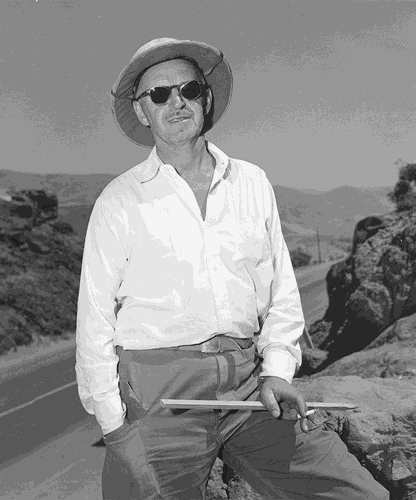
This portrait, also part of last week’s History Mystery, appears to show archaeologist Luther S. Cressman of the University of Oregon, now known as the “father of Oregon archaeology and anthropology,” who led the dig. Cressman and his crew found human-worked animal bones and numerous tools, including stone scrapers, projectile points, and pebble net sinkers, indicating that human occupation dated back 10,000 years, Butler noted.
In addition, at least 125,000 pieces of salmon vertebrae were found, which Butler, working with zooarchaeology, determined to be most likely accumulated by human activity, bearing testimony to the vital fishery and trade that took place at Celilo Falls.
Her analysis found that there was a unique mix of individual types of fish bones between human-harvested fish remains and those found naturally where dead fish collected.
Celilo Falls was located 200 miles from the mouth of the Columbia River and drew Native people from all over the Northwest.
Indian fishermen caught a rich supply of salmon and steelhead during the seasonal returns of the fish up the river to spawn.
20 years ago – 1999
Two investigations into allegations of misconduct by Klickitat County Sheriff Bob Kindler still await final decisions.


Commented