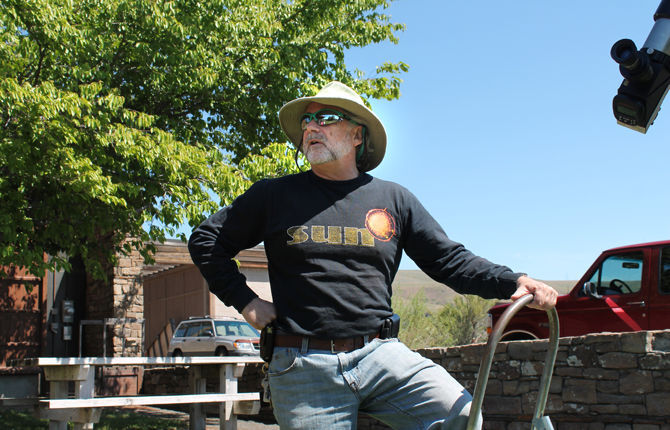
Bob Yoesle talks about the physics of the nuclear reactions happening in the sun, and of the filters and equipment his telescope has for safe solar viewing during a “Solar Saturday” event at the Columbia Gorge Discovery Center. The events are planned for the last Saturday of each month through the summer.
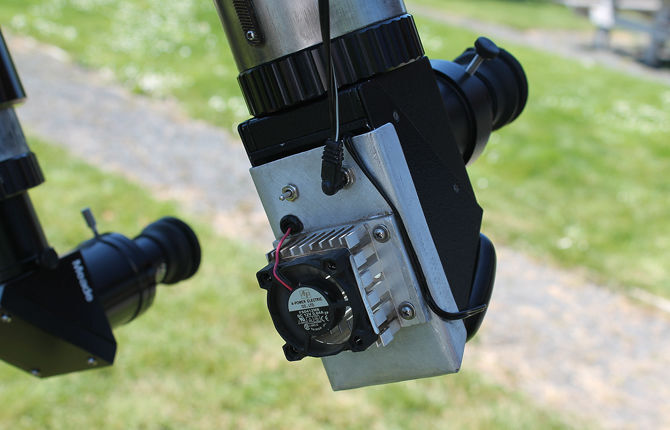
Bob Yoesle invented a cooling apparatus, above, for the viewfinder of his telescope that is now a widely accepted safety practice used when viewing the sun. Jim Drake photo
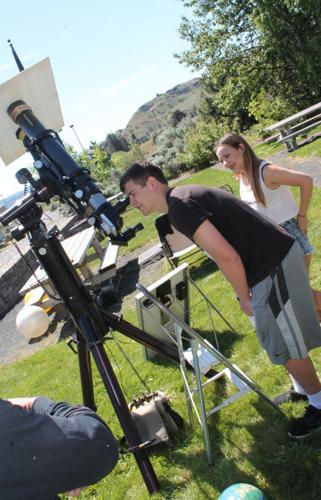
Joshua and Mikhail Thompson of The Dalles enjoy the solar show during a Solar Saturday event at the Columbia Gorge Discovery Center in The Dalles. The shows are planned for the last Saturday of each month. Jim Drake photo
Bob Yoesle talks about the physics of the nuclear reactions happening in the sun, and of the filters and equipment his telescope has for safe solar viewing during a “Solar Saturday” event at the Columbia Gorge Discovery Center. The events are planned for the last Saturday of each month through the summer.
Jim Drake
Bob Yoesle invented a cooling apparatus, above, for the viewfinder of his telescope that is now a widely accepted safety practice used when viewing the sun. Jim Drake photo
Jim Drake
Joshua and Mikhail Thompson of The Dalles enjoy the solar show during a Solar Saturday event at the Columbia Gorge Discovery Center in The Dalles. The shows are planned for the last Saturday of each month. Jim Drake photo
“What we’re doing is reducing the brightness of the sun by 100,000 times,” Bob Yoesle said of his solar viewing telescope system that he brought to The Columbia Gorge Discovery Center in The Dalles last Saturday afternoon.
The bright sunny day made for an afternoon of prime solar observation time that was open to the public — giving a rare chance to safely view the nearest star.
There were actually two telescopes in use, each set up for looking at different layers of the sun’s atmosphere. “In this view, you see a white disk, or photosphere, with a smattering of sunspots on it, the largest of which is the size of the earth. These are magnetic storms,” Yoesle said.
He said the slight wavey motion you observe is actually the result of the earth’s atmosphere.
“The layer above the photosphere is the chromosphere, which you can only usually see during a total eclipse. You can see a lot more activity.
“The sun is 109 times the diameter of the earth, and over one million earths can fit in the volume of the sun,” Yoesle said.
Yoesle explained that the chromosphere was the light of hydrogen gas at 20,000 degree Celsius, with telescope filters that show the ruby red light component at 650 nanometers.
“This is a layer of atmosphere that’s 2000 miles higher than the photosphere. You can also see the arches, or prominences, that are shaped by the magnetic fields,” Yoesle said.
cool view
Yoesle had special equipment on the viewfinders that deflected and cooled the beam of light that entered.
“That’s the actual brightness of the sun at the focus,” Yoesle said as he removed the viewfinder and held his arm under the light that was coming through.
You can’t keep your skin there for long, because it’s too hot, so he devised a vented cover with an electric fan that safely deflects the light out to the side. This equipment caught on with solar telescope operators and now it’s pretty much standard equipment.
“The photosphere is very intense light. The neat thing is our star is the only one that we can actually see the surface of. It’s fascinating because there’s always something new going on, minute by minute, day by day.”
Solar physics
Yoesle went on to explain some of the physics of how the sun worked and it’s importance for, well, everything on earth. “There’s a really active layer that’s between the photosphere and the corona, with all kinds of physical processes going on.
The sun is so hot that the gasses are electrically charged, which is called plasma. The core is high density hydrogen and helium, at 17 million degrees Celsius, and that’s where fusion occurs.
This is where four hydrogen atoms can fuse into a helium nucleus, which is two protons and two neutrons. Energy is produced, and there’s actually less mass in the end.
This is following Einstein’s famous equation E=mc2. The energy produced is huge, because the speed of light is a huge number, and that’s squared.
“That’s where we get all the energy that’s making life possible. The conversion of hydrogen into helium is what is driving everything. On earth, everything that isn’t nuclear powered is solar powered. All the plant life that became our source of hydrocarbons was driven by the sun,” Yoesle said.
the observatory
Yoesle has been fascinated by astronomy since he was young and he belongs to the Friends of the Goldendale Observatory.
His personal solar telescopes use a solar panel and battery system to power the electronics.
They are four inch refractor telescopes that needed to be adjusted for position every 15 minutes or so.
He praised the Goldendale Observatory, with a telescope size (24.5” mirror) which is normally only found in university type installations. He says they’re going to refurbish it soon, converting it from a Cassegrain-type focus (which is really a long focal length) to a Newtonian system where the focus will be at the top of the tube, creating a much lower focal length, and creating a much better visual experience.



Commented
Sorry, there are no recent results for popular commented articles.