
It’s mid-day on a Saturday in February, and artist Yvonne Pepin-Wakefield is pulling on a pair of heavy work gloves. “I melted my first ones,” she says as she heads out the back door of her working studio at Lone Pine dressed in jeans and a work shirt and takes a short trail down an embankment.
She is headed for “the pit,” a large hole about 3 ½ feet deep currently capped by large sheets of corrugated sheet metal. Portions of the covering metal are blackened by heat and smoke.
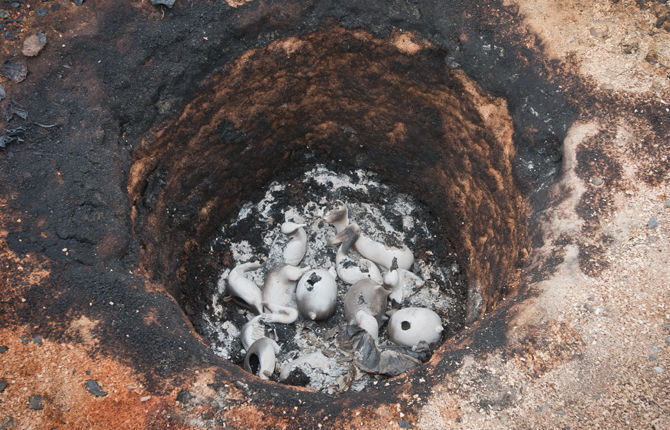
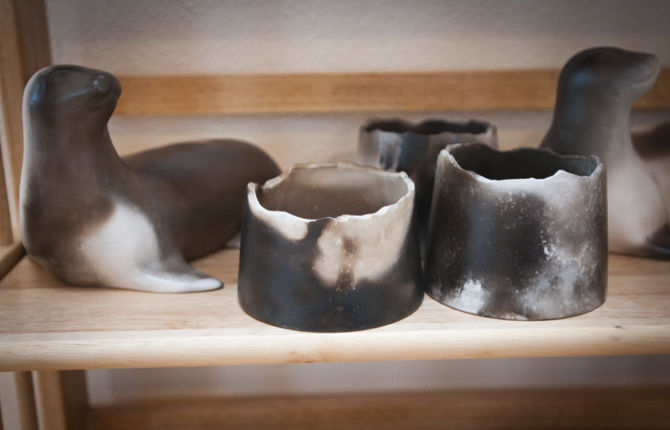
Earlier in the week, Wakefield placed a number of Bisque ceramic figures, already fired once in an electric kiln, into the pit – pigs, seals, pelicans – packed the hole with sawdust and wood shavings, set it all on fire and covered it with the metal sheets. It’s been five days.
“This is like Christmas,” she says. “You never know what you’re going to get. It could be presents, or – disaster.”
If all goes well, the un-glazed figures will be patterned in rich shades of brown and black created by the smoke, heat and oxygenation of the fire. But unlike an electric kiln, pit firing can be unpredictable.
The Pit
Approaching the pit, she points to a nearby ground squirrel hole where a large rock sits next to fresh diggings. “When I first dug the pit, I opened up an old hole,” she said. The squirrels were thrilled with the concept of central heating, tunneling around the hole and even opened one into the bottom of the pit. She plugged the hole in the pit with concrete, the one off to the side with a rock. The rock was clearly not effective.
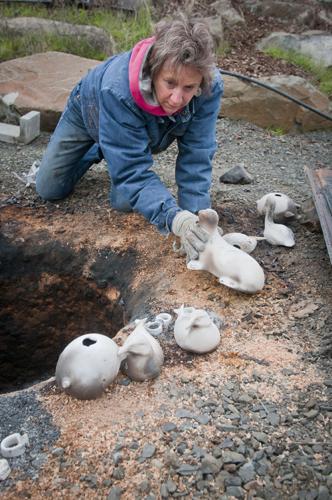
Wakefield lifts away two metal sheets overlapping the pit. An arms-length across, the pit is black with soot, showing lines of smoke-brown along the edges. Visible in the ash at the bottom are the ceramic figures. She lies flat on her stomach, stretching her arm down into the pit and running her gloved hands through the ashes. As she begins lifting out the pieces, placing them around the edge of the pit, her disappointment is palpable – all but one figure is virtually unmarked by the fire.
It isn’t Christmas, but it isn’t disaster, either. “I don’t know what happened,” she says, her brow creased in puzzlement. “The sawdust mixture? I don’t know. I think I’ll try doing them again.”
As she lifts out the final pieces and stirs the remaining ash, she notes that the squirrels have opened a new hold on the bottom of the pit. “They just dug around the concrete,” she points out.
Flawed Beauty
The pit kiln, with all its unpredictability, is part of a Japanese pottery technique called Kintdukutoi, which means “To repair with gold, embracing the flawed and imperfect.” She uses the technique
to create decorative shields made from plates purposefully broken in the firing process.
The breakage occurs when the pit is opened while the plates within are still hot – that’s how she melted her first pair of gloves. “Open it hot, it will crack them, especially if there’s snow or rain,” she explained. “The first one I did in the rain, they practically exploded. Cold is less direct, you can hear them cracking when you open the pit.”
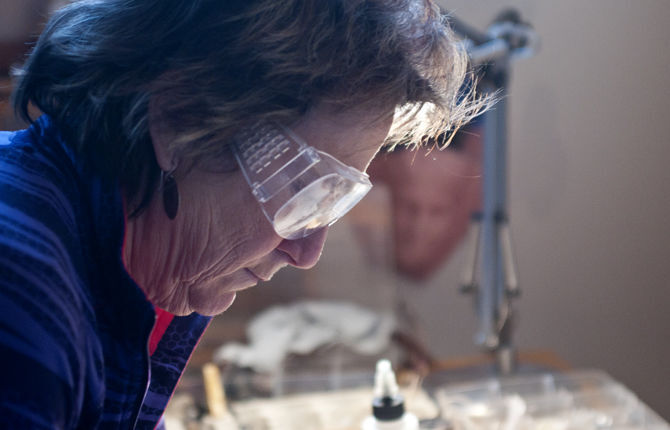
The broken plates are taken into the studio, where she uses a high speed tool, with a selection of drill-like attachments, to decorate the pieces with a variety of items, including porcupine quills.
Whether she is experimenting with figures or breaking plates, Wakefield is drawn by the imperfections inherent in pit-firing. “It’s the only thing I do that’s not perfect,” she explains. “With my writing, it has to be perfect, every word has to be right. Every letter, every sentence, every paragraph has to be perfect. The pottery is the antipathy of that. I purposefully break it, I don’t want anything to be perfect.”
“I do the pit-fired ceramics because I am in direct contact with the elements earth, fire and water,” she later explained in an email. “The results are unpredictable and primal, contrary to my work as a writer where every outcome has to be precise.
“My painting is the middle ground of these other two disciplines, adding in color to form a visual composition.”
The Magic of Moonlight
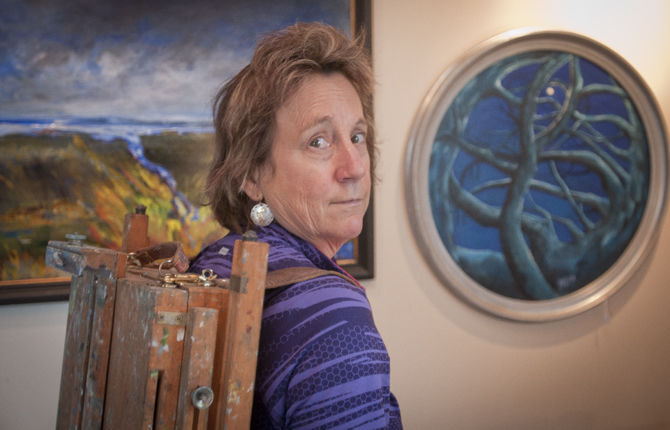
When the moon is full, Wakefield is drawn to the transformation. Working in the wide-open landscapes of the John Day area, where she has a log cabin, near her studio in The Dalles or at points between she eagerly prepares her paints and straps on her French easel — she outfitted it with straps and carries it like a backpack — and hikes out into the gathering dusk.
She explores until she finds the right place and sets up to paint. “One of my fortes is painting under the full moon.” she explains. “It’s painting by full moonlight.”
In John Day, and around The Dalles, the landscape is very open and the moonlight surprisingly bright. One of her favorite locations is currently Celilo Park just east of The Dalles.
She prefers oil, but also works in acrylic. “I pretty much paint on location, fill out the details in the studio, the grass or dirt or whatever,” she explains.
The results are both realistic and surreal, landscapes transformed not by the artist’s internal vision but by the moonlight itself.
Not all her painting is done at night, of course. She’s currently working with a series of paintings of the Native American fishing platforms lining the river just east of her studio. Unlike her moonlight paintings, these paintings will require more work in the studio. “My easel kept blowing over in the wind,” she explained. She is working on those images at her studio in Tieton Wash., where she rents one of 14 artists’ lofts at the “Mighty Tieton.”
“I do a lot of painting over there,” she said. She doesn’t paint at her studio in The Dalles because of the dust generated by her work in ceramic.
Holding onto the Past
Hanging among the paintings and ceramic “shields” displayed on her studio wall is yet another favored medium: hand-tinted photographs. They were created in Kuwait, where she taught art to Muslim women for several years. That experience is detailed in her book, “SUITCASE Filled with NAILS,” which was published just before she moved to The Dalles.
Some of the photographs were created as part of a grant she used to explore historic cultural practices in Kuwait which were no longer a part of daily life, like milking a camel or washing clothes in the river.
That idea is now a part of a grant-funded project here in Oregon.
The project, based on a grant awarded by the Oregon Cultural Trust, is called “Holding onto the past.”
“It’s hand-colored photos of people using their hands, doing certain tasks that we don’t do anymore,” Wakefield explained. Photographic prints, she plans to have them printed on aluminum this time so the show can travel more safely, will be hand-tinted with colored pencil and watercolor.
“I’m looking at things in Wasco County that people used to do, or use, 50 years ago but don’t do any longer. I want to show kids what their grandparents were doing on a daily basis,” she said.
She has planned a number of photographs already. Some are based on things she has found, like an implement she found during her explorations in John Day, a pronged tool that was used to lift sheep off the ground in the spring so they wouldn’t freeze. Others will be based on activities that are rarely seen today.
Work Ethic
Wakefield is a prolific artists — she currently has work in five shows between The Dalles and Seattle, Washington — but that is only one aspect of her work.
“My career is my writing and my art,” she said.
“I have always been able to patch together a living doing what I love,” she added. Yet the key to her success, she said, is treating it not as art but as a business. "I treat it like a business. I have to set hours, I have an agenda I have to get done.”
Her daily pattern is set. She gets up at 4 a.m. and writes till 8 a.m. Then she is off for a few hours to work out in the gym or run, eats a high-protein meal at noon. Marketing and other business lasts till 2 p.m., and after a break she works on her art from 3 to 6 p.m.
She learned how to work for something she wanted when she was young.
When she turned 18, and received her inheritance, she headed down her own Oregon Trail, exploring the areas around Bend, Sisters and Prineville When she saw the John Day property, “I knew it was my spot,” she said.
Every log was hand-notched, using saddle notches. Much of it she did alone, although she brought in help after almost falling a tree on herself.
Those she hired were an inspiration. “All those old guys I worked with, they are dead now. They showed me the heart of that country. I see a lot of that in The Dalles, with the logging and ranching.
“I chinked the entire cabin by myself, it’s about 30 feet tall at the peak.”
The cabin was the fulfillment of a dream she had when she was small and first her father, and then her mother, died. “The night my mom died, I realized I was an orphan. I thought, ‘if I could make it, if I could survive, someday I would get a cat and build a little cabin in Oregon.”
“I even made the ladder to get to the loft.”
“(The cabin) is where I first started to paint landscapes, although I drew all the time when I was young.”
She felt the same sense of connection a couple of years ago, when she first saw the property in Lone Pine where her current home is located. "I knew this was where I wanted to live.”
She lives there now with her husband of 25 years, Tod Wakefield and two dogs, Zachary and Henry.
“(The cabin) is where I first started to paint landscapes, although I drew all the time when I was young,” she noted, coming full circle to the present. Some of those early works, folded drawings that open out into a sort of visual journal, are currently on display at a gallery in Vancouver, Washington. “These drawings are a sort of visual journal, my being an orphan.”
The cabin has additional significance in the here-and-now. It is the central focus of three books she is currently writing.
Moving Forward
In addition to her own work as a writer and artist, Wakefield is deeply involved in the local artistic community. She recently helped start the group “Writers In Progress,” an open mike reading at The Dalles Art Center where writers can read works that are in progress. The first reading is from 7 to 8 p.m. on Friday, Feb. 27, at the center, located at 220 E. 4th St.
She is also teaching an adult clay class at the art center, as well as kids summer camp. She is on the art center board of directors, and participates in the Columbia Gorge Open Studio Tour in April.
Her TD studio is a ‘working studio,’ open by appointment. Her work can be found at www. yvonnepepinwakefield .com, and she can be contacted via email at wakefieldyvonne@yahoo.com.


Commented