"Joy Markgraff organizes the series, gets the speakers, and does the heavy lifting. I’m just here to say ‘Library, library, this is a White Salmon Community Library sponsored event. Library!” joked Ruth Shafer, head librarian. She explained that while it is happening at Mountain View Grange, it is still a library event. Friends of the White Salmon and Suksdorfia Native Plant society lend a hand.
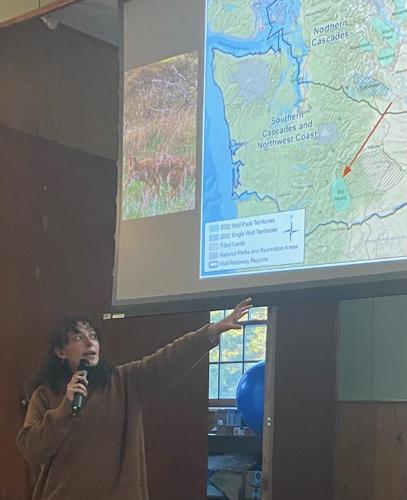
Human-Wildlife Interactions: Coyotes and Wolves by Lara Volski, University of Washington
Wolves have arrived in Klickitat County, the Big Muddy Pack. Currently the “pack” consists of one lone male. Should we celebrate their arrival or be concerned?
According to interviews Volski conducted with Klickitat County residents, many people see the fracturing of communities as one of the biggest dangers to humans following the return of wolves. One resident said, “To me, I see the risk being more of the breakdown of small local communities, where this is a great place to live because the same people go to church, play basketball together, and then go out in the woods and cut down firewood together… (Wolf conflict) can last generations or challenge the social fabric of a small community.” Others stated that they thought wolves would help increase biodiversity in Klickitat County by culling unhealthy deer and elk, which might help the ailing Mt. St. Helen’s elk herd.
“You can’t understand animals without understanding how they impact people, and how people respond to those effects,” stated Volski. Her previous research involved working with sheep producers to find ways to help protect their sheep from coyotes. They worked together to trial and error new methods. She hopes that will happen again here. For example, studies were inconclusive about the effectiveness of Fox Lights, which flash randomly, and hopefully scare coyotes away from livestock. Ranchers were willing to try them anyway. They hoped that “Maybe they will work better in combination with the other measures we are taking,” which include using guardian dogs and fencing.
Ranchers and farmers don’t always feel that they are the intended audience of scientific papers. Volski is hoping to change that. An interviewee stated, “It’s a problem. We would look at scientific papers and say ‘This is specifically written so I cannot understand it. You know, to make it exclusionary.”
Volski wants to bridge that gap in communication, and she also honors the lived experience of those who are actually on the land. “We need a better understanding of what works. Effectiveness matters little if ranchers are unable to adopt these measures, though.” In future studies, researchers should hand the tools to the people who would use them.
Why have coyotes survived while wolves have been wiped out? Historical removal efforts focused on both species.
Coyotes are adaptable and can switch from hunting alone to hunting in a pack. Wolves are social, pack animals. The “lone wolf,” is an anomaly and is usually an animal in trouble, with limited prospects for survival. While Coyotes have adapted to live in close proximity to humans, wolves are wary.
Wilhemina is a coyote who waits to be fed beside a “Do not feed the animals,” sign. People ignore the sign unless a ranger is nearby to explain the rule. Physical differences between coyotes and wolves include wolves having bigger paws while coyotes have longer ears, noses, and legs.
Volski’s goal as a researcher is not to advocate for the survival of the Big Muddy Pack but to listen to community members, share their perspectives, and encourage dialogue amidst polarization. People in rural areas need to work together despite differing opinions.
Freshwater Mussels of the Columbia by Emilie Blevins
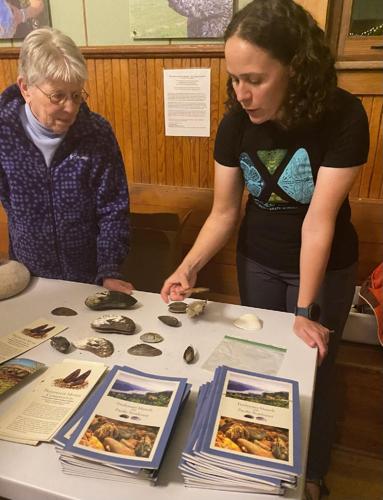
Series organizer Joy Markgraf (left) and presenter Emilie Blevins, who spoke on freshwater mussels in the Columbia.
Joan Chantler photo
Have you seen mussels at the beach, attached firmly to rocks? Have you eaten mussels in bouillabaisse, paella, or seafood stews? Freshwater mussels are somewhat similar and are found here in the Columbia and White Salmon rivers, and in Rattlesnake creek.
Freshwater mussels eat bacteria and algae, which cleans the water. Each mussel filters 10 to 16 gallons a day. Multiply that by 10,000 mussels in a bed, times their life span (2 to 100 years) and that’s a lot of improved water. However, they can be harmed by the ammonia found in sewage effluent near treatment plants
Mussels are one of the most imperiled wildlife on the planet, and not much is known about them. Emilie Blevins, Senior Conservation Biologist with the Xerces Society, states her conservation program aims for “healthy, diverse, connected, and abundant freshwater mussel populations.” Community scientists – that’s any of us - could be very helpful with increasing knowledge about where they can be found in our area. If you find mussels or their shells, take photos and send them to https://www.inaturalist.org/projects/freshwater-mussels-of-the-western-u-s
Look for mussels on slower moving water. Forget about streams that dry up in the summer; mussels have to have a year-round constant water supply. The usually dark shelled creatures can be mistaken for rocks until you look closer. There are several ways to view them: simply stand over them in shallow water, float over them with snorkeling gear, or wade with a glass bottomed bucket.
Mussels hold themselves at the bottom of a lake or stream bed using a strong muscular foot, but they can be swept away in a flood or strong current. They can use their foot to slowly crawl along. Most mussels will move little more than a few hundred feet as adults, which makes them extremely vulnerable to changing habitat conditions. It also gives rise to some strange breeding strategies to assure dispersal of their young- the tiny larva hitch rides in the gills of fish. Some mussels have developed an amazing strategy to attract those fish. They have an appendage that looks and wiggles just like a fish. (see You Tube True Facts: Mussels That Catch Fish).
Both presenters fielded many questions from the attentive and curious audience. Wild About Nature has concluded for the year. Look for the series next April and the last report in next week’s paper.



Commented