
One of the newest committees of the Columbia River Gorge Commission focuses on the health of local economies. Formed just last year and made up of five Gorge Commission members, the Economic Vitality Committee seeks to better fulfill one of the two stated purposes of the National Scenic Area Act: supporting the economy of local communities, consistent with scenic area protections.
At the committee’s March 4 meeting, Skamania County Commission chair Asa Leckie was invited to share an overview of the economic struggles his county faces.
“Economic development in the county is very tough to figure out,” Leckie told the Gorge Commission committee. “It is very challenging.”
Leckie tied much of that trouble to the limits on taxable land within the county boundaries, frustrations caused by logging regulations on national forest land and tangible challenges to developing a tourism-based economy.
- Limited land: According to the county’s official land ownership breakdown from 2012, which Leckie confirmed is still roughly accurate, 88.3% of the over 1 million acres of land in the county is non-taxable land. That includes over 760,000 acres of the Gifford Pinchot National Forest, land within the National Scenic Area and land owned by the State of Washington. And a majority of the taxable land is included in exemption programs, such as private timber lands that only make tax payments every few decades, leaving only 1.8% of the county’s land (less than 20,000 acres) taxable at full market value. Federal compensation payments have not made up the gap.
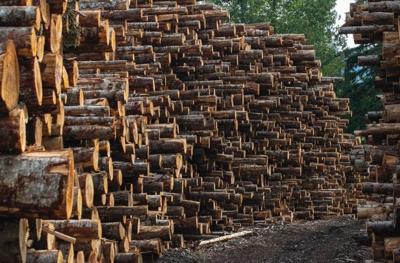
- Logging revenue: In the Gifford Pinchot National Forest, logging companies struggle to hit the prescribed sales quotas (PSQs) set by the state, Leckie told the committee, explaining that when companies miss those quotas, they are not required to share profit with the county government, cutting off that revenue stream. A federal program to make up for historic lost timber revenue has been unstable.
- Tourism challenges: The Washington side of the river, particularly Skamania County, had less infrastructure and smaller urban areas than the Oregon side when the National Scenic Act went into effect, which baked in a disadvantage to diversifying the local economy later, Leckie said. Plus, tourism goes up and down with the economy. When gas, fees and parking permits go up, hikers from Portland or Vancouver “are just going to brown-bag their lunch. They’re not going to stop at local businesses,” he said, but they still put extra demands on local services like search and rescue.
One of his suggested solutions included turning conservation efforts into a source of revenue for local governments, through payments for land set aside to protect wildlife habitat and old growth forests. “It’s not going to be on par with development, but I think communities would rather have a surety of income, not just the most income,” he said.
He also suggested expanding logging by concentrating it along existing roads, paving them and creating wildfire protection breaks of up to 5,000 feet on either side. If that happened along all 280 miles of road within the Gifford Pinchot National Forest, Leckie estimated that would open up 176,000 acres for logging.
“That solves the issue with the schools, that solves the issues with county revenue, and it doesn’t put the pressure for economic drivers where maybe they’re not appropriate,” such as within the Scenic Area, he told the committee.
Committee chair and Hood River resident Lach Litwer said he had not previously realized the full impact of undevelopable land on Skamania County’s economy, and characterized Leckie’s ideas as “super-specific and based on [his] knowledge of the area.” However, he pointed out that the committee, and indeed the Gorge Commission as a whole, is not responsible for regulation in the national forests. He suggested that only the Forest Service can bring about the kind of change that Leckie is seeking.
Leckie acknowledged this, saying that he has spoken with staff of Washington’s U.S. Senators Maria Cantwell and Patty Murray and found them receptive to his ideas. He said they shared mutual frustration that “things in the Forest Service do move at a very slow pace.”
Paradoxically, the Trump administration’s One Big Beautiful Bill Act, passed last year, includes provisions to increase logging in federal lands but redirects all that money into federal coffers, not to states or counties, meaning increased logging would not generate more money for Skamania County. In an interview with Uplift Local, Leckie said he understood why it was set up this way, but the law is “missing some key provisions” and he is concerned about the local impact.
Renée Tkach, a Skamania County resident and conservation director for the Friends of the Columbia River Gorge, attended Leckie’s presentation but was skeptical of his ideas. Speaking with Uplift Local, Tkach echoed Litwer’s comments about what the Gorge Commission can and cannot do. ”Every single point [Leckie] brought up in his presentation has nothing to do with the Gorge Commission’s regulatory power,” Tkach said.
And she doubted the Forest Service could take on paving roads since the agency’s staff has “basically been cut in half” and it “doesn’t have the full capacity to address many things that they used to,” she said.
Tkach said she had hoped to hear what Skamania County officials wanted the Gorge Commission to do differently. “We didn’t hear any of that,” she said.
While Litwer noted that the Gorge Commission could not change federal land use regulations or policies in the national forest, he said there is one very important thing it could do: start conversations with the people who do have that power. He suggested that Skamania County enlist the aid of organizations like the Mid-Columbia Economic Development District and the Washington Investment Board to tap into grant and loan money available for local economic development. He also offered to open up conversations with Forest Service partners to help ensure “everybody understands the problem the same way.”
Read full notes from the March 4 meeting of the Columbia River Gorge Commission’s Economic Vitality Committee by Gorge Documenter Lynda Ontiveros.
•••
Swen Carlson is Uplift Local's Community Editor in Oregon. He has lived in The Dalles for the past decade and got his start in journalism with Uplift Local's Gorge Documenters program.


Commented