OREGON — Federal matching dollars allowed a massive expansion of health insurance for low-income Oregonians. Now the feds are pulling back, and the state is left holding the bag.
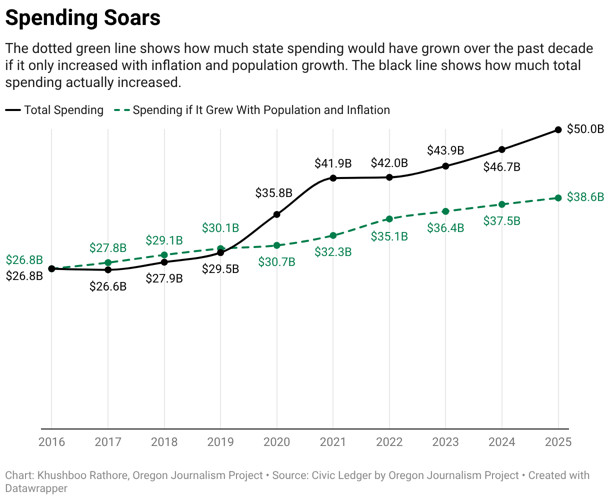
Over the past decade, the growth in Oregon’s total state government spending has far outpaced inflation and population growth.
That analysis comes from a new tool built by the Oregon Journalism Project. Called Civic Ledger, the tool allows users to examine total government spending over the past decade, adjusted for inflation and population growth
OJP pulled 10 years’ worth of spending data for 16 governments, including the state of Oregon. The data comes from each government’s annual comprehensive financial report and pinpoints a measure of spending that municipal finance experts say is more precise than annual budget numbers.
While the results vary for governments across Oregon, the trend line for state government is clear. Overall spending accelerated beyond inflation and population growth during the pandemic and never really slowed afterward.
In some cases, the increased spending resulted from new taxes. In 2017, for instance, lawmakers hiked gas taxes and vehicle fees to raise money for transportation. In 2019, a new tax on corporations funded the Student Success Act, pouring money into K–12 education. In 2019, lawmakers also passed a new payroll tax to fund paid family leave.
In other cases, state spending expanded thanks to a growing economy and revenues from existing taxes. Those revenues helped cover general expenditures, including pension costs for state employees, which over the past decade increased from 12% to 23% of payroll. (The state also created three new agencies in 2021: the Department of Early Learning and Care, the Oregon State Fire Marshal’s Office, and the Department of Emergency Management.)
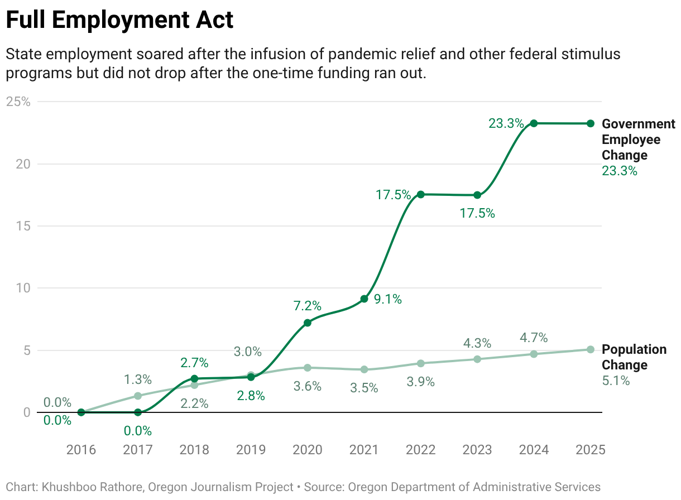
Over the past decade, the total number of state employees grew 23% to 47,763. That is more than four times the growth in the state’s population over the same period.
By far the biggest increase in state spending came from an expansion of the social safety net. Over the past decade, spending on human services, for instance, grew about 30% faster than spending on education, the second largest state expenditure. Viewed another way, human services accounted for more than half the increase in state spending between 2016 and 2025.
By leveraging federal Medicaid dollars (which often match state expenditures 3 to 1), the state extended health care coverage to low-income Oregonians — and the scope of the benefits they receive — at an aggressive rate. (Oregon calls its Medicaid program the Oregon Health Plan.)
Nearly half of the new state employees hired over the past decade work in what the state’s annual financial report calls “human services,” a category which includes the Oregon Health Authority (the administrator of the Oregon Health Plan) and the Oregon Department of Human Services.
And while some of the increase in spending on human services reflected compensation for new employees, most of the new state spending paid for doctor visits, pharmaceuticals, hospitalization and other treatment for Oregon Health Plan beneficiaries.
Drawing on federal matching dollars, lawmakers expanded the Oregon Health Plan into one of the most ambitious Medicaid programs in the country. It now covers 1 in 3 Oregonians — about 1.46 million people — and provides a breadth of services more generous than the offerings in other blue states such as California, New York and Washington.
Although the federal government paid for most of the growth, adding beneficiaries and services also required a heavy investment from the state’s general fund, the pot of money over which lawmakers exercise discretion. State funds allocated to matching federal Medicaid contributions more than tripled over the past decade — far outpacing the general fund’s growth.
Supporters say expansion was the right move. “I don’t regret it,” said state Rep. Rob Nosse (D-Portland), chair of the House Health Care Committee. “People got care that they wouldn’t have otherwise.”
Critics say Medicaid expansion went too far. “Nobody at OHA ever said no to any expansion — and the Legislature didn’t either,” said state Sen. Fred Girod (R-Stayton), a dentist and longtime member of the budget-writing Joint Ways and Means Committee.
“We’ve built a Medicaid system we can no longer afford,” added state Rep. Ed Diehl (R-Stayton), co-vice chair of the House Committee on Health Care.
Republicans and Democrats alike, however, agree the bill has now come due with President Donald Trump’s passage of large reductions to federal Medicaid funding.
Because Oregon leaders chose to expand Medicaid offerings so aggressively, those federal cuts will disproportionately hit the Oregon Health Plan, creating an estimated $421 million hole in the state’s 2027–29 budget.
Late last year, Gov. Tina Kotek convened experts to look for ways to shrink the Oregon Health Plan.
That panel’s report, delivered earlier this month, described the extent of the problem. “Medicaid enrollment has more than doubled in the past 10 years,” the report said. “OHP benefits have increased over the past 10 years, and Oregon’s optional benefit package is relatively rich compared to other states.”
There was no discussion in the panel’s recommendations to Kotek about one of the biggest recent drivers of increased Oregon Health Plan spending, a program called Healthier Oregon, which offers Medicaid to any undocumented person living in Oregon.
No other state, according to the health care research nonprofit KFF, offers such benefits to undocumented residents without limitation. And the cost to Oregon has been substantial. Healthier Oregon’s budget has risen 10-fold over the past decade to just over $1 billion in 2023–25; more than 100,000 people now receive benefits through the program. (Unlike most Medicaid programs, for which the federal government picks up the majority of the tab, Oregon pays three-quarters of the cost of Healthier Oregon.)
Nevertheless, Kotek’s panel did not recommend any changes to Healthier Oregon. Diehl told OJP the state cannot afford the program. “It should be eliminated except for emergency services,” he said. “It’s a matter of fairness and priorities.”
It’s not clear what the governor and the Legislature might do. Even as they struggle to cut Medicaid costs, a panel the Legislature created in 2023, the Universal Health Governance Board, will release a plan in September to make Oregon the first state to provide health care to all its residents.
While the Civic Ledger analysis makes clear that state spending grew rapidly during the past decade, former state economist Mark McMullen hopes leaders will pay attention to the projected big shifts in Oregon’s demographics as they ponder the next decade.
School enrollment is expected to continue to decline, McMullen points out, even as K–12 labor and pension costs continue to escalate. Meanwhile, the number of Oregonians aged 85 and older will soar. Aging Oregonians will need more and more expensive health care.
Taken together, those forces threaten to blow holes in future state budgets. “The main point is,” McMullen said, “demographics equal destiny.”
Such looming challenges worry lawmakers such as Girod who think the Legislature lacks fiscal discipline. His concern isn't just about the growth of the state’s Medicaid program — it's the trade-offs lawmakers made to pay for it.
Spending on transportation, for example, has barely kept pace with inflation and population growth over the past decade. State funding for public universities ranks 37th in the nation. And there are fewer state troopers patrolling state roads than 50 years ago when Oregon’s population was half its current size.
“OHA is a runaway train,” Girod said, “and its funding has come at the expense of areas like higher education and public safety.”





Commented