
THE DALLES — An intergovernmental agency went through months of hard work and long waits to win a major federal grant meant to provide affordable Internet to homes in rural northern Wasco County. And yet, right near the end of that process, the agency ultimately decided the project was not financially realizable and rejected the funds.
But an out-of-state company may soon pick up the project in those areas instead. In the meantime, the agency, known as QLife, has shifted its focus to another target area: the densest population center at the heart of The Dalles.
Here’s the backstory: In 2021, Congress approved $42 billion to bring high-speed internet to unserved and underserved communities nationwide. The Broadband Equity, Access and Deployment Program (BEAD) rolled out two years later, and in 2025 awarded Oregon roughly $689 million in funding to redistribute to local communities.
In February 2026, Wasco County’s QualityLife Intergovernmental Agency, or QLife Network, was awarded $15.2 million to build a fiber network serving parts of Northern Wasco County School District 21. The high speed internet it would deliver was meant to reach 921 homes and businesses.
QLife is a collaborative effort formed in 2001 between the City of The Dalles, Wasco County and Northern Wasco County People’s Utility District (PUD) with a single goal: to bring affordable high-speed broadband Internet to homes and businesses in the mid-Columbia region, particularly in underserved or underrepresented areas.
At the time of the $15.2 million award, QLife executive director Liz Lance called the opportunity “truly epic” in a conversation with Uplift Local.
But in the following months, Lance says, QLife staff and board, along with advisors and financial partners, conducted an extensive review of the project. They ultimately determined it would not be financially advisable and made the difficult decision to reject the award.
“Escalating construction costs and other economic factors have made it impractical for us to proceed with the project under the current funding structure,” the agency said in a June 23 announcement that it was rejecting the federal funds.
In a letter to the Oregon Broadband Office (OBO), explaining the decision, Lance cited challenging factors such as a “low-density customer base” with “unique economics.”
Financial struggles also played a factor. OBO had denied a QLife request for a waiver of BEAD’s requirement that the local agency match 25% of the funds of the grant, roughly $5.1 million. QLife had no identified source of revenue for that contribution. Additionally, labor costs and expenses such as replacing poles were higher than original estimates, the long wait time for the final approval for Oregon led to cash flow challenges, and the costs of providing maintenance to the project area long-term were projected to exceed revenue.
Lance noted that QLife is now renewing its focus on near-term investments in higher-density and financially sustainable service areas. Doing this will create a “stronger foundation” for future rural expansion and protect the long-term sustainability of the organization, she wrote to OBO.
QLife’s decision left the funds available for others, and the Oregon Broadband Office has preliminarily approved Nevada-based Stimulus Broadband to bring high-speed internet to the 921 addresses in northern Wasco County that QLife deemed too expensive to serve. Stimulus Broadband would be new to the Gorge but not to Oregon; its current service area includes parts of Jackson and Klamath counties in southern Oregon.
Other BEAD subgrantees, including Hood River Electric & Internet Co-Op and Blue Mountain Networks in parts of Hood River County, and Starlink, which provides satellite Internet in other areas of both counties, remain unchanged from February’s initial announcement.
At QLife’s July 23 board meeting, board member Scott Hege expressed both surprise and concern about Stimulus taking on this project. “They’re private sector, we’re public sector, nonprofit essentially,” Hege said. “They have to make money doing it. And yet we couldn’t even make it work as a nonprofit. So I wonder how it is that they can do that.”
Hege also expressed worry that QLife might have taken an incorrect approach in its original assessment, and about the potential of Stimulus as a competitor in their continued operations in the region.
In a conversation after the meeting with Uplift Local, Hege clarified his worry. “My concern is getting overbuilt,” Hege said, explaining that QLife has already put down a lot of fiber infrastructure and he is worried Stimulus would “come in and, basically, build a duplicate line.” However, Hege has heard talk that a plan to allow Stimulus to make use of the infrastructure QLife built might be in the works.
Other board members were less concerned. “[Stimulus has] not done the research on poles, they’ve not cost-estimated the poles, which we found out was going to be a gigantic expense, so they’ve not learned any of that yet,” QLife Chair Lee Weinstein said at the July 23 meeting.
Stimulus has until Sept. 18 to confirm their interest in taking on the project.
There is certainly sufficient demand in the region for a cost-effective, reliable option. The Mid-Columbia Economic Development District (MCEDD) did a regional broadband survey back in 2022, which showed that most households at that time paid between $70-$150 every month for broadband Internet. In other parts of Oregon, Stimulus offers plans beginning at $39.97. Stimulus Broadband representatives did not respond to a request for further information about their rollout plans in north Wasco County by publication time.
Lance hopes Stimulus succeeds. “As an intergovernmental agency, our mission is to develop broadband as far as it can go in our region,” Lance said during a recent episode of The Dalles Chamber of Commerce Community Affairs podcast. “And if I can’t develop something, because it’s not going to be sustainable for us, I am so excited that someone else has agreed to take it on.”
Facts about residential fiber service coming to The Dalles
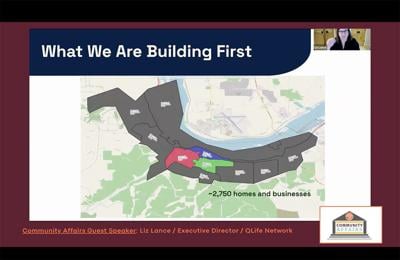
What areas are getting coverage? Eventually, the whole of The Dalles. However, the first stage of the rollout will focus on roughly 2,750 homes and businesses in the city’s downtown business district and a nearby high-density residential district to the west. (See image, this page, for a preliminary map of these areas.)
When can residents expect service? Originally, QLife planned for a timeframe where areas could expect service by the last quarter of this year. However, at the Aug. 27 meeting of QLife’s board of directors, Northern Wasco County PUD’s Broadband Manager Chris Walker announced that changing to the process to soliciting bids for the work will delay the construction date by a month, which will have a trickle-down effect on the rest of the rollout schedule. Walker hopes to have more definite dates by QLife’s September board meeting.
What kind of speed will QLife offer? Theoretically, fiber can support speeds of up to 10 gigabits per second. However, this is well beyond the demands of most residential consumers. Starting plans are projected to range between 300 megabits per second to 1 gigabit per second, though faster plans will be offered in the future if demand is sufficient.
How much will this cost? QLife has not released information about pricing at this time. However, during the Community Affairs podcast, Lance made reference to many residents of The Dalles paying over $100/month for current Internet services, implying they plan to offer something competitive to those figures.
•••
For further information about the recent activities of QLife, see full notes of the agency’s July 23 board meeting by Gorge Documenter and University of Oregon Snowden intern with Columbia Gorge News, Amelia Fiore, at columbia-gorge.documenters.org.
•••
Swen Carlson is Uplift Local’s Community Editor in Oregon. He has lived in The Dalles for the past decade and got his start in journalism with Uplift Local’s Gorge Documenters program.


Commented
Sorry, there are no recent results for popular commented articles.