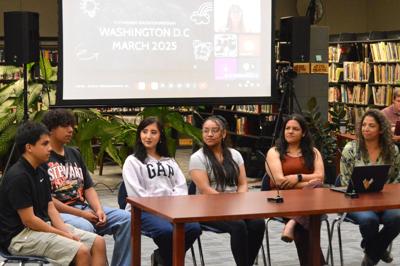
Hood River Valley High School (HRVHS) migrant education students, left to right, junior Amir Manzo, freshman Giovanni Baeza Salguero, and sophomores Camila Pedroza and Arely Torres Baeza present at the May 28 Hood River County School District board meeting alongside Region 9 Graduation Specialist América Flores and HRVHS Principal Columba Jones.
Hood River Valley High School (HRVHS) migrant education students, left to right, junior Amir Manzo, freshman Giovanni Baeza Salguero, and sophomores Camila Pedroza and Arely Torres Baeza present at the May 28 Hood River County School District board meeting alongside Region 9 Graduation Specialist América Flores and HRVHS Principal Columba Jones.
HOOD RIVER — A group of 24 Hood River Valley High School (HRVHS) migrant education students attended the Close-Up Foundation’s Washington, D.C., High School Program over spring break.
Four of those students — freshman Giovanni Baeza Salguero, sophomores Camila Pedroza and Arely Torres Baeza, and junior Amir Manzo — joined HRVHS Principal Columba Jones and Region 9 Graduation Specialist América Flores at the May 28 Hood River County School District (HRCSD) board meeting to give a firsthand account of the six-day, five-night trip.
The program combines civics education, classroom discourse, and travel opportunities “to inspire young people to find their unique voice and help them develop the skills and awareness they need to be engaged citizens for life” (closeup.org).
Students made new friends from around the U.S. while attending workshops, participating in a mock congress, and visiting Capitol Hill, the White House, and Arlington Cemetery, among other activities.
“Their days were full — they started at 7:30 in the morning with breakfast and they were on their busses by 8:15, 8:30,” said Jones, who chaperoned the trip with Flores. “They were going the whole day … I think on the mock congress day, [they] started at 7:30 and were listening to [their] congress session at eight, nine o’clock at night. So it’s a lot of work.”
“I think the most interesting part, to me, was working with others and figuring out how to work together,” said Torres Baeza, with Flores translating. She also learned a lot about politics and government.
“My favorite part was going to museums and looking at artifacts,” Pedroza said, especially noting the World War II and slavery artifacts, history she’d only read about previously. “It just doesn’t seem okay,” she concluded. The trip also made her look at the “way the world is” and “having rights for everybody” feels more important, she later added.
For Baeza Salguero, a highlight was seeing the White House: “I’ve seen pictures of it and I thought it was way bigger, but it was way smaller.” He also enjoyed meeting people from different states and with different views, and as a result of the trip, he’d like to attend college in Washington, D.C.
Manzo acknowledged the challenge of working with people with different opinions. “It was difficult, but we ended up working together,” he said. “… [The trip] really changed my point of view of politics … it makes you look at the United States [differently].”
Board Chair Corinda Hankins Elliot thanked the students for coming to present. “It’s really wonderful to see your perspective on the whole program and what it meant to you,” she said.



Commented