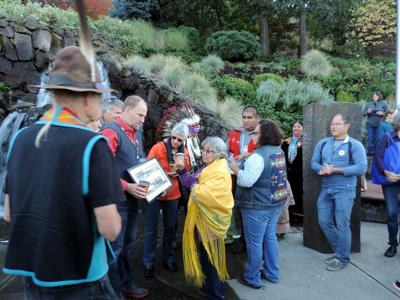
YAKAMA Nation elder LaRena Sohappy, center, and fellow tribe members give out salmon to city officials, including Mayor Paul Blackburn, holding a framed photo from the tribe, and City Council members Kate McBride, center and Peter Cornelison, far left.
YAKAMA Nation elder LaRena Sohappy, center, and fellow tribe members give out salmon to city officials, including Mayor Paul Blackburn, holding a framed photo from the tribe, and City Council members Kate McBride, center and Peter Cornelison, far left.
Reconciliation and remembrance were held forth along with gifts in Monday’s first ever Indigenous People Day in Hood River, attended by about 70 people at Overlook Memorial Park.
Education and conversation about indigenous peoples’ history, culture, and current plight are critical to healing wrongs of the past, speakers said at the event, held in front of a leaping-salmon fountain that serves as a symbol of the indigenous peoples’ innate connection to the land and the river that flows through it.
In September the City Council passed a resolution declaring the holiday on the second Tuesday of October. “This is long overdue,” said Mayor Paul Blackburn.
It’s an honor to be here and to feel things healing and all the good love that’s living here,” said Tuck’ush Winch Katchia, whose great-grandfather was among the Wasco Dog River Band peoples’ to meet Lewis and Clark when they stopped briefly at what is now Hood River.
Blackburn accepted gifts of herbs and beads from Heidi Katchia (Two Bears) and Katchia, who live near Corbett.
LaRena Sohappy and Terry Heemsah gave a framed photo from the Yamaka Nation and jars of salmon to city officials in thanks for the resolution, and had extra jars for any members of the military who were present.
Raymond Estrada of the Yakama, who lives at Celilo Village, said “If you feel you have it in you to help or be involved, remember the coal trains.
“Remember to help support the fight,” he said. “The trains run less than 100 feet from our homes.”
Blackburn and the City Council convened the ceremony, which was followed by a potluck at Riverside Community Church, where Lana Jack of Celilo, a Wyam tribe member, led both a Friendship Dance and potluck of salmon, fry bread, elk loaf, and other delectables.
Blackburn read the city resolution aloud and issued an apology. “For the despicable actions of my ancestors, I am profoundly sorry,” he said. “Words cannot begin to capture the magnitude of the events or my sorrow for the magnitude of my ancestors’ actions. Stealing the land and evicting the residents and putting up signs that said ‘No dogs or Indians allowed’ was wrong. I didn’t do it and I don’t expect anyone to accept any apology I could offer, but I am beyond sorry for what was perpetrated by our white ancestors.” Blackburn added, “I hope this can be the first step in a million-mile march toward restorative justice. Let us begin the conversation, let us tell our stories, let the healing begin.”
Mitch Hicks (Young Elk) of Hood River, a Yakama nation member, joined others in expressing gratitude to the City of Hood River for what was termed a “historic” step.
“We give thanks to our creator that the story has another chapter and it has not ended for the indigenous people,” said Hicks, who posed the question of what his ancestors might have thought the future would bring in the 1850s when treaties, later broken, were agreed to between the U.S. government and Columbia basin peoples.
“Of course, indigenous cultures are not as they once were, and much cannot be reversed. Yet many customs, values and beliefs endure today.” Hicks brought greetings from himself and his wife, Tiffany Hicks, a long-time police officer in Hood River and a member of the Choctaw nation.



Commented