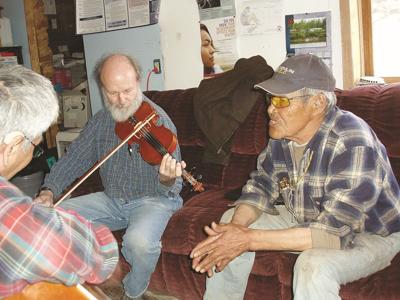
Climate change scientist Terry Chapin, left, plays the fiddle during with gathering of villagers in Alaska. Chapin, who is working with native Alaskan villages to develop strategies for coping with the effects of global warming, says he enjoys playing music in the villages, since it makes the connection to local people more personal. (Photos courtesy of Terry Chapin)
Climate change scientist Terry Chapin, left, plays the fiddle during with gathering of villagers in Alaska. Chapin, who is working with native Alaskan villages to develop strategies for coping with the effects of global warming, says he enjoys playing music in the villages, since it makes the connection to local people more personal. (Photos courtesy of Terry Chapin)
Growing up, Stuart Chapin III, or Terry, remembered visiting his grandmother in White Salmon, before he and his family moved to the area. Now, after retiring from the University of Alaska as a professor of ecology in the biology department, Chapin has been studying the effects of global warming on boreal native populations outside of Fairbanks, Alaska.
In White Salmon the effects of climate change were present in this last year: a hotter summer, and warmer fall led to drought conditions for the Pacific Northwest. But in Alaska, where Chapin now resides, the effects of “global weirding” are setting in faster, and are more readily seen than in the rest of the country.
After retirement Chapin shifted his work from academic research to encompass more field work, and is currently working with Indian and Eskimo communities in rural Alaska to learn how they’re coping with the changes in climate.
Chapin explained that working with the native populations means working with people who rely on their environment’s surroundings for survival. Their experience and adjustment to the changing climate will provide insight for future communities experiencing similar issues. “Since they’re out on the land, they see a lot more on climate change,” Chapin noted, “so I’ve learned a lot [from them], about the climate change that’s happening.”
“I’m working with them more to understand what their goals are for the future and how the university can help them reach their goals,” explained Chapin. The purpose of the study is to determine what native people in rural Alaska are doing to survive during the shifts to their home environment.
A lot of what Chapin does for this study involves communicating with community leaders, to learn how villages meet the needs of their people while navigating the changes to their surrounding climate. The villages he works with range anywhere from 50 to 1,000 individuals, most are between one to three hundred people, and mainly reside along the coast and river systems of Alaska.
Most of the villages Chapin works with are off the road system, and off the energy grid. “They get half of their food from hunting and fishing,” explained Chapin, “It’s a way of life for them, and as the climate changes that changes their opportunity for them to hunt and fish.”
The variations in seasons have manifested into land collapsing from thawing permafrost, more forest fires and thinner sea ice, which is dangerous for the communities traveling in order to gather food, “…since they travel by snow machine and they travel over river ice and sea ice, that makes it more difficult to continue their way of life,” explained Chapin. Thinner ice means less support for hunters when trekking over rivers or out over sea ice.
Warmer falls, Chapin explained, means a change in moose behavior which makes it harder for the Alaskan natives to hunt the creature. “When it’s warmer in the fall the leaves stay on the trees longer and the moose stay bedded down.” This behavior prevents natives from hunting the animal.
To adjust to this change Chapin and native communities have been working with the state of Alaska to try and change the hunting season to mirror the shift in moose behavior and create better hunting opportunities. “I’m impressed with the ideas and plans for how to adapt with climate change,” said Chapin, “They’ve had to deal with changes in weather every year for thousands of years, so they’re really good at adjusting to the changes in conditions that come along.”
Chapin explained their efforts as a way of “looking at how state and federal agencies can meet the challenge,” of climate change for native communities. “They’re wonderful people to work with,” said Chapin, because the natives facing the changes would prefer to solve their own problems rather than “get handouts from the government.”
“We try to narrow in on the type of project we could do together, jointly, that would meet the needs of the community in ways that the university could help out,” Chapin explained.
“They’re optimistic people, they’re adjusting so well,” said Chapin, “It makes me think people in the rest of the world can adjust to climate changes. The kinds of change that people are adjusting to in Alaska are things that people will need to do in other places.”
Another aspect of Chapin’s work with the various native villages is finding a way for the villages to have a source of alternative energy: since most communities are off the energy grid, diesel power plants have been used to meet public needs.
“Part of it has to do with talking with researchers, to talk about wind energy and biomass for fuel and how to have these energies work, and to help them find alternatives, since diesel is so expensive to fly into villages from Fairbanks,” explained Chapin.
One project Chapin and the university are pursuing is to find ways to integrate solar, wind, and river energy with the diesel power plant, “and that’s really difficult technology to figure out, integrating a constant diesel output with other energy sources that vary a lot depending on time of day and weather. That’s something the university was able to help out on,” said Chapin.
“My favorite part is just getting to know the people in the villages,” explained Chapin. “It’s just fun being with them. I play the fiddle and it’s fun being able to play the fiddle with some of the villagers.” Chapin’s study is ongoing, and continues to create a better understanding of how to adjust to the shifting climate.



Commented
Sorry, there are no recent results for popular commented articles.