
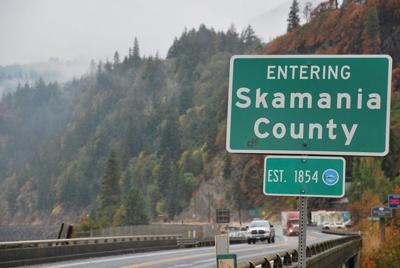
Skamania County’s Board of Commissioners unanimously took the bold step on Oct. 7 of declaring a state of emergency in the county “due to unhealthy national forest conditions, yearly threat to catastrophic fires, and, minimal county government, schools and emergency services.”
The County Board, in a strongly worded resolution covering nearly three pages, laid out the problems it sees on state and federal lands that are making it difficult for the county and local schools and emergency services to generate the revenue they need to meet all of their obligations.
District 1 Commissioner Chris Brong said the response from some quarters to the resolution (which was sent to federal officials who have a say in management of the Gifford Pinchot National Forest, and to state officials who have roles in the management of state timber lands) has “been very favorable.”
“People are saying it’s about time. People are saying every one of the resolution’s points is the truth,” Brong said. “There is no exaggeration in this resolution. Our board finally had to say ‘We are in an emergency situation.’”
The idea behind the resolution, said Brong, “is to wake people up who are willing to listen that this county is in trouble [financially],” said Brong. “We are asking people to work with us as we transition from the short-term Secure Rural Schools funding to long term financial stability.”
A major concern is the status of a bill in Congress that would reauthorize the federal Secure Rural Schools (SRS) program that helps timber-dependent counties that have been hit hard by the curtailment of timber harvests within their boundaries.
“If we don’t get SRS funding, we will be in a world of hurt,” Brong said.
District 3 Commissioner Bob Anderson said the county received $1,631,061 in SRS funding in 2014 for fiscal year 2013. SRS funding comprises about 16% of the county’s Current Expense fund revenues. The money covers general county expenses, from law enforcement to financial management. (The county also receives federal money that can be used only for search and rescue, and creating Firewise and Community Wildfire Protection plans. In 2014, it received $230,267 for fiscal year 2013.)
“If (SRS) is reauthorized, we will receive 95% of that in 2015,” Anderson noted.
The county’s recent annual state financial audit also contained bad news for the cash-strapped county.
“That was brutal,” Brong said of the process of dealing directly with state auditors and writing responses to auditors’ findings.
“This is my second year as a commissioner and, frankly, the situation is as the state auditor says: we are in danger,” Brong said.
County commissioners believe state and federal agencies can do more to help the county regain financial stability.
For starters, commissioners want the U.S. Forest Service to desist in acquiring any more private lands in the county using federal Land and Water Conservation funds. Ska-mania County’ taxable land base is about 2% of the more than million acres comprising the county. The federal government owns 80%, and the state holds 2% — all of it exempt from paying county taxes. The county receives Payments In Lieu of Taxes on federal lands, but those payments also are subject to Congressional reauthorization. (Another 10% of the county is designated as private forest land. That land only generates revenue when timber is harvested, according to Brong.)
“We have told the Forest Service personally and in writing that we don’t want any more private land taken off our tax rolls,” Brong said.
The Enterprise contacted Gov. Jay Inslee’s communications director and the Gifford Pinchot National Forest’s Public Affairs Office for comment on the county’s resolution but did not receive responses before press time.
State auditors want the county to prepare a detailed financial plan for every department in the event Secure Rural Schools funding is not reauthorized. Brong said the board is going to prepare such a plan to make sure the county can keep expenses within available revenue.
Right now, Skamania County general services are operating on a monthly cash flow and has had to borrow money from reserve funds “in order to make payroll for four months,” Brong noted. “We’re literally robbing Peter to pay Paul, except the law requires us to pay Peter back. It’s not a good way to do business.”
Moreover, the county is trying to renegotiate a $2.5 million loan it took out in 2012, with repayment due in November 2015. Brong said the county has asked the bank for four different options but, due to a change in ownership from Sterling Bank to Umpqua Bank, the new management has not yet responded to the county’s request
County commissioners believe one positive step that would improve the county’s financial and forest health would be for federal and state forest managers to schedule more timber harvests. At this, point, as the resolution states, “Skamania County elected officials have lost trust in the capability of local U.S. Forest Service management to implement the goals of the Northwest Forest Plan [of 1994].”
The commissioners assert the forest “is managed improperly by avoiding and limiting timber harvests that would provide healthy forest conditions, and forest receipts for Skamania County,” and that Forest Service managers have not involved county commissioners “as equal partners in the planning and management of the Gifford Pinchot National Forest.”
The institution of the Northwest Forest Plan and habitat plans to protect northern spotted owl, in particular, have put much of the Gifford Pinchot off-limits to timber harvests. According to Forest Service figures, the agency sold 689 million board-feet of timber in1990. By 2013, the number of board-feet sold had dropped to 34 million.
In their resolution, Skamania commissioners called on everybody from the President to the Governor’s Office”to immediately provide emergency funding to accomplish the pre-commercial and commercial tree thinning, timber sales, dead tree removal, fuel-load reduction, to protect affected areas from catastrophic wildfire, and watershed protection.”


Commented