
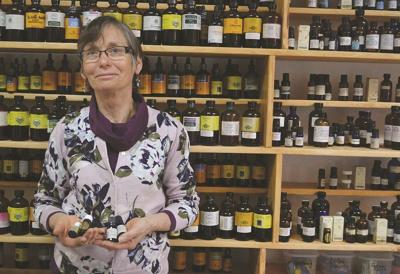
An eclectic assortment of amber glass bottles, vials of medicine, and circular plastic tubs were neatly arranged on the table in front of a small gathering of attentive locals.
Interested parties gathered Sunday afternoon to hear HealthCalls’ master medical herbalist, Hart Brent, talk about the use of homeopathy, herbs, and essential oils to fight infections.
“It’s hard to figure out what’s good for you,” Brent explained to attendees, “I can give you my 27 years of experience. But what I try to do in my practice is really match you to exactly what remedy works for you, because we can give you a lot of good ideas but I’m going to try and talk about what’s safe for you to use at home.”
Brent studied biology and pre-med at Smith College where she completed an honors thesis on The Role of Plant Saponins in Immunotherapy, which has been accepted for publication.
“If we [go] back to the late 1800s, Pasteur and this guy Béchamp, in Europe, were in this argument over what is it that causes disease,” said Brent. “And this is an important question, right? Because we want to stay healthy, what is it that makes us sick?”
Pasteur’s side of the argument cited germs as the root cause of illness, “He is the father of modern germ theory, so all modern medicine follows from the idea that if you kill the bad guys then you’ll be all right,” explained Brent.
The other side of the 1800s argument, presented by Béchamp, was centered on biological terrain as the issue which could make a difference, whether someone was sick or well. “So biological terrain, or is it the germs?” Brent asked to summarize the argument.
“Obviously, politically, we went with the germ theory, because all our modern medicine is geared to, what is the germ that’s making you sick, and let’s kill it,” said Brent.
The problem with that approach, Brent explained, is it doesn’t work. “Because if the body, the inner milieu, is not pH balanced, doesn’t have enough oxygen, has toxins, all those things, then the immune system cannot turn on, and do the job,” explained Brent.
“You can take IV antibiotics and you still will not do a 100 percent job because antibiotics clog up the lymph,” noted Brent. “That doesn’t mean that antibiotics weren’t a good thing. When they first came about, in war for stopping gangrene and other kinds of injuries, they were absolutely miracle drugs.”
“I’m not saying we don’t need antibiotics, but we need to save them for when we really need them,” said Brent. The result of using antibiotics to fight such things as colds, flu, and bronchitis kills off the good bacteria as well as the bad, Brent explained. “They kill off your good gut flora,” said Brent, “and a healthy GI track and good bacteria in there is absolutely key. It’s the foundation of a good immune system response.”
Brent expressed Béchamp’s line of thinking, explaining the primary cause of disease as always residing within a person. Germs are really the scavengers in this line of thought, “like maggots are on an injury or a wound,” said Brent. “They are a sign that the disease is there but killing them does not treat the underlying problem.”
From Béchamp’s point of view the problem was in one’s biological terrain, explained Brent, a disease couldn’t be properly addressed until the biological terrain was brought back to an equilibrium. Brent suggested eating clean, staying away from toxins like pesticides, and being sure to get enough oxygen in order to keep a healthy system from bogging down.
“Often malnutrition is the cause, the underlying cause of disease, so eat a nutrient dense diet,” Brent said. “These are things that are common sense, but what I’ve noticed is because we’ve come to expect that there’s a magic bullet out there that we can do whatever we want and then medicine will make us healthy. But I’m not sure that’s still true anymore.”
Brent then highlighted the practice of live blood analysis, which is a method of analyzing a person’s blood cells to assess what their cells look like. The practice is regulated in the U.S. and conducted in registered laboratories.
The information pooled from the analysis allows a glimpse at someone’s white blood cells, which clean up whatever illness is circulating through a person’s system. “The trouble is, things like chemicals and heavy metals, literally paralyze them, and one of the herbs that we use, Echinacea, is really key,” said Brent. “Because when I saw that people were doing Echinacea these monocytes, macrophages, (the ones that were the cleaner-upper cells that go around and eat up stuff) they flow better and work better and that’s basically what it does.”
“[Echinacea] really works for some people and not others,” Brent added. Some people will experience better results with a glyceride instead of an alcohol extract, a glyceride extract being more similar to what you would get if you made a tea, Brent explained.
Those who attended Sunday’s talk came away with a better understanding of how to weave basic homeopathic remedies in to daily life, like using onions and honey to help ease a cough. Brent will be hosting a workshop series at the White Salmon Valley Community Library beginning April 10 about GI Self Health Care for those interested in attending.


Commented