
By SVERRE BAKKE
The Enterprise
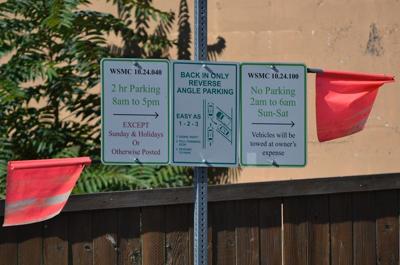
As expected, the White Salmon City Council last Wednesday re-pealed its back-in parking policy on downtown E Jewett Boulevard and added a new regulation that restricts the sizes of vehicles that can park on the south side of the street to 20 feet or less.
All five City Council members voted in favor of the legislation, which took effect Aug. 1, 2016. Business leaders approached the council on May 17 with an appeal: please repeal back-in parking, as it is having a deleterious effect on business and the town’s reputation.
Councilor Jason Sabourin said “the only reason I supported it initially is because it was a challenge [for people] to back out” of stalls on the south side of E Jewett and into oncoming, eastbound traffic.
City Administrator Pat Munyan said what makes backing in to the back-in parking stalls so challenging is the fact “the road drops off” from center line to curbing for drainage purposes.
Councilor Tao Berman noted that White Salmon will not be the only town where people have to back out into traffic.
“Bingen has it, and on a much busier highway, and they don’t seem to have a problem with it,” Berman said.
White Salmon’s Public Works Department will re-establish nose-in parking on the south side as soon as the ordinance takes effect, which should be on or around June 27-28.
Cost of the project is about $1,200 for labor and materials.
Moreover, the ordinance makes it illegal for vehicles and trailers exceeding 20 feet in length to park nose-first in the area between the intersection of E Jewett and S 1st Avenue and the midpoint of the 200 block of E Jewett.
Over-size vehicles have presented two problems: either the vehicle‘s back end hangs over and blocks part of the sidewalk, or the vehicle’s front end sticks out into and blocks a portion of the eastbound lane of traffic.
The length restriction, as determined by pavement striping and other controls, is intended to ad-dress these issues, Munyan said.
In other business, the council:
Approved a policy that allows for water leak adjustments in certain cases.
The topic of leak adjustments came up during the May 17 council meeting, at which time staff noted the city Grievance Committee “recently received a large volume of bill reduction requests due to a water leak.”
“The consensus of committee members was that, since the city changed the practice to read meters every other month, it may take longer to notice a leak, causing additional financial burden,” said Munyan in a June 7 agenda memo.
The council repealed its ordinance covering water leak adjustments in 2015.
The new water leak adjustment policy allows a one-time reduction of water charges where certain conditions have been met. The maximum amount of the water forgiveness is $500, without council approval.
“There are minimum and maximum limits to prevent frivolous requests and abuse,” Munyan said.
Moreover, the option to make payment arrangements on excess balances will remain in effect.
Aggrieved customers who want to claim more $500 will be able to petition the council for a review.
Customers currently in the grievance process will have to wait five days from June 22 publication of the ordinance before they can determine whether they qualify for for a leak adjustment.
The motion to approve included the following language: “The four customers in the grievance process, and customers with leaks identified from January 1, 2017 up to the effective date of the ordinance, will be evaluated against the requirements on a case by case basis to determine if they have met the intent of the code or if they have not met all the requirements, such as photographs and proof of notification within 72 hours.”
Entered into a water right lease agreement with Karleen Swarztrauber, of Husum, for seasonal irrigation, for a period of up to 20 years.
Under this agreement, the city is leasing Swarztrauber 15 gallons of water per minute, or 20 acre-feet per year. The lessee is buying water from the city for mitigation of new groundwater withdrawals from a new well on her Graves Road property.
Swarztrauber will be paying the city $100 per acre-foot per year, with a 3% escalator per year.
The result, according to Munyan, will be an increase in water revenue, starting at $2,000 in 2017 and running to $3,507 in year 20.
“This is not expected to impact the city’s water availability,” Munyan noted, “and there is the ability of the city to terminate with five years’ notice.”


Commented