
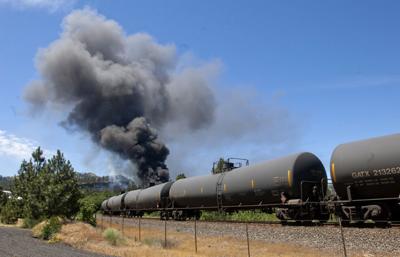
Mike Heiser, a resident of Mosier, had purchased some plants Friday and was just getting ready to put them in the ground around noon when he heard a big crash and the “whoof” of an explosion.
He saw smoke west of town, and heard another “whoof.”
Heiser drove to where the Mosier exit overpass crosses the train tracks and saw that at least eight tanker cars had derailed about 100 yards from the overpass, and one was burning.
They were folding into each other like an accordion, he said, and three tankers were stacked on top of one another, at least one of which was burning.
Throughout the afternoon heavy black smoke and flames were visible from downtown Mosier, and a trailer park and homes in the west part of town were evacuated.
Students from the school were also evacuated to Wahtonka Community School in The Dalles.
Interstate 84 was closed to through traffic in both directions until late Friday night, and motorists were advised to use Washington State Route 14 to get through the gorge.
The Mosier offramp remains closed.
Wasco County Emergency Management has set up a Mosier Train Derailment informational hotline number, 541-506-2792, which will be updated as information becomes available, according to the agency.
Mike Igo, who lives about six miles southeast of Mosier, said he saw heavy black smoke towards town.
“As I got down here the smoke was increasing, fire rigs were out and there was an oil train parked in town,” he said. “The cars were marked ‘1267,’ which means it was crude oil.”
“I walked close enough to see one on fire alongside the tracks, and then I left. Thank God it didn’t happen yesterday, with all the wind, it would have swept right through town,” he added.
The plume of black smoke from the oil fire could be seen as far away as Third Street in The Dalles.
No injuries were reported. Interstate 84 was closed between Hood River and The Dalles, and Highway 30 westbound traffic was restricted in Mosier.
The train was operated by Union Pacific.
A Union Pacific spokesman said several cars out of the 11 that derailed from a train hauling oil in Oregon's Columbia River Gorge caught fire, and apologized for the “inconvenience” caused by the derailment.
Union Pacific said at a news conference Friday evening that the cause of the derailment is under investigation.
Authorities say a mobile home park in Mosier with about 50 homes close to the incident was evacuated and will remain evacuated until further notice.
Authorities said Friday evening that they were moving into what they described as a cooling operation at the blaze and said they would work into the night on suppressing the fire.
It had been extinguished as of Saturday morning.
Union Pacific spokesman Aaron Hunt said earlier Friday that the derailment caused an oil leak. The train was hauling oil from Eastport, Idaho, and was headed for Tacoma, Washington.
It was carrying Bakken crude oil, a type of oil known to be highly volatile.
Union Pacific was sending a hazardous response team to contain the oil.
It wasn't immediately clear how much oil was released.
Maia Bellon, director of Washington State's Department of Ecology, said no oil has been spotted in the Columbia River.
The burning cars are located west of Mosier Creek, in the vicinity of Rock Creek.
Silas Bleakley was working at his restaurant in Mosier when the train derailed, according to an Associated Press report.
"You could feel it through the ground. It was more of a feeling than a noise," he said.
Bleakley said he went outside, saw the smoke, and got in his truck and drove about 2,000 feet to a bridge that crosses the railroad tracks.
There, he saw tanker cars "accordioned" across the tracks.
Another witness, Brian Shurton, was driving in Mosier and watching the train as it passed by the town when he heard a tremendous noise.
"All of a sudden, I heard 'Bang! Bang! Bang!' like dominoes," he told the Associated Press.
He, too, drove to the bridge overpass to look down and saw the cars flipped over before a fire started in one of the cars and he called 911, he said.
"The train wasn't going very fast. It would have been worse if it had been faster," said Shurton, who runs a windsurfing business in Hood River.
Environmentalists reacted quickly to the accident and called it a reminder of why oil should not be transported by rail.
"Moving oil by rail constantly puts our communities and environment at risk," said Jared Margolis, an attorney at the Center for Biological Diversity in Eugene.
Matt Lehner, a spokesman from the Federal Railroad Administration, said a team of investigators had arrived at the scene from Vancouver, Wash.
Union Pacific said 11 cars had derailed, but a spokesman from the Oregon Department of Forestry, which helped extinguish the blaze, said 12 cars had been involved. The discrepancy could not immediately be resolved.
Including Friday's accident, at least 26 oil trains have been involved in major fires or derailments during the past decade in the U.S. and Canada, according to Associated Press analysis of accident records from the two countries.
The worst was a 2013 derailment that killed 47 people in Lac-Megantic, Quebec. Damage from that accident has been estimated at $1.2 billion or higher.
At least 12 of the oil trains that derailed were carrying crude from the Northern Plains' Bakken region — fuel that is known for being highly volatile. Of those, eight resulted in fires.
Since last spring, North Dakota regulators have required companies to treat oil before it's shipped by rail to make it less combustible.
A May 2015 derailment near Heimdal, North Dakota, involved cars carrying oil that had been treated to reduce the volatility, but the crude still ignited.
The treatment was not expected to stop oil train fires.
Department of Transportation rules imposed last year require companies to use stronger tank cars that are better able to withstand derailments.
But tens of thousands of outdated tank cars that are prone to split open during accidents remain in use.
It's expected to take years to retrofit or replace them.
Hunt, the Union Pacific spokesman, did not respond to questions about whether the Bakken oil in Friday's derailment had been treated to reduce volatility. It also wasn't clear if the tank cars involved were retrofitted.
To get to refineries on the East and West coasts and the Gulf of Mexico, oil trains move through more than 400 counties, including major metropolitan areas such as Philadelphia; Seattle; Chicago; Newark, New Jersey; and dozens of other cities, according to railroad disclosures filed with regulators.
Associated Press writers Gillian Flaccus, Steven Dubois, Alina Hartounian and Matthew Brown in contributed to this report.


Commented
Sorry, there are no recent results for popular commented articles.