June brings the summer solstice and the start of summer. This year June will also bring the closest approach of the planet Jupiter, a conjunction of the planets Mercury and Mars, and the first appearance this year of Saturn in the evening sky. Yes, darkness comes late, but nights are warmer and we usually have more clear nights.
A good month to enjoy the night skies!
Jupiter is becoming prominent in the evening sky. It will reach “opposition,” the point at which it is opposite the Sun in our sky, and closest to Earth—on June 10. On that night it will rise at about sunset, and be highest in the sky at about 1 a.m. (midnight if we were not on daylight savings time).
Even though it will be closest at that time, later in the month will be better for viewing Jupiter. The planet will appear just a tiny bit smaller but will rise earlier and be in a good position to view earlier in the evening. By the end of the month, Jupiter will rise at about 7:30 p.m. and be highest at about 11:30 p.m. Jupiter’s four largest moons are visible in a telescope, and even in binoculars, and it can be fun to try and spot them. Their positions near Jupiter change nightly as they orbit the planet. A telescope also reveals the atmospheric bands on the planet and even the elusive red spot. Jupiter will be easy to locate. It’s the brightest object (other than the Moon) in the southern sky.
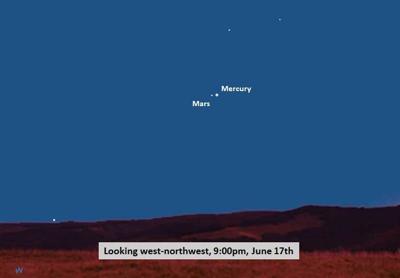
Mid-June is a good time to catch our innermost planet, Mercury, and a conjunction between Mercury and Mars. A conjunction is simply when two celestial bodies appear close together from our viewpoint. You will have to look low in the west right after sunset. Start looking around June 10. Mercury will be in the west-northwest, about 10 degrees above the horizon at sunset. A clenched fist, held at arm’s length, covers about 10 degrees. A pair of binoculars should help locate Mercury, especially right after sunset. Mars will be above and to the left of Mercury and not as bright. If you watch them on subsequent nights, they’ll grow closer together, with closest approach June 17 and 18. Although they appear close together, Mars is actually about 2½ times as far from us as Mercury.
Our Moon will be new on June 3, with full Moon following on June 17. The bright, nearly-full Moon will be near Jupiter June 15 and 16, and near Saturn on June 18.
The ringed-planet Saturn is just starting to appear in the evening sky. Look for it low in the southeastern sky in the second half of the month. Saturn rises around midnight in early June and will rise at about 9:30 p.m. at the end of the month. Better viewing will come in July and August.
On June 23 Saturn will be about as far from the Sun as it gets and will be visible low in the western sky after sunset.
Summer constellations are starting to peek above the eastern horizon on June evenings. Look for the bright star Vega, about half-way up in the eastern sky. Vega is the brightest star in the small constellation Lyra. Just below Vega, find the Northern Cross (Cygnus the Swan) and the summer Milky Way.



Commented