The winds may have taken their sweet time getting to Rufus this weekend for the annual Hood River Huckfest competition, but for both participants and spectators, it was worth the wait.
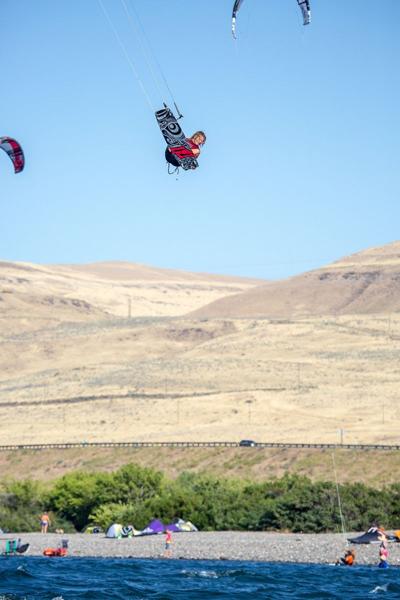
Nearly 60 competitors and numerous spectators headed out to the eastern part of the Gorge on Sunday to watch the third annual running of the big-air kiteboarding competition, which attracts both pros and amateurs who compete against one another to see how high they can launch themselves off the surface of the Columbia River. The event was originally supposed to be held on Saturday, but was pushed back to Sunday morning and then to Sunday afternoon as the winds were either non-existent or non-compliant.
“We were getting pretty nervous about it all,” said event organizer Mike Duhaime, who noted that the event’s three-day permit window ended that evening, “but we had a show-must-go-on attitude.”
Despite the setbacks and a “super-light first heat,” the wind gradually got cooking by late afternoon/early evening, with sustained speeds of around 25 mph and gusts over 30. Moreover, the 58 competitors who turned out were the most in the event’s history and Duhaime said the spectators were the most he’d seen as well — likely attributed to the fact that this year’s Huckfest was the first to be held on a weekend.
The event was started back in 2013 as a way to lend some credence to the “fish stories” kiteboarders might spin from time to time about how much air they’ve gotten off a jump. In the first two years, Huckfest used a telemetry device called Xensr that could accurately record kiteboarders’ leaps and other data, settling once and for all the question: Who jumped higher?
For this year’s event, kiteboarders used a similar device called the “WOO,” which records height, along with hang time, G-force, and other data. Duhaime explained the gadget clips onto the rider’s kiteboard, similar to a GoPro, and the data can be synced with the rider’s iPhone through an app. After a run, the competitor sends the WOO device back to the judges, who download the data, and then post the results to social media.
“It was a very connected event,” Duhaime said.
Huckfest attracts people from all over the world (the winner of the men’s final, Ewan Jaspen, who had an event-high jump of over 45 feet, hails from Australia), but a fair amount from the Gorge entered as well and finished near the top of the heap (top five results are at right). Though the event is growing, Duhaime said that it is still very much a “grassroots, community event,” that has a “low-key, good vibe” quality to it.
As Huckfest is organized in a heat/elimination format, sometimes the biggest jumps of the day don’t happen during the finals. But one of the advantages that came out of having some late-arriving wind was that Huckfest ended with a more of a bang after starting with more of a whimper.
“We peaked right around the finals,” he said. “We didn’t set any records this year, but we were able to have a proper big-air event by the end of the day.”



Commented
Sorry, there are no recent results for popular commented articles.