
I remember when my interest in Russia — back then, it was the Soviet Union — was first piqued.
It’s embarrassing to admit, but in college I saw a postcard my mom got from a friend who’d travelled there, and I was surprised to see blue sky in the picture.
Yes, I was surprised to learn that the sun actually shone in Russia. So dumb of me, but maybe also a testament to how we were taught to view the place.
My senior year of college, I spent almost two weeks in Moscow, Vilnius and Leningrad as part of Friendship Force International, a citizen diplomacy effort.
It was 1985, the 40-year anniversary of the end of World War II. The Soviets had been our allies in defeating Nazi Germany. Commemorative signage was everywhere, as were uniformed soldiers.
Pre-Soviet buildings were intricately beautiful. Soviet-era buildings were mostly shabby and boxy. In Moscow, someone in our group quipped, “You could film Blade Runner in this city.”
Clothes were shabby too, and apparently hard to get. The line at a shoe store in Moscow wrapped around the block. Our Intourist guide said there was a sale going on. I later learned she said that to every foreign group.
Western items were prized and largely unavailable, so the black market thrived. We traded gum, pins, posters, jeans, cigarettes, necklaces, whatever we thought to bring.
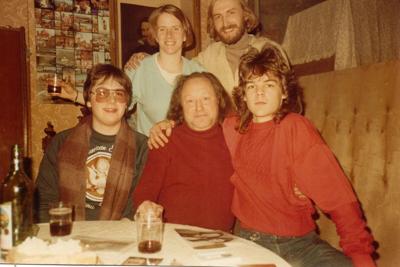
Our goal was to make citizen-to-citizen contact, and in Leningrad, my small clique met Anatoli and Misha. They invited us to Anatoli’s tiny apartment, which he said was actually quite large.
Anatoli was plump and jolly, a balding musician with long hair and chutzpah. He asked for guitar picks and strings; for us to ferry a letter to an American friend; and literally for the sweatshirt off one of our backs. (He got it.) He also asked us to buy a certain book available only in the foreign-currency store (a beriozka).
He said he didn’t follow politics because “we don’t have truth.”
He offhandedly said he was followed by the KGB, the Soviet secret police, and didn’t have the necessary papers to travel within the Soviet Union, much less outside it. He wasn’t loyal, he said, so he wasn’t allowed to travel.
After our evening visit with him, we got spooked when we noticed two cars that parked a short distance from our bus stop, headlights on, and didn’t move as we waited and waited and waited for a bus that should’ve come by, but didn’t. We finally decided to walk the 20 minutes to our hotel instead. When we got too far away to catch it, the bus showed.
On our flight back home, I sat next to a Russian, a grad student at Stanford, who’d been living in America for two and a half years and had married an American. He’d come back to Leningrad for his father’s funeral.
He kept saying that he’d forgotten how to live in the Soviet Union. He said, “We all know our lifestyle is bad, but we know how to ignore it. I’ve forgotten how to ignore it.”
I told him I’d be writing about my trip for my college newspaper, and he said, “I’d better watch what I say.” Then he added, “I mean it. You need to watch what you say there.”
•••
As the destruction of Ukraine at the hands of Vladimir Putin’s Russian army continues, deaths are mounting. Homes, hospitals and entire towns are being turned to rubble, and seemingly each hour brings new horrors.
Of course, it utterly pales in comparison to what Ukraine is going through, but I also can’t help thinking of the Russian populace, also victims of Putin’s insanity, as they rapidly slide back in time to a threadbare, fearful existence under Soviet-style oppression.
It perhaps sounds tone deaf to be thinking of the Russian citizenry right now, but as a Polish national noted in the Columbia Gorge News recently, the enemy isn’t the Russian people themselves, it is the Russian regime.


Commented
Sorry, there are no recent results for popular commented articles.