
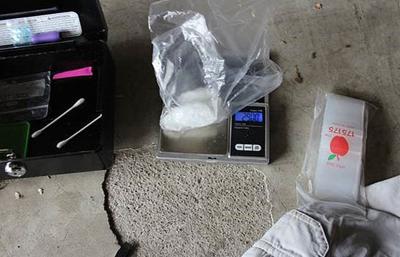
Last year, police in The Dalles started getting calls from other police agencies, asking them, “What’s going on there? Our drug dealers are afraid to go to The Dalles.”
What was going on was a regional drug task force went into high gear, cranking out 30-plus search warrants in 2015, up from around five or six the year before, when staffing was lower.
This year is looking just as busy, said a detective on the Mid-Columbia Interagency Narcotics Task Force, which is staffed by The Dalles Police Department and the Hood River and Wasco County sheriff’s office, and serves Hood River, Wasco and Sherman counties.
“It’s work that I absolutely love,” said the detective, who will go nameless in this article to shield his identity.
His favorite thing is to slap his badge against a car window when catching people mid-drug buy, or mid-shooting up. He scared one woman so bad she bent the needle she was using to draw meth from a spoon into a syringe.
“There’s very little preparation for that kind of thing. You might have to just react and that’s the most fun for me,” he said. “That’s the most dangerous thing — that and breaking someone’s door down at 6 a.m. is also dangerous.”
He enjoys working with other police agencies, and said he even enjoys “working with the drug users, actually. It sounds weird, but I do; they can be irritating at times.”
The MINT detective has a sympathetic view of how a life of drugs can spawn from a bad decision.
“I’m not making excuses for their behavior, but some of these drugs are very addictive and you don’t realize it,” he said.
Others, particularly heroin addicts, started out with a prescription to pain meds and not enough education on how addictive they can be. Once the prescription gets shut off, heroin is the next step on the addiction ladder.
“The heroin use in this area, it’s increased tremendously,” he said. “And it is probably, in my opinion, the single most destructive drug we have on the streets. And part of the reason is the withdrawals from heroin are so awful that sometimes when people are using heroin, they aren’t using to get high anymore, they’re using to avoid those horrible withdrawals.”
Methamphetamine users are the most paranoid, he said. Opposite that are heroin users, who are “a little less alert,” he said diplomatically.
Drug users themselves are a key component of drug work. One gets caught, then turns against his (sometimes her) dealer, and so on, as police seek to bust bigger and bigger dealers.
“Unfortunately, in our work we have to use not the most savory types, but that’s just how the job gets done,” he said. “They’re what make our world go round.”
More confidential informants, as they’re called, flake out than prove successful. They’ve stolen his phones. They’ve even tried to steal the money the police gave them to buy drugs.
But a handful have become clean and stayed clean, he said.
When the MINT detective began working the task force in January 2015, he said, “the drug possession stuff was just blatant and drug sales were just blatant.”
Now, with a busy 15 months of drug enforcement under their belts, the team’s work is getting a little harder. The detective thinks that’s a reflection on the work they’re doing.
The detective works for The Dalles Police Department. TDPD Capt. Steve Baska said the detective was picked for the job based on the number of drug cases he worked as a patrol officer.
And ironically, the detective’s work on MINT has produced fewer drug arrests by patrol officers. “It’s definitely having an effect,” Baska said.
Wasco County Sheriff’s Det. Sgt. Scott Williams, a supervisor of MINT, said his agency is seeing fewer of the crimes associated with drug use, such as thefts and car prowls.
Baska issued a warning to a specific audience: “If you’re a drug dealer, I suggest you leave town, we will find you.”
There’s a chance a drug dealer is indeed reading this. Williams recounted a MINT team arrest of one man who had an article saved on his phone about another drug arrest by MINT.
Methamphetamine is hands down the most common drug pulled off the streets.
The quantities being found are becoming larger and larger, mostly because the drug is getting cheaper. Five years ago, one ounce cost $1,200.
Now it costs $350, he said, noting those are Portland prices. “Around here, its $500.”
As for cocaine, he said, “we haven’t gotten into that a lot. It’s not that it’s not here, we just haven’t gotten there.”
That’s a different clientele, and coke costs more. “We generally don’t have coke users committing property crimes to get their supply.”
“From what I’ve seen and heard, these people have jobs and they can afford to support their own habit,” he said of coke users.
As for marijuana, the detective said he’s never had to fight someone on pot, but he has those on meth or heroin.
“Even when it was illegal, you very rarely come across a violent marijuana user,” he said. “I don’t want to advocate, because I’m certainly not, but I’m just stating the facts.”
“As for marijuana, it’s a whole different set of issues, and we will investigate those crimes, however MINT focuses mostly on meth, pills and heroin,” Williams said.
The MINT team has seen many combinations of participating agencies over the last several decades. Agencies pulled from the team as budgets shrank, and came back as budgets allowed.
The detective thinks one secret to the MINT team’s success is “flat out hard work.”
They punch in at 8 a.m., but work day or night, as needed. Just last week, the team pulled two 14-hour days. “I don’t think anything substitutes hard work.”
Another key is being upfront and fair with the drug users they work with, he said, and also having good lines of communication with the patrol officers who are out on the streets and are a good source of valuable information.
The MINT tipline, at 541-296-1885, is also checked daily and can prove fruitful.
Another key, the detective said, is the team’s ability to work with the involved district attorneys: Eric Nisley in Wasco County, John Sewell in Hood River County and Wade McLeod in Sherman County.
The detective said of Nisley, “I’ve woke him up many times and I’m sure he appreciates it. John Sewell, Wade McLeod, same way.”
Nisley said he regularly is asked to read — on the spot, because time is of the essence — 20- to 30-page affidavits in support of search warrants.
“I really like working with the guys because they’re working really hard and that’s always fun when you’ve got somebody really out there busting their hump. You want to support them,” Nisley said.
He said the detectives are just doing “old fashioned police work, which they used to call shoe leather, which is talking to people, getting out there, gathering information.”
The detective also credited MINT team administrators with giving them the freedom to do things like go into neighboring counties or even Washington to make busts.
“Just because there’s a river that divides us from Washington, that doesn’t mean that’s where it stops,” the detective said of drugs.
The detective feels his work is making a difference.
People will thank officers after they execute search warrants, and they know they’ve helped improve a neighborhood, reducing property thefts and heavy traffic to a drug house.
“The success of the warrant isn’t necessarily predicated on the quantity of drugs that we’re going to find.”
It might not yield newsworthy levels of drugs, but cleaning up a neighborhood is its own reward.
“Sometimes,” he said, “some of our best work isn’t even known to the general public.”


Commented