Considering the fact that each ambulance costs upwards of $389,000, it’s beneficial to ensure that taxpayers get the most out of every vehicle from the day it is purchased to the day it no longer runs. While there aren’t any vehicles that last forever, prolonging the life of an ambulance is key to getting the most for this large expense. The “useful life” of an ambulance is typically between 200,000-250,000 miles, which equates to six to 10 years in time. Routine maintenance becomes very important when you are talking about extending the life of this important purchase.
Your Klickitat County ambulance service has three primary ambulances, one on-call ambulance and two back-up ambulances for a total of six. Two new ambulances have been ordered, to be delivered near the end of this year. When one ambulance comes close to the end of its useful life as a primary resource with KCEMS1, the replacement process starts. We then use it as a secondary or back-up ambulance.
The next step of this process is passing on the older ambulance with higher mileage to any of the 15 fire departments in our EMS district. This is one way your tax dollars are utilized for as long as possible. The fire department recipients then help with emergency response and provide a volunteer service helping their community with additional emergency medical support. Each of the departments that receive an ambulance have EMTs that are certified to provide BLS (Basic Life Support) services. Sometimes that is providing medical support care prior to KCEMS1 arriving, or in critical situations transporting the patient to meet the KCEMS1 ambulance where they will then receive more advanced care.
So, let’s break down the different costs involved in purchasing a new ambulance. Our service area necessitates the use of four-wheel-drive ambulances. The base cost of one of these ambulances is $260,000, just for the chassis and the box mounted onto the back. The box is outfitted with a small refrigerator for temperature sensitive medications; a small heating pad to keep IV fluids and blankets warm; a locking compartment for narcotics; built in suction; and special compartments to house ventilators, oxygen tanks, trauma and medical supplies, rescue kits and other tools. In addition to all of this, we then have to add radios and communications equipment at a cost of approximately $10,000. A patient gurney for $30,000 must be added, and a power load system for that gurney for $25,000. Other large item expenses are the patient monitor, capable of multiple life-saving functions (currently a LifePak 15) at a cost of $30,000, and a transport ventilator at approximately $14,000. Other items that are on our ambulances — such as a stair chair, portable suction unit, hard case medical kit, backpack trauma kit, back boards, scoop stretcher, traction devices, extrication devices and other medical and trauma supplies and tools — have an approximate cost of $ 20,000. With all of these additional costs, it comes to an approximate cost of $389,000 to place a new ambulance in service.
As you can see, providing emergency services to our communities is costly.
Safety Tip of the Month: How to yield to an emergency vehicle safely. When an ambulance or other emergency vehicle comes upon you while driving, most people will slow down and pull to the right, but most forget to stop to allow the emergency vehicle to pass safely. The rule according to the Washington State driver’s manual specifically says, “You must yield the right-of-way to a police vehicle, fire engine, ambulance, or other emergency vehicle using a siren, air horn, or a red or blue flashing light. Pull over to the right edge of the road, or as near to the right as possible, and stop when you see or hear an emergency vehicle approaching from any direction. If you are in an intersection, drive through the intersection before you pull over. If the light is red, stay where you are. Follow any instructions given over the emergency vehicle’s loudspeaker.” Oregon State laws are very similarly worded.
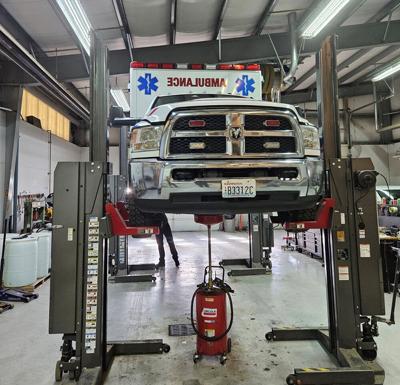
KCEMS1 Fun Fact of the Month: When our ambulances are needing routine and sometimes emergency maintenance, we utilize the Transportation Department of the White Salmon Valley School District, thus keeping our tax dollars in our own county. Additionally, two of the Transportation Department employees are or have been EMT’s in our county.
KCEMS1 Statistic of the Month: In the month of May, KCEMS1 ambulances were driven a total of 9,830 total miles.
•••
Katharina Larson is a paramedic and Suzanne Gilmer an EMT-IV technician with Klickitat County EMS District No. 1. Additionally, both are members of the IAFF Local 5172, Professional EMS Providers of Klickitat County.



Commented