
So far as I can learn, nobody knows for sure why birds sing in big choruses at dawn.
Maybe they’re using those still, quiet morning hours when sound carries better in the moist air. Maybe — and we have actual evidence for this one — it’s not safe to forage when it’s too dark to see, so you might as well sing. Maybe birds who get up earliest and sing loud and long from good territories attract great partners. Maybe males wake early to greet females of the many night-migrating species, arriving at dawn.
Note that word “maybe.” Researchers have great theories, but I don’t think anyone knows for certain sure. Researcher Karl Berg recorded 57 species in Ecuador, and found that each started singing at a different time, relative to dawn. Their timing correlated with the size of their eyes, and their typical foraging height in the canopy, suggesting light levels were important. The idea is, birds wake up, sing like mad things until it’s light enough to safely forage, and then stop because they’re busy courting, nesting and stuffing themselves with bugs.
Not all birds wait for morning. Some, like Yellow-breasted Chats, who share riparian streambanks with owls in the white oak forests I explore, sing at night.
The chorus builds through early spring, peaking in late May and early June when most birds are courting and defending territories and nest sites.
Soon after 4 a.m. in June, when stars still show and colors are barely visible, Violet-green Swallows start singing crazily from the dark upper air. Most swallows go silent a little before sunrise, when American Robins join in from high perches.
Singing peaks as the sun rises, with grosbeaks, warblers, tanagers, flycatchers and more countersinging from every grove. Some species, like vireos, won’t start to sing until the sun’s well up. (Except on days with fog, steady drizzle, and rain; birds hate that kind of thing and tend to disappear of the face of the earth at such times.)
The concert trails off to silence as the sun rises halfway up the sky — in my oak forests, by 10 or 11 a.m.
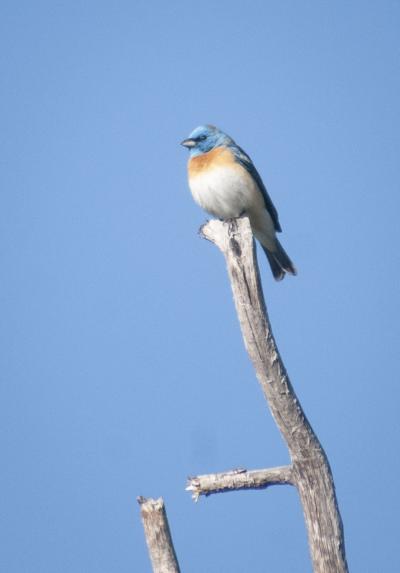
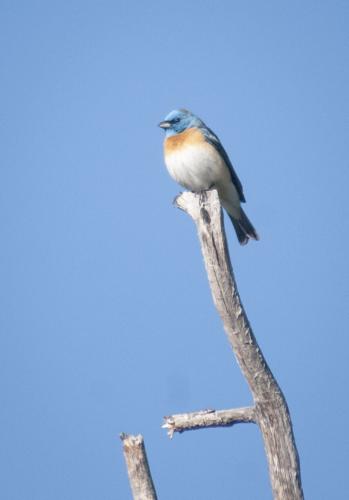
A few species will keep singing late into the day. In the oak forests near The Dalles that I know best, this includes Lazuli Buntings, Black-throated Gray Warblers and Western Wood-pewees.
Most of the dawn singers’ tunes are not inborn. They practice and learn their songs from other members of their species.
Many species, like the Western Wood-pewee, sing a special, more complicated song at dawn, one very rarely heard later in the day. Chipping sparrows, for instance, gather on the ground at dawn to sing frantic, short, fast songs. Then they climb to higher perches and exhale long, leisurely trills in later morning hours.
Dusk choruses also happen, with birds like robins and Hermit Thrushes singing just before they roost.
Birds aren’t the only ones chorusing at dawn and dusk. So do some mammals, and fish. Researchers off the coast of Australia recorded fishes dawn chorus, a concert of groans, burbles and space-age sound effects. You can listen to one here: www.bbc.co.uk/sounds/play/p048nzcl.
Maybe a researcher somewhere, whose work I haven’t heard of yet, has a theory that explains the dawn chorus. Personally, I enjoy the fact that, after so many decades of eager Western scientists with tape recorders, the avian chorus that fills the forests before most of us awake can still be so mysterious.
To hear some chorus without getting up at 3 a.m., or in winter, head to www.macaulaylibrary.org. Set the search filters to “environmental” to find recordings from the dawn chorus, or “dawn song” to hear the special songs only sung before sunrise. Another citizen-science project, dawn-chorus.org, is dedicated to monitoring bird diversity over time through the dawn chorus recordings people contribute.


Commented
Sorry, there are no recent results for popular commented articles.