BINGEN — The Bingen City Council’s regular meeting on June 16 opened with a presentation on the new Oregon/Washington bridge.
Michael Shannon, project director for the Hood River-White Salmon Bridge Authority, which is overseeing the project, was joined by engineer Gabby Preciado for the update. The bridge is now 60% designed, and its design is fully funded.
The new bridge will be built 150 feet downstream of the old bridge, which will remain open during construction. It will feature two 12-foot vehicle lanes, 4-foot shoulders in order to prevent stopping, a 5-foot directional bicycle lane, and an 8-foot pedestrian sidewalk along the west side. After feedback from the aesthetics committee, the new bridge will provide dark sky-compliant lighting, two overlooks, and a safety barrier between the bike and vehicle lane. The plan is for in-water construction to begin in October 2027, after the design is complete. The group hopes the new bridge will open to traffic in May 2031, after which the old bridge will be removed.
On the Oregon side, the bridge ties into the same intersection as the old bridge, with no toll booth and pedestrian plazas on either side. On the Washington side, however, the bridge ends in a roundabout, with an adjacent entry plaza and a park-and-ride space.
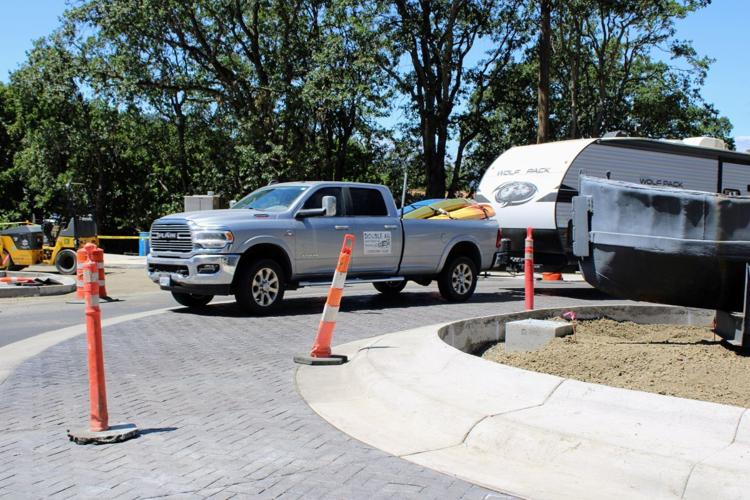
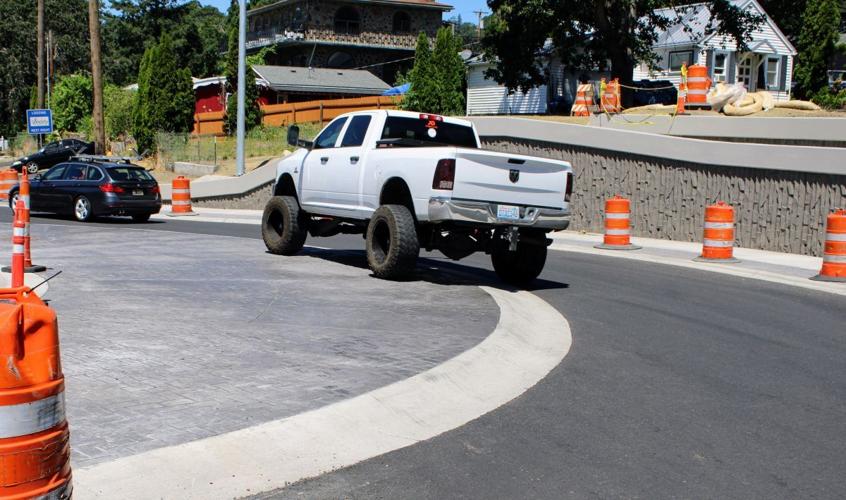
A pickup drives on the roundabout apron due to the small size of the roadway.
Nan Noteboom photo
Feedback from the council and City Administrator Krista Loney mentioned the city’s experience with its new roundabout at the Highway 14 railroad crossing. A small roundabout makes it difficult for larger vehicles to navigate through the curves accurately, and as a result, some drivers simply drive over the apron, or middle section of the roundabout, destroying its concrete. The Hood River-White Salmon Bridge Authority invites comment and feedback on the bridge’s design plans.
The city continues to move forward with its plans to develop a Quiet Zone and eliminate the extremely loud train whistles that occur frequently in Bingen. Thanks to Washington State grant funds, they were able to award the Quiet Zone project to local engineering company Gray & Osborne. The scope of work for the project will be presented at the July 7 meeting.
The next move is to enter into an agreement with railroad company BNSF (Burlington Northern Santa Fe) Railroad to complete the work. A Quiet Zone is developed by replacing train whistles with supplemental safety measures. This typically involves the use of quadrant gates and a channelization median that prevent all vehicle traffic from attempting to cross. Each quad gates costs around $1 million to install, and the city currently has $1.4 million set aside for this project in the Connecting Washington infrastructure fund. The focus will be the two crossings at Walnut and Maple streets.
The next Bingen City Council meeting is set for Tuesday, July 7 at 6 p.m. Details on the Quiet Zone project will be on the agenda.



Commented