On April 28, Alexa Whipple, director of the Methow Beaver Project and helping beavers help us, presented “Watershed and Climate Resilience: The Many Benefits of Living with Beavers” as part of the Wild About Nature series, held the month of April and the first week in May at the White Salmon Grange.
Whipple gave us a rundown on the history of beavers and the challenges they face. They were hunted extensively, and nearly extirpated by the 1850s. Their fur made luxurious top hats.
When we think we know better than mother nature, sometimes things don’t end well. Draining wetlands is one example. We learned that wetlands protect and improve water quality, provide fish and wildlife habitats, store floodwaters and maintain surface water flow during dry periods. Many species of birds and mammals rely on wetlands for food, water and shelter, especially during migration and breeding. Wetlands are productive ecosystems, comparable to rain forests and coral reefs. Wetlands are important in fighting wildfires.
We have volunteers that would love to help us restore wetlands, taking it as their mission in life. They build dams, work hard, and are skilled engineers. The wetlands they create capture more pollutants than those made by human engineers. Humans are building beaver analog dams to restore wetlands, but beavers do it faster and better. All they ask in return is some cottonwood or aspen trees and water pools deep enough to escape their predators. Beavers are eager get to work.
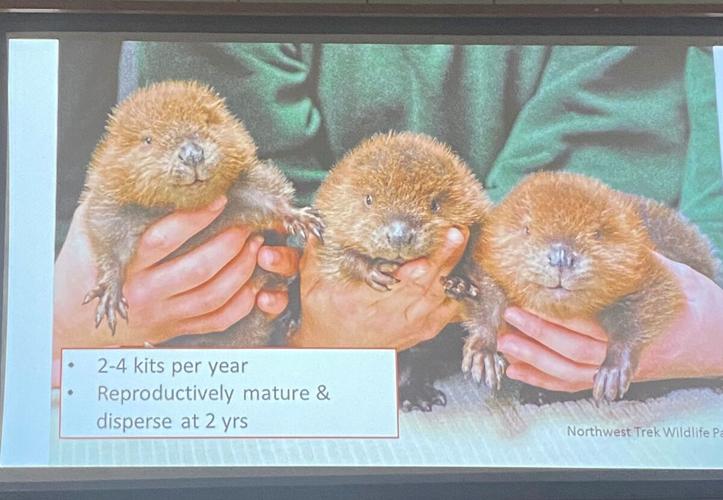
Beavers can have two to four kits per year. The room was full of “Ahs,” and “So cute,” as slides of baby beavers appeared. Beavers are doting parents and their young live with them for at least two years. Like humans, they can have boomerang kids, where the young come back for refuge for a while before trying to make it on their own again.
Beavers are strict and choosy herbivores, eating the cambium layer of deciduous trees such as willows or aspen. They have self-sharpening orange front teeth for tree felling. While they do not eat fish, their dam building does provide habitat that helps juvenile salmon.
Sometimes landowners work with the Methow Beaver Project to reintroduce beavers. Other times coexisting with a native species who wants to re-do your landscaping can be challenging, and Whipple and her crew also help with that. They advise on how to protect a favorite tree, resolve culvert blocking challenges, or as a last resort they can live-trap and relocate beavers.
The population is still trying to recover. It isn’t easy to bring beavers back due to degraded habitat, predation risk, unlimited lethal removal due to conflict, and a 5-month harvest season with unlimited recreational and commercial trapping. These loose rules seem a bit short sighted considering all the benefits this keystone species brings to the environment.
If you have trouble with or want to help beavers, you can contact alexa.mbp@methowsalmon.org for a referral to local organization.
•••
Beavers and amphibians were the topic of the April 28 Wild About Nature lecture at the White Salmon Grange. The series has concluded for the season.
Photo courtesy Joan Chantler
Beaver ponds benefit amphibians, noted Charlotte Corkran, a naturalist form the Northwest Ecological Research Institute, in her presentation “Amphibians of the Columbia Gorge” later that evening.
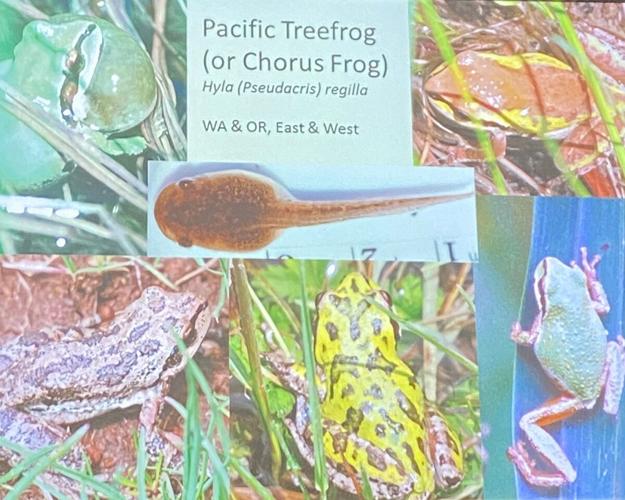
What is an amphibian? “No fur, no feathers, no scales,” was Corkran’s short answer. She clarified that a newt is a type of salamander, and a toad is a type of frog. Species in our area can be divided into four quadrants, with the Columbia River forming a barrier to species dispersal. Imagine a tiny salamander or tree frog trying to swim the mighty Columbia and you can quickly see why. The Cascade Mountains form another division, with the physical barrier and the difference in rainfall. The Coastal Pacific Giant Salamander is an exception to the quadrants. An odd, quirky population is found near the Deschutes River. How they got there is a puzzle.
With soft bodies, scaleless and without shells, amphibians rely on camouflage to hide or poisons to defend themselves. The rough-skinned newt is deadly poisonous if eaten. Like Monarch butterflies, and many other creatures, they signal their poisonous status with the color orange. They flash their orange bellies to say, “I am poisonous, don’t eat me.”
The word “amphibians” itself suggests a dual existence — (amphi, both kinds; bios, life). They breathe through their skin while in water and must have water or moist places to reproduce. Most females lays eggs in ponds or streams and males float their sperm over them. They typically spend part of their lives in the water and some on land. However, some species can have members of the same generation who spend all their lives in water, while other siblings move onto land after their watery beginnings.
“Hedging their bets. If it is a very dry year and the pond dries up the land lovers will survive. If there is a wildfire, the pond dwellers may live through it,” explained Corkran.
Like lizards, some salamanders can break off their tails to escape if threatened. However, they store fat in their tails and they have to find a lot more food to make up for the loss.
“The Clouded Salamander can climb trees and jump, which can be quite startling,” said Corkran. They can be found up high in redwood trees. She found a Long-toed Salamander frozen rock solid in Alberta Canada, which later thawed out and walked around.
Sadly, despite their 360 million year history of success, amphibian’s are now in trouble. A warming world is a drier one. We can help by leaving in place leaves, logs, or any habitat that will retain moisture. Refraining from dumping products into storm drains would help, and “the less chemicals, the better,” she said. Despite the current situation, Cockran’s presentation was informative and surprisingly humorous. She could do stand-up comedy.
•••
The Wild About Nature series is held the month of April and the first week in May every Friday night at the White Salmon Grange, and is now over for the season. More recaps from this series will appear in upcoming editions of Columbia Gorge News.



Commented