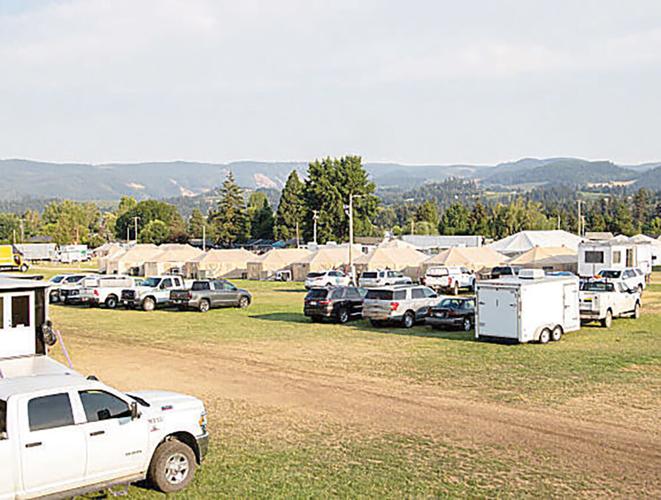
The Hood River County Fairgrounds served as headquarters for the Microwave Tower and Whisky Creek fires in the Columbia River Gorge. Hundreds of firefighters and personnel will come and go during the duration of fire season.
The Hood River County Fairgrounds served as headquarters for the Microwave Tower and Whisky Creek fires in the Columbia River Gorge. Hundreds of firefighters and personnel will come and go during the duration of fire season.
CASCADE LOCKS — The Whisky Creek Fire, which ignited July 20 and charred 3,239 acres in the Mark O. Hatfield Wilderness near Cascade Locks, is no longer burning. Officially contained Nov. 2, all closures have been lifted and this year’s wildfire season is finally over.
The impacts in Oregon, however, have been particularly devastating. More than 1.9 million acres burned this summer and fall, a new state record that’s triple the 10-year average, according to Oregon’s Department of Forestry. Exacerbated by climate change and a scorching July, the Northwest Interagency Coordination Center estimates that humans caused about 60% of fires in Oregon this season, including Whisky Creek.
“Not only are we seeing damage to a resource — a beautiful natural area — we’re also seeing the brave firefighters who have to be exposed just because someone wasn’t acting responsibly in the woods,” said Omar Flores, engine captain and type 3 incident commander for the Columbia River Gorge National Scenic Area.
After receiving a smoke report and hiking six miles through rough terrain, Flores was among the first on scene. They assessed the situation, cleared nearby hiking trails and then established a type 3 incident management team (IMT) with staff from Mt. Hood and Gifford Pinchot national forests, along with the Scenic Area. A few days passed; then they ordered a complex IMT.
Depending on the size and expected duration of an emergency situation, as Flores explained, different IMTs respond, ranging from least advanced (type 5) to most advanced (complex). In total, two complex, three type 3 and one type 4 team managed Whisky Creek at various stages of the fire, and its remoteness was an important factor in planning.
“We had to really take into account not just how far it might be, at the time anyways, from values at risk such as houses and communities, but also putting firefighters onto a landscape that was so far and deep out,” said Flores. As such, they needed a foolproof strategy to evacuate firefighters should they get hurt or injured.
Responders had at least one thing working in their favor, though: The Eagle Creek Fire scar left from 2017. Flores said that wildfires could move through previously burned areas, but whenever the Whisky Creek Fire approached, it fell and stopped spreading — a natural boundary along the northern and western edges.
The scar allowed firefighters to focus on the southern and eastern flanks, where they employed both direct and indirect tactics. Direct tactics include clearing land immediately adjacent to a fire while indirect tactics, for instance, could involve using an advantageous ridge to deliberately light a backfire, wiping out a broader swath of fuels in a wildfire’s projected path, or laying down preemptive sprinkler lines.
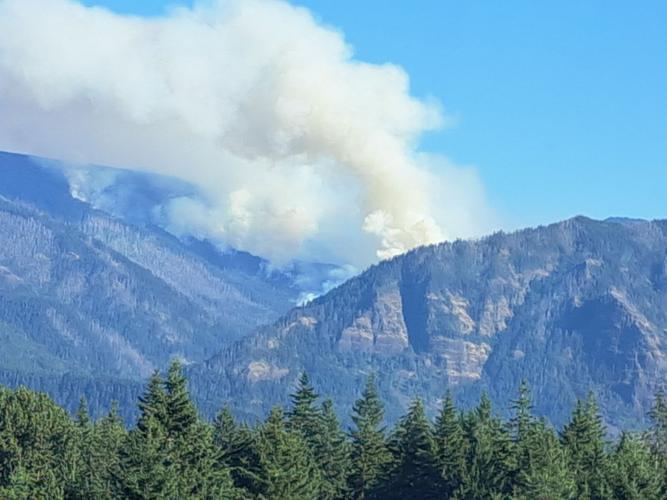
The Whisky Creek fire as it appeared in the afternoon of July 23. The fire began July 20.
Operations Chief Brian Burns
With an investigation ongoing, who started the Whisky Creek Fire is still unknown. But Flores did report the fire burned in a mosaic pattern, so ecologically speaking, the effects were fairly positive.
“In some areas, you saw higher severity with pockets of mortality, so a lot of trees died,” said Flores. “Throughout most of the fire, it was a more low-intensity fire that worked more like an under burn, kind of cleaning up the forest floor.”
Even though all trails are now open, Flores wouldn’t recommend hiking in the area, especially with other options nearby. Wildfires tend to decrease soil stability, made worse by increased precipitation during the colder months, and there’s always a risk of burned trees, called snags, falling. Regardless, he encouraged folks to be conscientious while exploring.
“It’s paramount to anybody who goes out there and enjoys beautiful spaces to make sure they’re being responsible about what they do,” said Flores. “Care for it like you would your own backyard, because it’s our public land.”




Commented