Welcome to June, the month of the summer solstice. On June 21, our Sun will be at its highest point in our sky, about 67 degrees above the southern horizon. If you were on the Tropic of Cancer, the Sun would be pretty much directly overhead. We will be at about our maximum day length, with the Sun rising at about 5:15 a.m., and setting at about 9 p.m. That gives us about 15 hours and 45 minutes of daylight. Viewing the night skies requires you to stay up a bit late (or get up early), and there are less than three hours of total darkness, outside of twilight hours.
We will have the first of three consecutive “supermoons” in June, where our Moon is closer than average to Earth. The Moon will be about 222,349 miles from Earth, close to the minimum distance of about 225,000 miles. On average, the Moon is about 238,900 miles. The full Moon will appear a bit larger and brighter than usual.
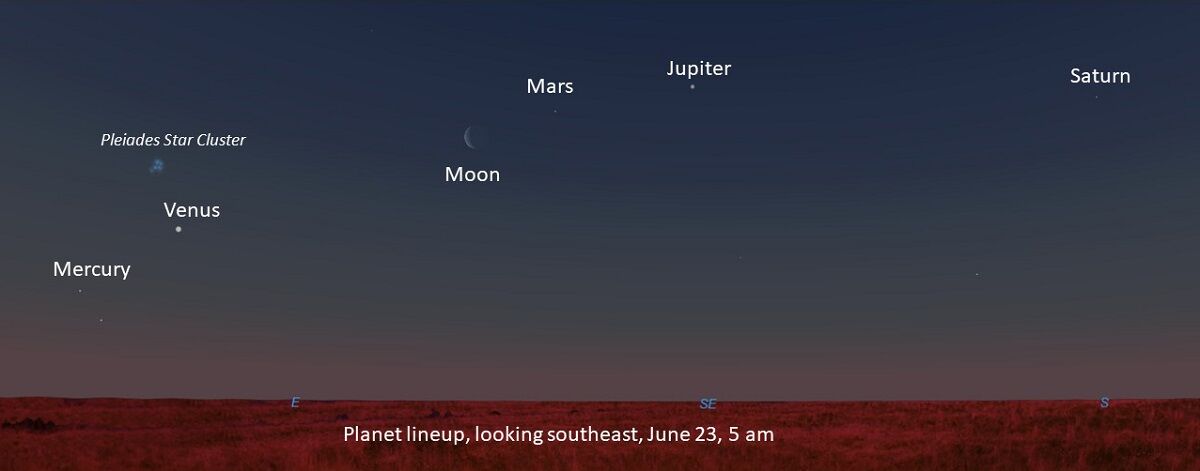
If you are an early riser, June presents the opportunity to see all of the naked-eye visible planets in the early morning hours. Mid and late June works the best, as Mercury will be higher in the sky before the Sun rises. The Moon joins the party in late June. Check out the southeastern sky on June 23 to see the crescent Moon in line with Mercury, Venus, Mars, Jupiter and Saturn. The bright planets will still be absent from the evening sky, so viewing them will be for early risers.
June begins with a thin crescent Moon low in the west after sunset, below the twin stars of Gemini, Castor and Pollux. On the 2nd, the Moon will be just to the left of these two stars. On the 5th, the Moon will lie in the constellation Leo the Lion. The almost full Moon will lie near the bright star Antares on the 12th. The Moon will move along the mentioned line of planets, below Jupiter on the 21st, to the right of Mars on the 22nd, and to the left of Venus on the 26th.
The spring constellations Leo and Virgo are sinking into the west in June, as we move in our orbit around the Sun. In the eastern evening sky, Cygnus the Swan is rising, along with the summer Milky Way. A couple of bright stars can serve as “beacons” to help you navigate the eastern and southern sky in June. Vega, the 5th brightest star on our sky, will be in the east. Arcturus, slightly brighter, will be in the south. Vega is the brightest star in the little constellation Lyra, and Arcturus lies at the base of the dim constellation Bootes. Between Vega and Arcturus lies the constellation Hercules, and the little half-circle of the constellation Corona Borealis.
Looking north, you may notice the “W” shape of Cassiopeia, below the north star Polaris, and its constellation Ursa Minor. To the left of Polaris, when facing north, you’ll find the familiar Big Dipper in the constellation Ursa Major. These constellations are “circumpolar” at our latitude, meaning they never set.
Are you interested in the night sky, and maybe familiar with the Goldendale Observatory? Or maybe you enjoy the explosion of wildflowers on the Columbia Hills State Park? A new group, supporting the observatory and other Washington State Parks in the area (Columbia Hills, Maryhill, Brooks Memorial) may be of interest to you. Check it out at the Friends of Gorge Area Parks webpage at www.4gorgeparks.org/




Commented