August already, our last full month of summer, how did that happen so fast?
If you are ready to view some night skies, August is a great month. Weather is usually clear, and dark skies are starting to come earlier. Plus, we greet Jupiter and Saturn as they move into the evening sky.
The beautiful ringed planet Saturn will make its closest approach to us this year on Aug. 14. At that time the Earth will be right “between” the Sun and Saturn. Saturn will rise at sunset, and set at sunrise. After the 14th, Saturn will pull away from us, but not by much in the next month or so. And it will rise earlier each night, and be higher in the sky during evening hours. A great time to view the rings if you have not seen them.
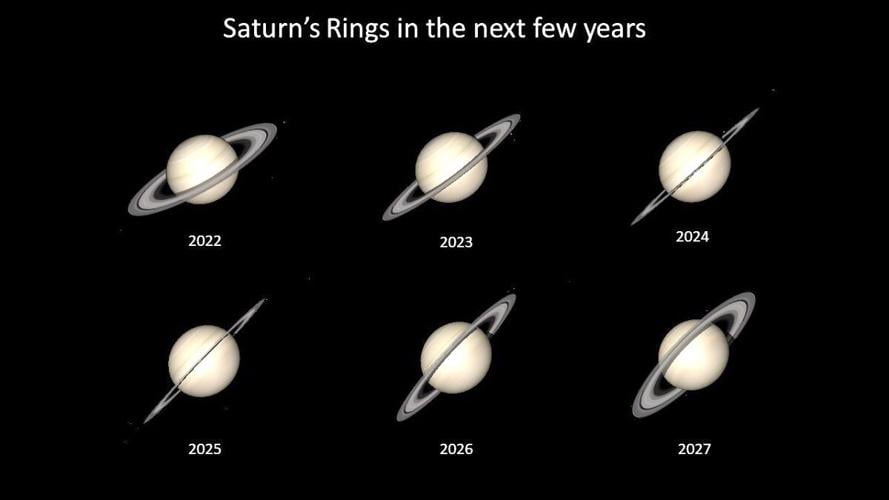
This will be a good year to view Saturn’s rings, as they won’t be as prominent in the next few years. As Saturn makes its 29-year orbit around the Sun, our view of the rings changes from year to year. Currently the rings are “tilted,” from our perspective, so that we can see them well. In a couple of years, the plane of the rings will be in our line of sight, and we’ll only see a thin line (the rings are not very thick). Check out the picture with this column to get the idea.
Giant Jupiter is beginning to make its presence in August’s evening sky as well. At the start of the month Jupiter will rise at about 11 p.m. On the 14th, when Saturn is at opposition, Jupiter will be easy to find, located just to the left of the waxing gibbous Moon. Jupiter will make its closest approach to us in September.
The Perseid meteor shower will peak on Aug. 11-12. Unfortunately, we’ll have a very bright Moon this year, which will “wash out” many of the meteors.
August’s full Moon will occur on the 11th, right before the peak of the Perseid Meteor shower. New Moon will be on Aug. 27. On the 3rd, you’ll find the Moon just above the bright star Spica, in the constellation Virgo. On the 6th, the waxing gibbous Moon will be low in the south, in the constellation Scorpius, and will be in Sagittarius on the 7th and 8th. On the 15th, you’ll find the Moon just below Jupiter in the late evening or early morning sky. The morning of the 19th should present a very neat view, with the third-quarter Moon just above Mars, and just below the star cluster Pleiades. On the morning of the 23rd, the thin, waning crescent will be just to the right of the Gemini twins, Castor and Pollux.
August is a great time to view the Milky Way, especially when the Moon is out of the evening sky, later in the month. If you have a good view of the southern sky, you’ll notice that the Milky Way is much brighter in that area. You are looking toward the center of our galaxy, and thus seeing the cumulative light from many more stars. Notice the “darker” areas within the bright milky way, dust lanes where interstellar dust blocks our view. You can follow the arc of the Milky Way up through Aquila and Cygnus, Cassiopeia, and finally Perseus in the north.
Find a nice, dark site on a clear evening, and enjoy the view!




Commented
Sorry, there are no recent results for popular commented articles.