
Welcome to April, our first full month of spring. The month features shorter but warmer nights and generally a few more clear nights as we approach summer. And this year we have the chance to spot a comet, and view a total solar eclipse.
The big event of April is that solar eclipse on Monday, April 8. Unless you have been living under a rock, you’ve certainly heard about it. The path of the total eclipse — the narrow corridor where you can experience totality — stretches from Mexico northeast across Texas and a number of other states, into Ontario, Quebec and New Brunswick in Canada. Many people will be traveling to see the eclipse, especially to the south (Mexico or Texas) where the chance of clear skies is greater. In our area, only about 25% of the sun will be blocked by the moon. For us, the eclipse starts at about 10:30 a.m., reaches its peak at about 11:15 a.m., and ends at about 12:30 p.m.
To view the eclipse safely, you will need to have eclipse glasses, which block most of the light of the sun. Under no circumstances should you attempt to look at the sun directly. You can also view the eclipse online at the NASA website, plus.nasa.gov/scheduled-video/2024-total-solar-eclipse-through-the-eyes-of-nasa/?linkId=351284624.
You can also make a simple pinhole camera, allowing you to view a projected image of the Sun. The NASA Jet Propulsion Laboratory has some good instructions.
Now about that comet. If you read my column in March, you know that it will be visible at the end of that month. It will also be visible in early April. It will be very low in the west, right after sunset, during the first half of the month. Although it may be “naked eye” visible, you’ll likely need binoculars. Sunset in early April is at about 7:40 p.m., so check around 8:30. You’ll need a good view of the low western horizon to see it. Look for Jupiter, the brightest object low in the west, and go from there to the right and a bit lower. Use the map with this column to help.
The bright planets are again not in good viewing position during evenings this month. As already mentioned, Jupiter is visible, but very low in the west. Mercury is below Jupiter, in the first few days of April, but barely visible, and quickly drops below the horizon. Venus, Mars and Saturn are all visible in the morning, just before sunrise. On April 10, Saturn and Mars come very close together, very low in the east.
April’s new moon comes — you guessed it — on April 8 with the solar eclipse. Full moon follows on the 23rd of the month. On the 10th, the moon will lie between Jupiter and the bright star cluster Pleiades. On the 14th, the Moon will be just below the Gemini twins, Castor and Pollux, a great time to identify the stars and their parent constellation.
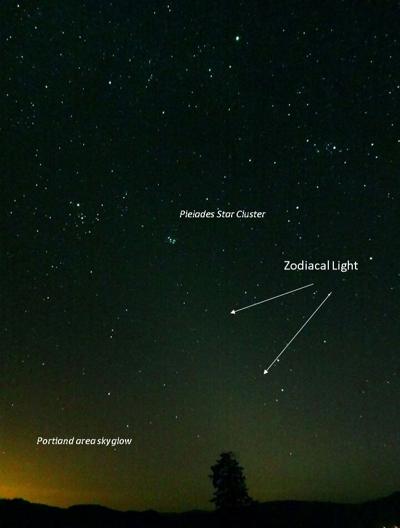
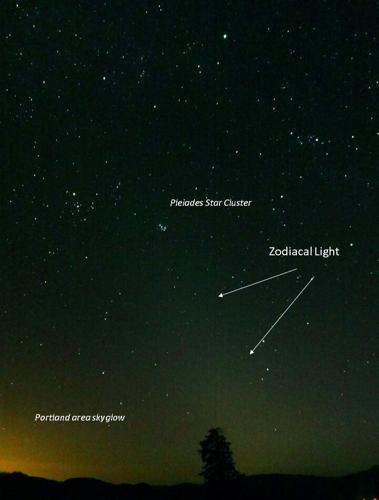
One of my favorite things to view in spring is the Zodiacal Light, a faint band of light in the western sky, visible after skies get quite dark. Interstellar dust is a bit more concentrated along the path of Earth’s orbit, and that path stands up almost vertical against our horizon in the spring. After sunset, the dust particles reflect sunlight, hence we see the band. There is dust outside of the path as well, but we see it as more concentrated and brighter along the orbital path. You need clear, dark skies to see it. Look in the western sky, below the star cluster Pleiades, in the area where Jupiter is located now. In the southwest, you will also see the skyglow of Portland and Vancouver. The Zodiacal light will be fainter, and located to the right of the skyglow. Look in early April; after about April 12, the brightening moon will “wash out” the faint glow of the Zodiacal light. It is a phenomenon that most people have never seen. Give it a try.


Commented