
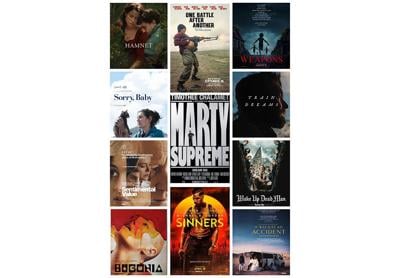

I’ve had enough of 2025. Relentless political and cultural division, the frightening, meteoric rise of A.I. and climate inaction have cast a dark shadow over the future, exacerbating an omnipresent sense of dread and anxiety deeply felt amongst young adults. As a fresh college graduate — a Gen-Z newbie entering the workforce — I can’t help but worry about what’s next. I can’t help but fear where this doomful trajectory might lead us.
But at the cinema, my uneasiness instantly evolves into a momentary hope — a feeling of warmth and gratitude towards 2025, which has etched itself as one of the decade’s best in film. As we barrel closer towards an increasingly uncurious, creatively bankrupt collective — no thanks to the short-form content machine and generative A.I. — I take solace in the fact that resonant, forward-thinking works still have a seat at the table.
Before I dive into my ten favorite films of the year, I’d be remiss to ignore a couple I have yet to view, specifically those I feel have a strong shot at entering the list down the road.
Yet to see
“No Other Choice” directed by Park Chan-Wook (South Korea), “The Secret Agent” directed by Kleber Mendonça Filho (Brazil), “It Was Just an Accident” directed by Jafar Panahi (Iran), “Avatar: Fire and Ash” directed by James Cameron (USA), “If I Had Legs, I’d Kick You” directed by Mary Bronstein (USA).
Honorable mentions
“Frankenstein” directed by Guillermo Del Toro (USA), “Eddington” directed by Ari Aster (USA), “The Phoenician Scheme” directed by Wes Anderson (USA), “Superman” directed by James Gunn (USA), “Mickey 17” directed by Bong Joon-Ho (USA)
10. “Wake Up Dead Man”
It’s a winning recipe. The third installment in Rian Johnson’s whodunnit franchise, “Wake Up Dead Man: A Knives Out Mystery,” is another wildly entertaining entry in the series, assembling a colorful crop of A-listers aside theatrical detective Benoit Blanc (Daniel Craig) to tackle murder and social politics. Josh O’Connor plays Father Jud Duplenticy, a young priest sent to a rural church to assist a fiery Monsignor (Jeff Bridges) and his cultish following, delivering a series-best lead performance. It’s twisted, it’s topical — it’s everything you want out of a “Knives Out” flick, and perhaps the most visually rewarding turn thus far.
9. “Train Dreams”
It’s fleeting — life, love, modernity — all of it. Clint Bentley’s “Train Dreams” is a haunting reminder of the passage of time, how the world turns, and technology advances faster than any of us can grasp. Joel Edgerton plays a Pacific Northwest logger with quiet grace, experiencing a life’s worth of yearning and devastation in the blink of an eye, searching for meaning while society silently passes him by. Cinematographer Adolpho Veloso handsomely captures the calm beauty of nature in one of the year’s most consistently gorgeous films. “Train Dreams” is like sipping a cup of coffee on a brisk, foggy morning, relishing in a brief stillness before another tiresome day.
8. “Weapons”
It’s bloodcurdling. Zach Cregger terrified audiences last summer with his sophomore feature “Weapons,” which traces the horrific aftermath of a small town’s reckoning with impossible tragedy: Ms. Gandy’s (Julia Garner) classroom, save for one curious boy, has inexplicably vanished. After enveloping you in its bewitching premise, the film takes off into a hair-raising, non-linear caper, toggling between each character’s point of view, divvying out information before culminating in an outrageous and rewarding grand finale.
7. “Bugonia”
It’s peculiar. If you love Yorgos Lanthimos, the mastermind behind idiosyncratic and darkly comedic films like “Poor Things” or “The Favourite,” you’ll dig his latest oddity, “Bugonia.” Convinced she’s an alien hellbent on destroying planet Earth, two conspiracy-obsessed cousins (Jesse Plemons, Aidan Delbis) kidnap a high-powered, pharmaceutical CEO (Emma Stone) and imprison her in their basement. Lanthimos takes on class division, modern inceldom, and corporate America in a thunderous, unpredictable fight-to-the-finish, where Plemons and Stone verbally spar their way to potential Oscar nominations.
6. “Sentimental Value”
It’s melancholic. Norwegian auteur Joachim Trier’s “Sentimental Value” is a somber attention to intergenerational pain and childhood trauma, how we absorb the actions — and inactions — of our parents, which trickle into adulthood as we silently yearn for healing and reconciliation. The film follows sisters Nora (Renate Reinsve) and Agnes (Inga Ibsdotter), who reunite with their estranged father and ageing filmmaker Gustav (Stellan Skarsgard). Trier’s direction is subtle, precise and delicate, piercing deep into the untapped, unmended scars within. The beauty and heartache haven’t left my soul since the credits started rolling.
5. “Sorry, Baby”
It’s vulnerable. Eva Victor’s “Sorry, Baby” is a quaint and honest account of a woman grappling with a traumatic incident, labeled the “bad thing,” which flipped her world upside down a few years back. Victor glides back and forth through time, navigating heavy subject matter with heart and humor, infusing an otherwise crushing story with a sincere and lighthearted energy. It’s not the grandest, funniest or saddest film of the year, but the most authentic, distorting and playing with tone as its protagonist struggles to locate herself.
4. “Hamnet”
It’s devastating. Chloe Zhao’s “Hamnet” isn’t slight in its illustration of tragedy, containing some of the loudest, in-your-face grief ever put to screen, namely the events that inspired the creation of Shakespeare’s “Hamlet.” Jessie Buckley is unbelievable as the mystical Agnes, whose world crumbles before her in an all-time display of agony and heartache — a surefire Best Actress winner. Paul Mescal is equally brilliant, but it’s the young Jacobi Jupe in the titular role that knocked my socks off. Period costumes and sets are all curated to perfection, and Łukasz Zal’s elegant cinematography is the icing on the cake.
3. “Sinners”
It’s historic. Ryan Coogler’s genre-bending “Sinners” rocked the world earlier this year, proving that entirely original blockbusters can still achieve critical and commercial success. The film traces the surprise return of hotshot gangsters, the Smokestack Twins (Michael B. Jordan), to their humble Mississippi Delta origins, where they open a juke joint in an old sawmill. What begins as a liberating night guided by blues and community devolves into a blood-soaked clash with an unforeseen evil. Ensemble majesty, gorgeous 1930s sets, layered subtext and Ludwig Goransson’s outstanding score shape an instant classic.
2. “Marty Supreme”
It’s electrifying. Josh Safdie’s 1950s ping-pong odyssey, “Marty Supreme,” is also a frenetic character study, clinging to the unabashed go-getter Marty Mauser (Timothee Chalamet) in his full-throttle pursuit of greatness. Chalamet is stunning as the titular hustler and all-around narcissist, whose lips move faster than his backhand, inhabiting nearly every second of a non-stop thrill ride. Stellar supporting performances, larger-than-life synths and upper-echelon direction deliver an unforgettable moviegoing experience — what I like to call “Capital-F Filmmaking.”
1. “One Battle After Another”
It’s undeniable. Paul Thomas Anderson’s gripping political thriller “One Battle After Another” is the king of 2025, and perhaps the decade thus far — an expertly-paced, sharply topical, nearly three-hour epic that earns every last bit of your attention. When a past nemesis, the abhorrent Col. Steven J. Lockjaw (Sean Penn), resurfaces after 16 years, retired leftist revolutionary Bob Ferguson (Leonardo DiCaprio) must reunite with allies to track down and rescue his daughter (Chase Infiniti). Penn is terrifying and pathetic, DiCaprio is hilarious and Anderson is at the pinnacle of his game. Every element, from the piano-heavy score to its unsubtle dissection of white supremacy and militarized violence, works harmoniously to flesh out a genuine, year-defining masterpiece.


Commented