Welcome to March, when spring arrives, and we move back to daylight saving time. Remember to set your clocks ahead (“spring ahead”) on Sunday, March 13.
The first day of spring, the Vernal Equinox, comes on Sunday, March 20. On that day, the Sun will be directly over the equator and our day and night lengths will be about equal. It will not be exactly equal though. Our atmosphere bends (refracts) the sunlight somewhat, and we actually see the Sun for a few minutes after it has set in the evening. The same occurs in the morning — we see the Sun shortly before it actually rises. So, we get a few more minutes of sunshine. I doubt many complain!
If you read my column last month, you’ll recall that we did not have a new Moon in February, a rarity that is possible because our shortest month has fewer days than a full lunar cycle (about 29.5 day). And because of that, we’ll have two new Moons in March, one March 2 and one on the 31st. The second new Moon is called a Black Moon. But it will be limited to the west coast of the continental U.S. The time of new Moon on the 31st will be about 11:30 p.m. For those who are east of us, that new Moon will occur early on April 1. No fooling!
Jupiter, the last of the bright planets that has been in our evening sky, slips past the Sun in March and enters the morning sky, joining Venus, Mars, Saturn and Mercury. Jupiter and Mercury will be difficult to see in March, as they will be very close to the Sun in our sky. Venus, Mars, and Saturn will be close together later in the month. Look for them to form a nice triangle on March 24, low in the southeast before sunrise. Look at about 6-6:30 a.m. Locate bright Venus, and look for Mars to the right of Venus, and Saturn below Venus.
The constellations continue to change in the evening sky, as the Earth rotates the Sun. By 9 p.m. on March evenings, Perseus is disappearing in the west, and bright Orion is sinking low in the southwestern sky. Ursa Major and the Big Dipper ride high overhead. In the east, spring constellations Leo, Virgo, and Bootes are now above the horizon.
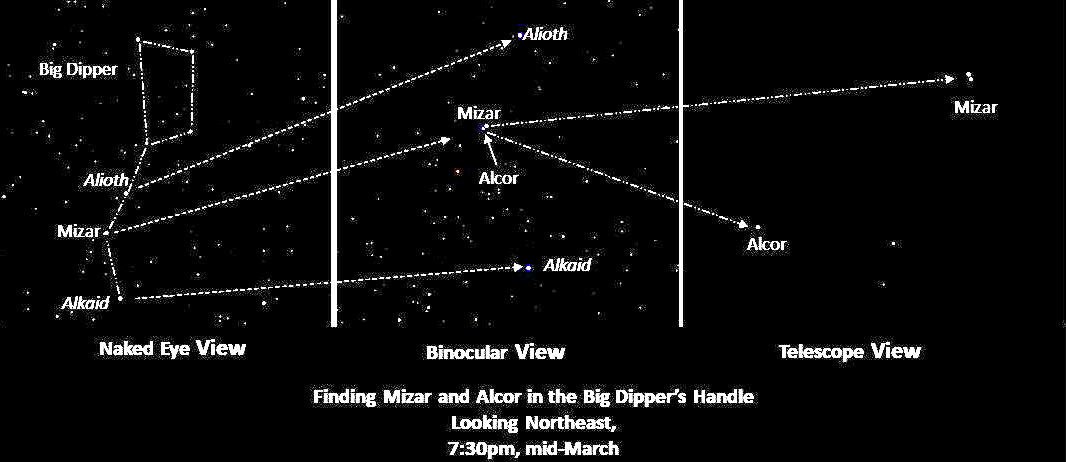
An interesting star to observe is Mizar in the Big Dipper. The Dipper will be located high up in the eastern sky in March, with the “handle” facing down toward the horizon. There are three bright stars in the handle, below the “cup” of the dipper. The closest star to the cup is Alioth, and the farthest from the cup, at the end of the handle, is Alkaid. Mizar is between these two. Use the picture above to locate Mizar.
Give Mizar a close look. Do you see another, dimmer star, very close to Mizar? That star is Alcor. Spotting Alcor is a test of good eyesight!
Train a pair of binoculars on the duo, and you’ll clearly see the separation. There definitely are two stars, where you casually see only one.
With even a small telescope, you’ll notice something else. Mizar itself is two stars, a “binary” system of two stars orbiting each other. A telescope allows you to “split” the two, whereas your naked eye sees one point of light.
But there is more, as the late-night TV ads often say. While they cannot be seen with a telescope, spectroscopic telescopes have observed that both components of Mizar are also binaries. And Alcor has been found to be a binary as well. So, when you look up at that star in the handle of the Big Dipper, you are actually seeing six stars!




Commented