
By Amelia Fiore
Columbia Gorge News
THE DALLES — The Columbia River Gorge stretches for 80 miles along the border between Oregon and Washington, harboring a diverse community of indigenous plants, mammals, birds, and other wildlife. The Gorge was shaped over millions of years, leaving some room for stories of the area to surface.
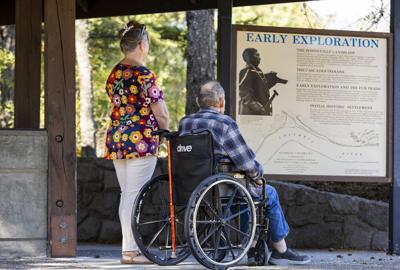
Mindfulness Coach Emily Goodwin Martin believes those stories should be shared with people who travel through the Gorge. On July 17, she hosted a Tales and Trails hike along The Dalles Riverfront Trail, where participants listened to audio clips about the area as a previewof Gorge Audio Trails, a project that took nearly three years to come to fruition.
It’s housed on Accessible Gorge’s website, which also includes a database of businesses, attractions and trails that disabled visitors and residents can experience.
Gorge Audio Trails features dozens of audio clips narrated by a range of local ecological, cultural and historical scientists, specialists on everything from bumblebees to Sasquatch. Martin has also hosted tours of the Mosier Twin Tunnels and will host a hike by Maryhill Museum in Goldendale on Aug. 1.
Martin explained the genesis of the idea: “I pitched an idea to a friend and said, ‘Hey, can we get Travel Oregon money to make mindfulness files for hiking trails?’ And she said, ‘Yes, as long as you do historical stories, cultural stories, ecological stories, in addition.’” With Martin’s passion for mindfulness and her experience as a high school science teacher, she found the perfect medium to blend the two.
On The Dalles hike, Martin played three stories. The first was narrated by Wilbur Slockish Jr. (Sla-kish), member of Yakama Nation’s Klickitat Band and the Columbia River Inter-Tribal Fish Commission, who has dedicated his career to protecting the fishing rights of his people. In his clip, Slockish spoke about the Gorge’s abundance of meat and vegetation for Indigenous communities, and the harm in industrial farms taking over.
Other audio stories included a lesson on the journey of sandpipers and an anecdote from a Lewis and Clark historian. Martin spoke with dozens of experts across the Pacific Northwest, each of whom provided a unique, informed perspective. Travel Oregon provided the funding, Northern Wasco Parks and Recreation matched story with place, and, the Columbia Gorge Stewardship Alliance choose all trails with accessibility in mind.
Most are paved with multiple entry points. There is accessibility information for individual trails and an option to listen to the clips in Spanish online. And, according to the Accessible Gorge website, “To make the experience more inclusive, the recordings are also available by text for the deaf and hard of hearing community as well as for easy translation into 100-plus languages.”
The signs presenting QR codes for the audio clips will be 3D printed by the Columbia Gorge Community College through its federally-funded 3D Printing Lab through grants from the U.S. Department of Energy and the National Institute of Standards and Technology. The signs are projected to be placed on trails beginning late August or September, and the website will feature a map of QR codes on the trails.
Some of the audios contain meditation prompts alongside a story, something Martin hopes to add more of. As for now, she said, “It’s been so amazing for a number of reasons. I’ve learned so much. It’s really deepened my understanding of the Gorge.”
There will be six trails across Oregon’s side of the Gorge, each providing a handful of unique audio stories. While some of the project’s audio stories are already published, all clips will be available on the Accessible Gorge website, accessiblegorge.com/gorge-audio-trails, in late August.
•••
Our journalism needs your support. Subscribe and read more at columbiagorgenews.com.


Commented