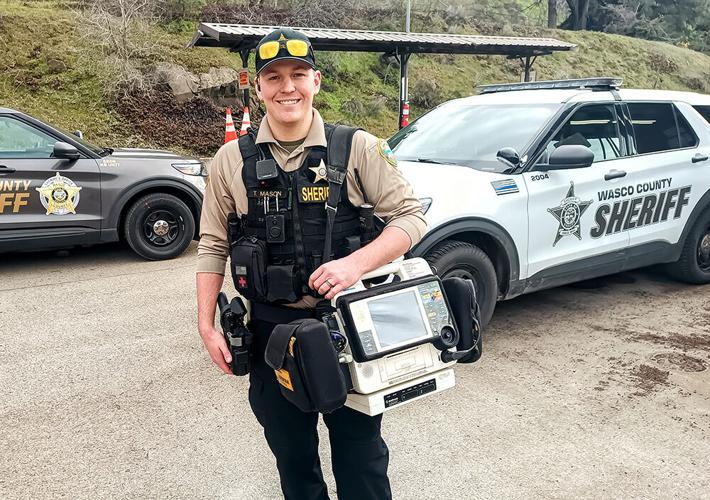
Wasco County Sheriff’s Deputy and Emergency Medical Technician (EMT) Trenton Mason is pictured with one of two cardiac monitors the sheriff’s office uses for its new deputy/medic program.
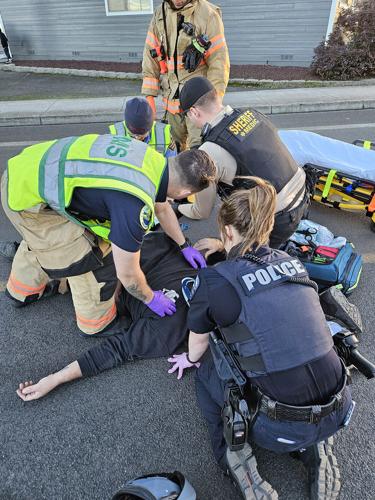
Wasco County Sheriff's Deputy and EMT Kanyon Reams, with his back to the camera, is pictured responding to a medical emergency recently. He is one of two deputy/medics working for the sheriff’s office.
Wasco County Sheriff’s Deputy and Emergency Medical Technician (EMT) Trenton Mason is pictured with one of two cardiac monitors the sheriff’s office uses for its new deputy/medic program.
This story has been updated to reflect Wamic Rural Fire Protection District was an initial supporter of the new deputy medic program.
WASCO CO. — Wasco County Sheriff’s Deputies Trenton Mason and Kanyon Reams have the usual police gear in their patrol cars, but they also have cardiac monitors and airway tubes.
In what may be the first program of its kind in the state, the deputies, who are also Emergency Medical Technicians (EMTs), operate under an agreement with Mid-Columbia Fire & Rescue (MCF&R) and can respond as EMT’s to medical emergencies.
“When we show up on scene, sometimes people are confused, but it’s very easy to explain to them, we’re EMTs,” Reams said.
Mason said he’s gotten positive responses from people when he’s told them, “We’re here to help in a medical capacity as well as a law enforcement capacity.”
Both have often hopped in the backs of ambulances to provide care and are fairly new to the sheriff’s office — Mason since December 2021 and Reams since July 2023. But they’ve responded medically to heart attacks, strokes, diabetic emergencies, falls, car crashes, trauma, allergic reactions, gunshot wounds, stabbings and farming accidents.
Mason started in the fire service, following in the footsteps of his dad, Curt Mason, who recently retired from MCF&R. But he found he wanted more interaction with the public.
Reams always had his eye on law enforcement, serving as a Gresham police cadet and park ranger before working for Corbett as a firefighter/EMT. He worked for The Dalles Police Department for about a year — where he started a similar police/medic program — before joining the sheriff’s office.
The program is the brainchild of Mason, 23, who grew up in Sherman County. Just a week after he started the job, he responded to an overdose. “I realized my medical background could come in handy,” he said.
By the end of his first month, he’d pitched a dual deputy/EMT role to Chief Deputy Scott Williams, who enthusiastically supported it, Mason said.
The sheriff's office originally partnered with Wamic Rural Fire Protection District. “Chief Larry Magill fully supported this program and helped us get it up and running by providing training and equipment,” Williams said.
“As the program progressed, for ease of training we moved into a partnership with Mid-Columbia Fire & Rescue,” Williams said.
The sheriff’s office made an agreement to operate under the guidance of MCF&R’s medical officer. Mason got the program rolling before he even went to police academy for law enforcement training.
Wasco County Sheriff's Deputy and EMT Kanyon Reams, with his back to the camera, is pictured responding to a medical emergency recently. He is one of two deputy/medics working for the sheriff’s office.
Contributed photo
“This program is about providing the best access to emergency medicine to every citizen of Wasco County,” Mason said.
Their work has not gone unnoticed. They’ve gotten letters of appreciation from Life Flight, rural ambulance services and community members grateful for their quick response and medical care.
And while police response is always their priority, they will also respond to medical calls “to augment the existing EMS system,” said Reams, 24, who grew up in Corbett.
They have to prioritize what medical supplies they can carry in their limited space, but it is fairly extensive. “We carry just about everything you’d see in a BLS (basic life support) ambulance, and we cram it all into the back of our patrol cars,” said Reams.
In addition to their cardiac monitors — one of which was obtained via a grant from the Mid-Columbia Health Foundation, and one was donated by Corbett Fire District No. 14 — They have c-collars to stabilize necks, medications, wound supplies and an oxygen bottle. Limited space means careful packing and stacking of supplies.
“Our goal is to get to people quicker to stabilize them until advanced life support can get there and take over,” Reams said.
Because law enforcement officers are always on patrol, they often are the first to arrive to medical emergencies. “We act more like fly cars for critical emergencies,” Mason said.
They are also available for critical situations like SWAT calls, active threats or other major incidents. “That is a deeper combination of law enforcement and emergency medicine working in conjunction with each other,” Mason said.
Their patrol cars bear a medical emblem, and they have a small patch on the front of their vest. The back of the vest says “sheriff/medic.”
Reams and Mason are also training their fellow deputies in what they’ve termed “basic patrol medicine.”
“I’ve established an actual training regiment of classroom and scenario-based training to cover all types of medical emergency scenarios,” Mason said.
They cover everything from responding to a drowning to a diabetic emergency.
Both Reams and Mason prefer trauma calls. “Trauma calls present a great amount of complexity and problems you have to work through,” Reams said.
Their medical background can come in handy in responding to some types of what initially start as police calls.
“If we’re responding to an altered mental status type of call, oftentimes we may be able to detect why that altered mental status is happening, just through vital signs and different diagnostics,” Mason said.
Their dual role suits both deputies.
“We’ve got the opportunity to help people in every way possible,” Reams said. “We can immediately switch from being a police officer responding to a call to rendering aid to somebody’s who’s hurt.”
Mason was asked if he’d consider switching back to the fire service. “Not a chance. This is pretty great.”



Commented
Sorry, there are no recent results for popular commented articles.