Skies are usually quite cloudy in November, but we can hope for some clear weather on Nov. 8. On that date, early in the morning, we will be greeted with a total lunar eclipse. It will be total in the western United States, but only partial in the eastern U.S.
The eclipse begins at about midnight on the 7th, but you won’t be able to see much then. The early part of the eclipse, the penumbra, is barely noticeable. At a bit after 1 a.m., the full shadow of the Earth begins to creep across the surface of the Moon. By about 2:15 a.m. the Moon should be fully eclipsed, and will appear a deep reddish color. The Moon will appear fully eclipsed until about 3:50 a.m., then will slowly brighten. The entire eclipse will be over by about 6 a.m. Best viewing, alas, will be from about 2-4 a.m. After 4 a.m., the eclipse will be barely noticeable.
If skies are clear, and you can stay awake (or get up early), give it a look. This will be our last full lunar eclipse until 2025. There will be partial eclipses in 2024, but the next full lunar eclipse will not be until March 14, 2025.
November will be another good month to view the bright planets Jupiter and Saturn, and this month Mars will join the party. At the start of November, the red planet will rise at about 8:30 p.m. By the end of the month, Mars will be high in the eastern sky, located in the constellation Taurus. November will be the last good month for viewing Saturn in the evening sky. By the end of the month, the ringed planet will set by about 10 p.m.
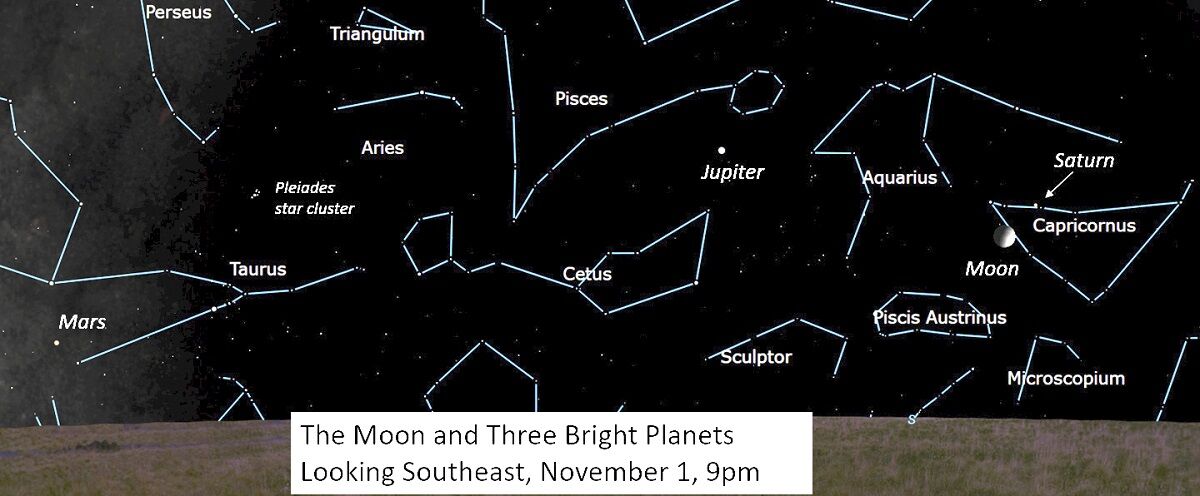
Those three planets, along with the first quarter Moon, will make for a nice view on Nov. 1. At 9 p.m., with a good view of the southern and eastern sky, you will be able to see Mars low in the east and Jupiter due south. In the southeast, the Moon will be just to the left of Saturn.
A couple of nights later, on Nov. 4, the almost full Moon will be just to the left of Jupiter. On the 10th, the waning gibbous Moon will be just to the right of Mars. November’s full Moon will be on the 8th, with new Moon following on the 23rd.
A nice “signpost” in the November eastern sky is the bright star cluster, the Pleiades. Look for it in the eastern sky, above and to the right of Mars, and right above the bright star Aldebaran in the constellation Taurus, the Bull. The Pleiades, also known as the “Seven sisters,” is a cluster of bright, blue-white stars, and the brightest star cluster in our sky. It is visible to the naked eye, and is a beautiful sight in a pair of binoculars.
To the left of the Pleiades, find the bright star Capella, the sixth brightest star in our night sky. Below the Pleiades and Taurus, find the rising constellation Orion. As many know, the Pleiades is known as Subaru in Japan, and the emblem of the Subaru automobile is a representation of the star cluster.
Remember to set your clocks back an hour (“fall back”) on Sunday, Nov. 6, as we revert to Pacific Standard Time.




Commented