
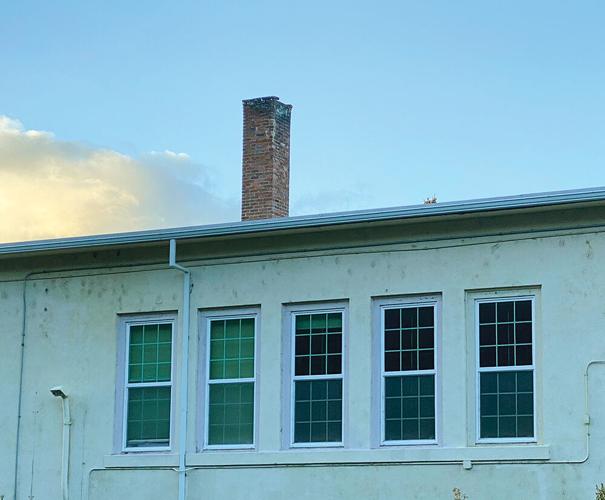

MOSIER — A few years ago, Mosier naturalist Brian Barrett looked up from his hammock and spotted a flock of slender, dark-brown, four-inch-long birds zooming overhead — all in the same direction. Intrigued, he climbed out for a better look.
“And I’m like, ‘Whoa, there’s a vortex of them,’” he recalled. He’d found the up-to-500 Vaux’s Swifts that swirl into in Mosier Community School (MCS)’s 100-year-old chimney every spring and fall. “It was just magical. ... You can hear them tweeting. They have a beautiful tweet.”
These tiny four-inch-long insect-eaters migrate to Mexico and Guatemala every winter, sleeping in many chimneys and hollow trees along the way. “They’re so acrobatic. ... They’re going so fast, and then they put on the brakes against the wind, and then, Boom!” Into the chimney. “So cool.”
This September Barrett planned a festival in conjunction with MCS, to introduce the birds to students, who remain unfamiliar with them. “I don’t think [the students] even know,” said Principal Michelle Dawkins, “so that’s our hope, is to raise awareness.”
But then the swifts all disappeared, flying south or finding other roosts.
Flocks at the famous Chapman Elementary School chimney in Portland are also down, from 7,000 in previous mid-Septembers to barely 1,000 at the same time this year, according to Portland Bird Alliance. Why is unknown, but they may have found other roosts — for instance, hollow burned-over trees from 2024’s record-breaking wildfire season.
Vaux’s Swifts also nest locally, building “little bitty” nest in a cavity by sticking twigs together with saliva, said Larry Schwitters, who’s spent more than 17 years studying Vaux’s Swifts and runs the website Vaux Happenings. Swifts feed up to seven chicks on about 11,500 insects daily, then migrate south in August and September.
“I consider birds like swifts to be pretty important for public health,” said Barrett, a registered nurse. “I mean, if they’re eating mosquitoes, it’s a really good thing.”
With tiny, attenuated feet, these swifts can’t perch, only hang from rough surfaces. They eat, drink, court, mate and gather nest material in the air. To avoid overheating from day-long flights, their feathered bodies lose warmth easily. But they “don’t fluff up well,” and when night comes, the air chills and swifts need warmth.
Schwitters learned chimneys like MCS’ can remain up to 25 degrees warmer than the night air, keeping the swifts huddled inside cozy. But chimneys must be the right sort — big, old and rough-textured on the inside.
MCS’ chimney is special, for several reasons. It was built before a 1941 code required smooth linings in chimneys, which swift claws can’t grip. It’s industrial-sized. And it’s surrounded by open space, rising high above the roof, beyond easy reach of predators like crows.
“It’s a very quirky old school,” Dawkins said, built around 1924. The original building was modified, but this chimney is in the old part. Only swifts use it, without causing any problems for the school that Dawkins knows of.
“For the most part, you can be dancing down below the chimney, playing, beating on a drum, and it doesn’t seem to bother them — but don’t tear it down,” Schwitters urged. “They will find another place. But when that one’s torn down, they’ll probably still find another place, but eventually they’ll run out of places.”
About two years ago, “We noticed that the swifts weren’t coming around anymore,” Barrett said. Very bright lights were installed on and near MCS at that time.
MCS had good reason for adding lights, building fences and hiring a school resource officer: A teacher received online threats from a local resident.
But the lights were hard for neighbors — shining into windows and yards and blinding Barrett on his driveway. An LED streetlight, also updated, earned the nickname “Eye of Sauron” for its brilliance.
Mary Coolidge from Portland Bird Alliance (formerly Portland Audubon) confirmed to Barrett that swifts could be spooked by bright lights. Some still roosted nearby, in a church and an old house. “I don’t think we killed them,” said Barrett. “They just went to smaller chimneys.”
He petitioned to get the lights updated, emailing a Pacific Power rep in Utah and talking to officials. The school later shielded its lights — illuminating the ground, without allowing light to shine upwards to sky and trees. The “Eye of Sauron” was removed.
The effect on Vaux’s Swifts is still just speculative. But this spring, they returned, in flocks of 200.
Barrett hopes they return again in 2025. He’s already planning his swift costume for next year’s festival.
Locals who want to protect swifts can help by educating others, Schwitters said, noting “Fifty, 60 years ago ... most people didn’t even know what a swift was.”
The updated building codes and loss of big, old trees mean a decline in usable roosts. Now the Vaux’s Swift is dependent on architecture, and since the code of 1941 means fewer ideal roosts are built. In cold weather, they may fly in windows, or huddle together on the outside of tree trunks.
The 300,000 birds from this subspecies of Vaux’s Swift which remain alive are vulnerable, due to their small population and the fact that one-third spend time together in one chimney. If something happens to one roost, a whole flock is impacted. For instance, if a heating system is turned on with swifts in the chimneys, “they come out on fire,” Schwitters said. In one such incident, 4,000 swifts died in Hillsboro, Oregon, he recalled.
And swifts need insects. Pesticides have resulted in widespread insect declines, according to scientists. “It’s dusk to dawn for a pair of swifts raising six young. They’re going at it all day long, bringing the bugs back,” Schwitters said.
Barrett figures there could be other swift roosts in the Hood River area. “Maybe people are keeping it secret or they don’t know about it,” he said. “After-dinner time is when this happens, and what do people do after dinner now? They just go on television or the computer. They don’t go outside.”
What to look for? “A small bird, about the size of a sparrow, but with more slender wings and flying together with others,” Barrett said.


Commented