
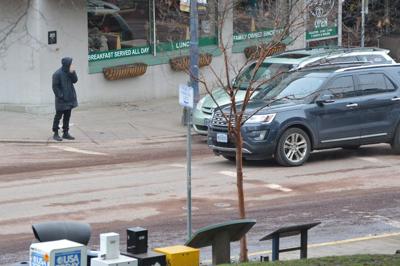
A list of 31 parking supply strategies are contained in a draft parking study delivered by a consultant earlier this month to the City of Hood River.
City Council accepted the report, conditionally, in its Jan. 13 meeting and will revisit the document on Monday night.
Council meets at 6 p.m. at City Hall.
Strategies address improved curb markings, better coordination of parking areas both on-and off-street, code revisions to deal with commercial and residential development in support of new growth, limiting and designating employee parking, improved signage and information along with data collection, and use of multimodal — bikes, e-cars and public transportation.
The strategies also call for branding, bringing all city-owned lots up to uniform standard, geographically-based lot naming (“Fourth and Cascade,” for example), consistency of zones and restrictions, and clearer signage and rules.
City Manager Rachael Fuller said the next step is to bring a resolution Jan. 27 related to strategies 1-2 along with a some minor changes to the report. Strategies 1-2 deal with overall rules and standards.
The overriding issue is lack of capacity — expanding the number of parking spaces and improving their utilization, and other resources to handle demand such as multi-modal — or a combination of the two.
“We can’t live with the current supply; we have to increase capacity if we want Hood River to grow,” Planning Director Dustin Nilsen said.
The purpose of the parking study is “to analyze the effectiveness of the downtown parking supply to best meet the needs of the community and to anticipate future constraints on the system,” stated the firm Rick Williams Consulting of Portland, hired by the city in December 2018.
Among its strategies: “Expand bike parking network to create connections between parking and the downtown to encourage employee bike trips and draw customers to downtown businesses.” Options would include bike corrals, sidewalk bike parking and use of private property.
City officials and consultants have stressed that the city is the overseer of parking solutions, but that most solutions draw on public and private participation and/or funding; 70 percent of the downtown parking supply is located on private property, and the report calls for improved coordination and off-hours utilization.
Throughout 2019, the team and ad project committee (see box, above) have held 10 meetings, two open house meetings for the public, and conducted a public survey to guide and review the work completed to date.
According to the Williams team, “The majority of the work has focused on the analysis of background conditions, guiding principles of the parking strategy, current parking demand, and forecasted parking demand.”
Strategies are broken into policy and code (1-4); improve on-street parking (5-11); improve off-street parking (12-20); improve access and integration with other modes (21-24); residential parking (25-26); and new capacity and funding (27-31).
Another strategy calls for elimination of parking within 20 feet of crosswalks (up from 10, typically) where there is a need for improved pedestrian visibility. City officials note that this reduces capacity while improving safety at key intersections, including Fifth and Oak streets.
Also highlighted: Replace all coin operated meters with pay stations and deploy pay-by-app technology that allows customers to pay for parking through a mobile application using their license plate and a credit card.
The consultants wrote that the success of the strategies will be measured against their role in making the Hood River parking system more:
Convenient — by ensuring that users who choose to drive can visit and experience downtown with minimal delay related to conveniently finding and paying for parking.
Clear and understandable — in that parking is clearly communicated, making it easy for users to park and get to their destination.
Attainable — by minimizing or eliminating any unnecessary parking-related obstacles and barriers to downtown development.
Multimodal — in that parking management should support and integrate with efforts to encourage increased use of alternative modes (transit, bike and walk).
Flexible — by maximizing the use of existing parking resources and anticipating increasing demand for access to the downtown over time.
Equitable — by ensuring fairness and balance in regulation and management.
The city should consider renaming its facilities as part of a broader effort to make the parking system more intuitive and easier to use. As shared use facilities are developed and integrated into the city system, they can be added to the naming system.
This step has an estimated 12-24-month timeline and has an estimated cost of $5,000 to $10,000 for coordinating new messaging into all communications (maps, app, webpage, etc.), changing existing signage and integration in marketing and promotional materials.
One oft-mentioned way to address downtown parking, construction of a garage, is the 31st and final strategy in the report.
The consultants state, “Parking garage development and transit-shuttle capacity growth require sophisticated infrastructure and are very costly. It will be important for Hood River to give adequate time and effort to determine the most beneficial and cost-effective formats for increasing the capacity of the downtown access system. Planning for, and finding funding for, new capacity is time-consuming, so a focused and objective evaluation will greatly facilitate decision-making before access constraints create adverse impacts on the downtown.”
85 percent and beyond
The strategies involve on-street changes to parking spaces, meters and the physical properties of parking, as well as operations and management ideas, and over-arching measures such as the top two strategies:
Strategy One — Formalize guiding principles as polices in the parking and transportation system plan.
“Growth in the downtown area will require an integrated and comprehensive package of strategies to respond to growth, maintain balance and efficiency within the access system and establish clear priorities necessary to ‘get the right vehicle to the right parking stall’,” states the study.
Categories for implementation include city role and coordination, priority users, active capacity management information systems, intergeneration with other transportation modes, planning for future supply, and financial viability.
Strategy Two — Adopt the 85 percent Rule as the standard for measuring performance of the parking supply and triggering specific management strategies and rate ranges.
“The 85 Percent Rule is founded on when occupancy rates routinely reach 85 percent in the peak hour, more intensive and aggressive parking management strategies are called for.”
For Strategies One and Two, the timeline is less than 12 months and the consultants stated that costs are minimal other than staff time required for necessary policy or code changes. “Implementation of the operational and management aspects will require ongoing evaluation of budget and staff capacity,” Fuller said, adding that depending on council’s direction, Urban Renewal funding (downtown property taxes assessed for development projects) could be a source of funds to help address parking supply and wayfinding. Fuller said the city has begun evaluating some of the operations and management ideas; for example, to free up on street spaces last summer the city reduced the number of on-street parking passes through attrition.
“If they were not renewed, we did not re-sell,” the pass, Fuller said.
Most downtown parking is privately-owned and off-street. Of the 780 stalls on 35 lots in the study area, 238 are open to the public. 70 percent of off-street is privately-owned.


Commented