

Quick takeaways
• Judge Lung Hung found insufficient evidence to prove Hunter Brucker was impaired by marijuana at the time of the fatal crash.
• Brucker previously entered a no-contest plea to criminally negligent homicide and third-degree assault under a plea agreement.
• Sentencing was postponed from June 4 to July 1, drawing emotional reactions from Wyatt Cannon’s family.
• Attorneys disputed whether Oregon State Police investigation provided enough evidence.
Editor's note: This article has been updated to reflect the legalities of the plea deal.
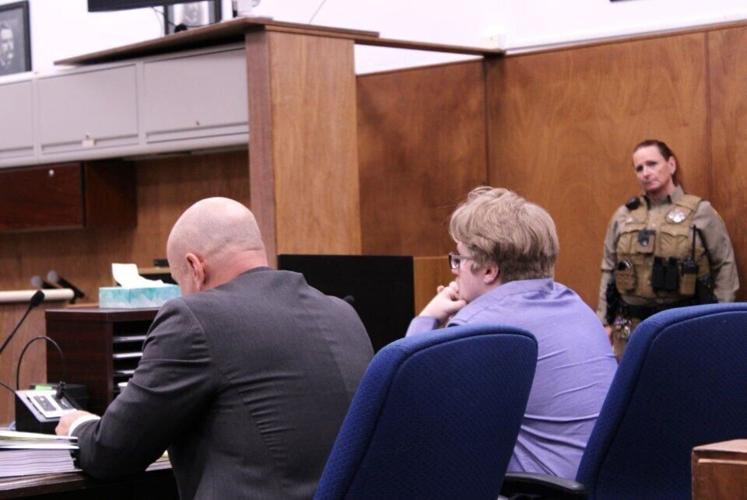
VALE — Dozens of family and friends of Wyatt Cannon filled a courtroom at Malheur County Circuit Court on June 4, as they waited for DUII bench trial and sentencing of the man who killed him in a car crash in April of 2024 that also injured his younger sister, Sara. In a heart-wrenching twist, the sentencing got delayed until July 1. Furthermore, during the bench trial, Circuit Court Judge Lung Hung acquitted Hunter Brucker, of Redmond, of driving while under the influence of marijuana.

Siblings Wyatt and Sara Cannon are pictured. The teens were victims of a head-on crash in April of 2024 that killed Wyatt and injured Sara. The driver of the other vehicle, a Redmond man, is facing multiple charges for the crash, including driving while impaired. A jury trial is slated to begin on May 29.
Photos courtesy Tamara Cannon“Because the full truth of past events is often hard to determine, the task is not to define the ultimate truth, but whether the state has proven charges,” Hung said.
He said there was “simply a lack of evidence beyond a reasonable doubt” that Brucker was under the influence of marijuana when the fatal crash happened. This stems from the only evidence being a blood test, which is not admissible for driving under the influence of marijuana without behavioral evidence that also demonstrates intoxication. Such evidence is usually gathered through a field sobriety test or an evaluation by a drug recognition expert, something Oregon State Police troopers did not do.
“The state often misstates reasonable doubt and states that it exists if there is another reasonable [factor],” Hung said.
His opinion came after a few-hour recess in which he reviewed evidence presented by the state and Brucker’s defense attorney. Among the evidence were reports and body worn camera footage of OSP troopers.
During an earlier recess, attorneys departed from normal courtroom decorum. Deputy District Attorney Michael Heninger and defense attorney Evander McIver had a heated, expletive-laden argument. The confrontation ended with Heninger throwing a notebook onto a table and storming out of the room.
Plea deal and sentencing delay
Brucker was initially facing six charges and had pleaded not guilty to them triggering a jury trial. However, he entered a plea deal on May 28, changing his plea from not guilty to “no contest” on two counts. These were criminally negligent homicide and assault in the third degree. With the plea deal, Brucker waived his right to jury trial and saw the dismissal of the other three charges. Those were manslaughter in the second degree, reckless driving and assault in the fourth degree.
On the criminally negligent homicide charge, the gridblock sentence based on Brucker's history would have allowed for probation, according to information from District Attorney David Goldthorpe. However, Heninger negotiated the case in a way to ensure that Brucker goes to prison under the following guidelines: 21 to 24 months in prison, five years supervised probation, a drug and alcohol package, restitution and no contact with the Cannon family.
The plea deal also carries a downward departure on assault in the third degree, where the state is suspending more prison time over Brucker being released from prison.
Goldthorpe explained that the parties could not agree on a conviction for the DUII and Oregon does not allow a negotiated dismissal of that charge. As such, the parties agreed to a bench trial on that count.
"The DUII was never going to change the defendant's sentence, except for a mandatory fine that would have been imposed," Goldthorpe explained. "He is already going to receive a longer license suspension from the other counts than the DUII would have required."
The sentencing was set to take place at the bench trial June 4. However, it was discovered by the judge and victim’s family during the bench trial there was a written agreement before the plea deal between Heninger and McIver. Heninger looked for the email McIver sent him that he had agreed to and told the judge he had found it. Hung then reluctantly granted the three-week extension of time for Brucker to “get his affairs in order.”
This realization was unsettling to Cannon’s parents, who vocally expressed their frustration with, “Why?!” and “I want this done today!” Hung told them they would have to discuss that with the state but that if there was a written agreement, he had no choice but to grant the extension. Heninger later explained to the parents that allowing a sentencing after such an agreement would carry the risk of an appeal.
Expert witness: marijuana intoxication only lasts ‘3 to 4 hours’
During the bench hearing, Hung listened to expert witness Kenn Meneely, who has decades of experience working for the OSP Crime Lab and often testifies during criminal cases regarding intoxication.
On the day of the crash, troopers initially stated they did not believe Brucker was under the influence, could not smell drugs or alcohol, and that his reaction to the crash, including red eyes, was appropriate.
However, that changed after Brucker admitted to them that he had smoked marijuana earlier that day. He told troopers he smoked “a dime-size bowl” of marijuana at 8 a.m. PT that morning, leaving central Oregon around 12:30 p.m. PT. The crash happened at about 4:20 p.m. MT.
Troopers asked Brucker if he would agree to a blood test. He did and it showed THC was in his system — the amount of which was not allowed to be disclosed during the trial.
Brucker’s lawyer asked Meneely why smoking in the morning didn’t necessarily mean he was under the influence when the crash happened that afternoon.
Meneely said even though Brucker had used marijuana early that morning, the effects of marijuana, according to experts, only last “three to four hours.”
He said marijuana can stay in the system for “many, many days” after use and “much longer” for a common user.
Meneeley said after reviewing the case files, including the camera footage, Brucker did not appear intoxicated. He described him as “responsive, articulate, no hand tremors, didn’t drop documents, no daze or blank stair and was able to understand instructions.”
Meneely and McIver said that there were a variety of tests and observations that would either conclude or exclude drug impairment. Those would be then coupled with a blood or urine test to validate those issues. Meneely also said that THC could be detected in urine up to 72 days after use.
State’s stance
Heninger tried to make the case to Hung that although there were no obvious signs of impairment, Brucker’s perception of time and distance were skewed during and after the crash. Heninger claimed this was due to the intoxicating effects of marijuana.
He pointed out that Brucker told troopers he was going 45 mph behind a semi truck, then 55 mph to pass, changing that speed on a phone call the next day to a range of 55 to 60 mph. He said airbag crash control module readings put the speed at 82 mph four seconds before impact.
Heninger pointed out that the crash happened on a stretch of Highway 20 at the bottom of a hill with a straight section of road visible for over a half-mile in each direction from the crash location on a sunny day with no wind or adverse weather.
He acknowledged troopers did not do a field sobriety test of DRE exam and that there were no typical signs of impairment.
“But this is not a typical situation,” Heninger said. “This was an extremely serious crash that took place and officers made the decision due to the potential state of shock and injuries the defendant may not have been aware of.”
He also stated that troopers found six various vape canisters located in Brucker’s vehicle that were accessible to him while he was driving that day.
“I will agree this is not a case that is a fall-down drunk case with obvious signs of impairment,” Heninger said. “This is a case involving mental faculties of the defendant being affected and that … causing his ability to drive to decrease, which caused this crash to occur.”
‘Dereliction of duty’
McIver said troopers not doing the field sobriety test or DRE evaluation was a “dereliction of their duty.” He said they were “not competent in their jobs,” with Brucker showing no signs of impairment and then troopers later trying to “bootstrap it in with a blood test.”
He furthermore took issue with the troopers turning off body cameras during portions of interviews with Brucker and allowing Brucker to be taken to the hospital for the blood draw by friends rather than law enforcement. He said it didn’t protect the integrity of evidence if they actually thought he was impaired.
“I understand the family lost somebody. It’s huge. It’s horrible. But sometimes bad things happen to wonderful people,” McIver said.
He said because there was a tragedy they were trying to “drum up” the DUI charge based solely on a blood sample, which is not allowed due to precedents set in previous court cases.
“This sort of thing brings into play the massive coercive nature of the state,” McIver said, adding that there was no basis or probable cause, “let alone beyond a reasonable doubt.”
McIver said the troopers’ mistaken belief that Brucker was intoxicated “should have been caught by the DA,” saying he understands there is pressure to hold someone accountable when someone dies.”
“But the evidence has to come from observations and tests … which they simply and inexplicably failed to do,” he said.
He added to this that the death investigation “was atrocious.”
“It boggles the mind how we got to a DUI charge here,” McIver said. “Beyond a reasonable doubt is an exacting standard and it should be. … This did not even come close.”


Commented
Sorry, there are no recent results for popular commented articles.