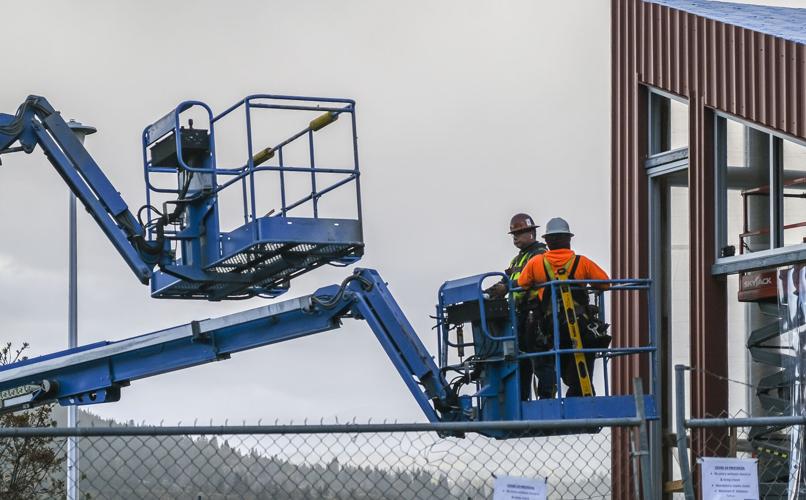
Construction workers were putting up drywall Wednesday afternoon. According to superintendent Christopher Douglass of construction firm Howard S. Wright, work on the roof is substantially complete, and phase one of the project is set to be complete in January.
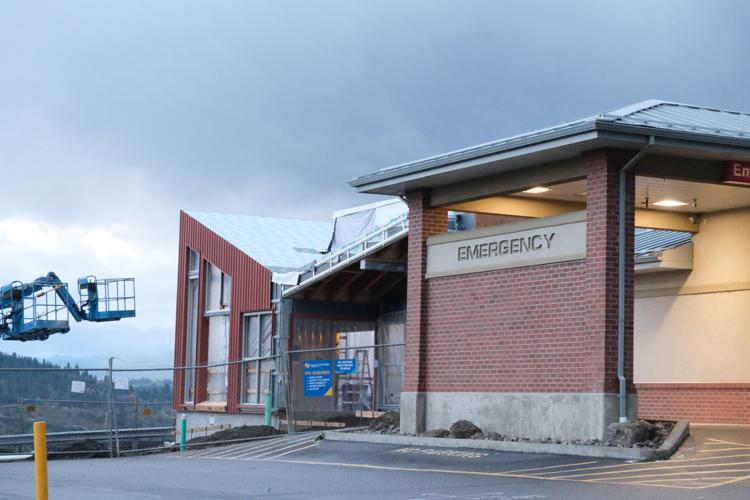
Skyline Hospital’s emergency department expansion and renovation project will see the addition of two examination rooms, four patient-centered rooms, a new nurses’ station and will see various renovations to the existing emergency department.
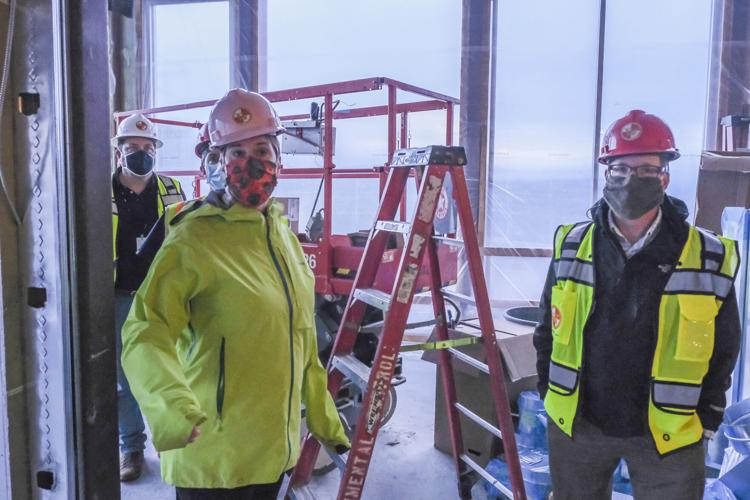
Skyline Health Marketing and Foundation Director Elizabeth Vaivoda and CEO Robb Kimmes tour the emergency department expansion last Wednesday.
Jacob Bertram photo
Construction workers were putting up drywall Wednesday afternoon. According to superintendent Christopher Douglass of construction firm Howard S. Wright, work on the roof is substantially complete, and phase one of the project is set to be complete in January.
Jacob Bertram photo
Skyline Hospital’s emergency department expansion and renovation project will see the addition of two examination rooms, four patient-centered rooms, a new nurses’ station and will see various renovations to the existing emergency department.
Drywall and sheet rock were going up last Wednesday on the Skyline Health campus construction site in White Salmon, marking progress on the emergency department expansion and renovation project, which began last August.
Skyline Health’s emergency department capital project will soon move on to phase two of their construction timeline, set to be complete in May of 2021.
Skyline’s $6.1 million project will increase capacity, enhance patient security and privacy, and improve staff workflow, said Skyline CEO Robb Kimmes. Funding comes from a mixture of state grants, donations, and from bonds refinanced in 2017.
“We’ve got top-notch providers, and now we’re going to have a top-notch space to go with it,” said Kimmes.
Kimmes said the project reflects growth in the area, as the hospital makes moves to expand and revitalize services to its full potential. “As the town has grown, so has the needs of the emergency department,” said Kimmes.
Phase one of the project includes the construction of the emergency department expansion, while phase two will see renovations to the existing emergency department, constructed in 1996.
The expansion will add around 2,800 square feet to the department, including two examination rooms, four patient-centered rooms, a new nurse’s station, and a family lounge, Skyline’s take on a waiting room. Renovations include security doors to the emergency department and a separate ambulance bay from visitor access to the department.
Each examination room will be bigger than the existing rooms, allowing for medical technology, such as ultrasound technology and X-ray machinery, to be transported into patients’ rooms and for more medical personnel to be present and have easy access to the bed.
The four patient-centered rooms included in the project are a new trauma room with access to the helipad, a serenity room, a crisis room, and a consultation room.
The space will also be more open to natural lighting. The design allows for a near 180-degree view of the Columbia River Gorge in the family lounge, while patient rooms will include windows overlooking the scenery.
“The thing I’m most excited about is the improvement in lighting ... it’s just going to feel like a cleaner, brighter space,” said Dr. Andrew Miller, emergency department medical director for Skyline Health.
The additional rooms will assist with keeping Skyline Health’s promise of having no wait times for patients. Said Miller, “On busy days, the lack of additional rooms is what makes people wait.”
Phase one of the project is set to wrap up sometime in January. The construction crew have been working in close coordination with hospital staff to ensure a running emergency department while installing the improvements. Christopher Douglass, superintendent of the project with construction firm Howard S. Wright, said at one point, the team had to open the wall to the trauma center to install a glulam beam, all while keeping the trauma center active.
“It takes a lot of coordination, with both Dr. Miller and the facility staff and all the teams to really understand, a.) what sustenance means, and b.) how we can modify our typical approach to achieve something like a glulam going in an exterior wall,” said Douglass.
Also included in the renovations will be an update to the older wing of the hospital’s HVAC system, and each of the new exam rooms will be installed with negative-pressure systems, allowing for safe ventilation of airborne infectious diseases, an addition to the design spurred by the ongoing COVID-19 pandemic. “There’s no more perfect time,” said Miller.



Commented