
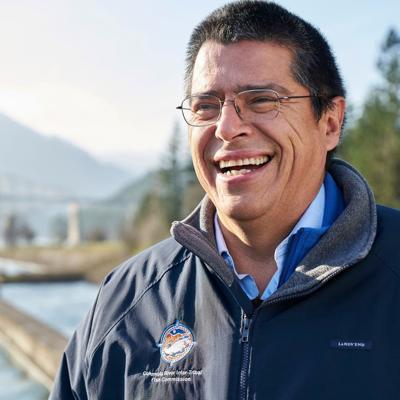
THE GORGE — “There was millions and millions of salmon, and they’re not coming back like they used to.”
Salmon dominated the conversation between Sarah Fox and Buck Jones in the next-to-last Sense of Place lecture on Feb. 12. Fox and Jones had been acquainted for years — they first met for a podcast on tribal fishing. Fox kept in touch, asking to understand what went on in Jones’ circles. When they met, Jones’ title at Columbia River Inter-Tribal Fish Commission (CRITFC) was in salmon marketing.
CRITFC is a technical and advisory arm of four Tribal nations — The Confederated Tribes of Umatilla Indian Reservation, Warm Springs, Yakama, and the Nez Perce.
“Fishing wars was going on, especially up in the Nisqually area, but we also had tribal members that were here — that was a treaty right for us to fish — [who were] getting arrested for fishing,” and nets were being cut, Jones said of CRITFC’s beginning. “And so the tribes was battling either the states or the federal government, and it took a lot of resources for the tribes to go on their own and fight these battles.”
So they teamed up, and formed CRITFC in 1977. Now a hundred staff in Portland work in science, fish and watershed management, human resources and policy, and as lawyers. Recently, a community development department was added. An enforcement arm in Hood River “really strengthened our sovereignty,” said Jones, because their deputized enforcement officers can control the tribal laws for their people. (They can also respond to other legal violations by non-tribal members). And there’s a genetics lab in Idaho.
CRITFC also handles fishing site maintenance for in-lieu and treaty fishing sites along the river. But the 50-year budget for that management is almost gone, Jones said. Some tribal members live along the river, at fishing sites: “This is where their bloodlines were from ... affordable housing the Gorge, you know, it’s not just a tribal issue, it’s a society problem.”
“[They’re] essentially nations within a nation here, with these four treaty tribes,” Fox said.
In the 1980s, salmon marketing also became an issue for the roughly 700 tribal fishers in the region, Jones said. Those fishers could sell to a wholesale buyer for “a couple dollars a pound,” and then the markets would fluctuate and “that same beautiful fish was being sold to wholesale buyers for 25 cents a pound, and then you’re seeing it ... in Portland and stuff at $8 to $10, to $18 and $20 a pound.” So Jones’ job was to develop high-end markets “around here” where fishers could get good prices, and keep established sales going.
“In some of our creation stories, the salmon gave up its life when we were poor, pitiful people — gave up its life to feed us,” Jones said. “It goes out in the ocean three to five years ... so that made us stewards. Stewards of the land, and the water that it returns to. We’ve always been sustainable.”
He noted that at Celilo Falls, “the chiefs ... would say, ‘Yeah, the salmon are back, but we’re not going to fish right now because those salmon have got to go home ...’” At one time, Celilo was known as the Wall Street of the West because “there was so much trade and commerce going on with the fishing sites.” Zone 6, the area between Bonneville and McNary dams, is now designated strictly a tribal and sport fishery.
Each spring, the tribes honor the salmon in a First Foods ceremony. “We live in a reciprocal world where we have to take care of that water, we have to take care of the forests and the things where they return,” he said.
Jones grew up in Pilot Rock, working with horses and wearing cowboy boots so often he didn’t learn to tie shoes until third grade, he said. Jones’ father was a farrier. “It was a rough trade, and I had horses and was raised around horses ... I used to be a jockey in the Pendleton Roundup, doing the Indian relay races.”
But his father took those horses away when young Jones became so focused on basketball he couldn’t put in the time to maintain them anymore, he recalled. Responding to an audience member’s question later, Jones said he credits the job and family he has now, to that change in his life. “We got people that ... got everything they need on their reservation. I was like that. Why would I go anywhere else? I can go hunting when I want, I can go fishing when I want ... I would probably be on the rez and I probably wouldn’t have left.”
Instead, Jones went to tribal basketball tournaments, became an all-state basketball player (when there were very few Native players), then a fisher on the Columbia, then worked for CRITFC — making a 180-mile commute for seven years.
He gaffed salmon with relatives on the reservation as a child, later learning gillnetting on the Columbia (at night, so salmon couldn’t see the nets), and processing in a small facility, from the late Mary Goudy Settler. “She was raised on the river ... We had a processing line ... and she could plug up — there was eight people behind her and they couldn’t keep up with her, ‘cause she can cut fish that fast,” he said. “... They took me in for numerous years ... I could never forget that.”
Settler was one of those arrested and jailed for upholding treaty fishing rights in earlier years. After cleaning the fish, Jones would rest on the nets in a loft — and read binders of Supreme Court decisions and paperwork on treaty fishing rights, unwittingly preparing for CRITFC work. “All of our tribal people should know this stuff, but it’s not taught in our schools,” he recalled. “... Without reading those binders in a laundry basket or whatever, I wouldn’t be where I’m at, I really wouldn’t, because I don’t have no education.”
A request for Season 16 speakers is open at mtadamsinstitute.org/senseofplace. You can apply yourself or nominate someone you know.


Commented