
By Flora M. Gibson
Columbia Gorge News
KLICKITAT CO. — The “Top of the World” prescribed burn was declared a wildfire on Oct. 14, joining the less than 1% of U.S. Forest Service prescribed burns which do not go according to plan. That’s out of roughly 4,500 prescribed burns ignited by the Forest Service annually, treating about 1.3 million acres across the National Forest System.
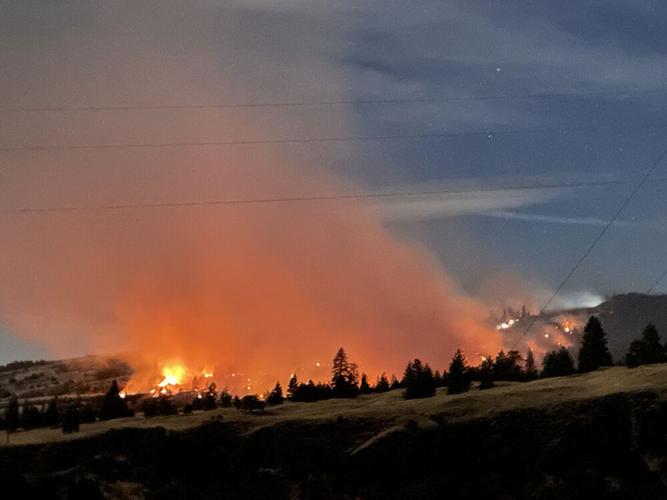
The burn was part of “continuing efforts to reduce hazardous fuels and improve forest health surrounding the popular Coyote Wall and Catherine Creek trail systems,” according to a news release from the Forest Service. Increasing wind gusts, and a shift in wind direction, blew out embers that started several spot fires outside the area managers had planned to burn.
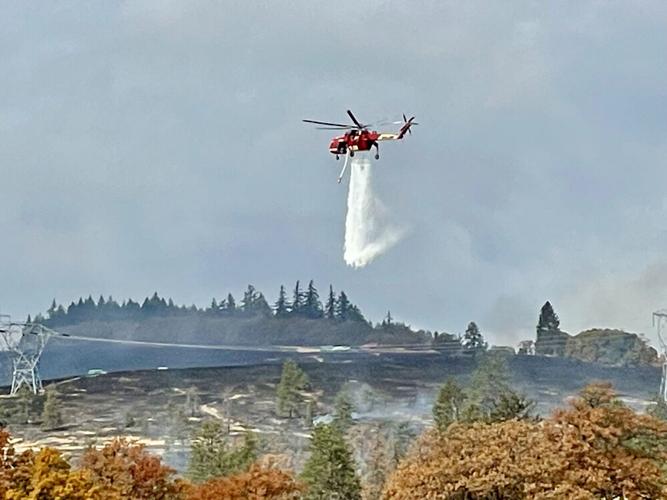
Seven handcrews, five engines and two water tenders had gotten the fire 70% contained the next day. Two helicopters were called in the next day, to help cool down hotspots, while firelines were completed. Firefighters then walked the perimeter, mapping the fire at 170 acres — including the planned prescribed burn.
About 99.84% of Forest Service prescribed burns “go according to plan,” and very few are declared wildfires, Forest Service Public Affairs Specialist Beth Kennedy told Columbia Gorge News in an email. A few are declared wildfires, which brings more firefighting resources to the scene.
“We can never guarantee that prescribed fires won’t escape because there are risks when we use this tool,” Kennedy wrote. “It’s a trade-off we have to take seriously together with communities. The alternative is more large and destructive wildfires like we have seen the past several decades — a result of the combination of overgrown forests, climate change, a growing number of homes in the wildland-urban interface, and more than a century of fire suppression.”
The Top of the World fire was 100% contained by Oct. 25, after several days of cooler weather and light rain, according to a later Forest Service press release. It remained on National Forest System lands, between Lyle and Bingen. No structures were threatened, no evacuations ordered.
Klickitat County Fire Districts, Washington State Department of Natural Resources (DNR), Oregon Department of Forestry and Mid-Columbia Fire and Rescue (MCFR) responded to help contain the fire. Cool weather also helped.
“As prescribed fire operations increase, we can reasonably expect the number of ‘declared wildfires’ to also increase,” wrote fire communications specialist Erica Keene and Kennedy in a joint email to Columbia Gorge News. “[Wildfire] risk has reached critical levels in the west ... Prescribed fire implementation is essential in combating large and destructive wildfires while reducing risks to valued assets within our treasured landscapes. We are dedicated to learning from recent events to reduce the risks of escapes ...
“Even among the most experienced fire managers, variations and anomalies in weather modeling and actual conditions during burns can still pose unexpected challenges,” they wrote.
Prescribed fires are scientifically planned and lower in intensity than wildfires, Keene said in an interview. Risk is always present; there’s always things that “aren’t able to be predicted.”
Fire agencies are notified before burns are conducted, Kennedy said in that interview, and contingency plans can include the availability of extra firefighting resources.
Every wildfire is managed differently, making the cost of escaped prescribed burns hard to generalize, Kennedy went on.
The Forest Service will keep exploring the use of prescribed burns, but personnel are “taking a hard look” at what they can learn from the incident via an after action review, Kennedy added.
“[Wildfire] seasons like we’ve had should demonstrate the need for this,” said Roland Rose, fuels planner at Columbia River Gorge National Scenic Area, told Columbia Gorge News in an earlier interview, when burns were being planned near Bingen. “It’s the most critical thing that we continue to do burning, because of these giant fires that we are getting — bigger and bigger, more fires every year ... If we don’t proactively burn and release a little bit of smoke, that same piece of ground can burn and have a lot more negative effects.”
The Forest Service cautioned people to be extra careful of hazards in the Catherine Creek area, like falling rocks and fire-weakened trees. Recreational trails remained open.


Commented