There was a time when eating gluten-free bread required managing your expectations. A loaf that stayed together when sliced felt like a win. Cakes were often gritty, and getting the chewy texture of a good loaf without wheat flour was notoriously difficult.
That is changing. Gluten-free bakers are turning out everything from tender cakes and chewy bagels to crisp pizza crusts and sourdough bread, one of the more challenging breads to recreate without gluten.
Better flour blends are part of the reason, but bakers have also learned a few tricks along the way. Choosing the right flour, measuring it carefully and even letting the batter sit for a few extra minutes can make a noticeable difference in how gluten-free baked goods turn out.
Why Gluten-Free Baking Is So Tricky
Texture is one of the biggest challenges.
A 2026 review published in theInternational Journal of Food Sciencefound that creatinggluten-free breadwith the qualities of traditional bread is still a challenge. The simple reason is that gluten helps give bread its familiar stretch and chew. Take it away, and bakers have to find other ways to get that texture.
That helps explain why replacing wheat flour is rarely as simple as reaching for a single substitute.
Today’s gluten-free flour blends often combine several types of flour and starches, with each playing a different role. The goal is simple: create baked goods that hold together, stay moist and have a texture closer to what you would expect from traditional baking.
Carolyn Haeler knows how tricky that balance can be.
Haeler, founder of Mightylicious Gluten Free, has celiac disease and spent nine months developing a gluten-free flour blend for the company’s cookies. Eventually, she decided to offer flour blends that home bakers could use in their own recipes.
“I was inspired by the challenge of creating gluten-free baked goods that are genuinely delicious, not just ‘good for gluten-free,’” Haeler said. “I wanted to develop blends that make baking easier and deliver the taste, texture, and quality people expect from traditional baking, without compromising on ingredients or flavor.”
Haeler says one key to her flour is finely milled rice flour, which is intended to create a smoother texture without the grittiness sometimes associated with gluten-free baking.
The Promise, and Limits, of 1-to-1 Flour
Another change has made gluten-free baking more approachable for home cooks: the rise of 1-to-1 flour blends.
These products are designed to replace all-purpose wheat flour using the same amount called for in a recipe. That can eliminate some of the calculations and extra ingredients that once made converting a favorite recipe to gluten-free feel like a science experiment.
There is a catch.
A 1-to-1 swap is generally much easier with non-yeasted baked goods such as cookies, brownies, muffins and cakes. King Arthur Baking, for example, recommends its measure-for-measure flour as a direct substitute in non-yeasted recipes but advises a different approach for breads and pizza.
Haeler also qualifies her advice. She says Mightylicious blends can be used as a 1-to-1 replacement for wheat flour in many recipes.
“Our goal is to make gluten-free baking feel less complicated while still giving you delicious, reliable results,” she said.
Bread is where things get more interesting.
Sourdough Puts Gluten-Free Flour to the Test
Few baked goods rely on texture quite like sourdough.
Part of the pleasure of slicing into a good loaf is the contrast between the crisp crust and chewy interior. Those qualities are harder to reproduce when gluten is removed from the equation.
That makes sourdough a fitting test of how far gluten-free baking has come.
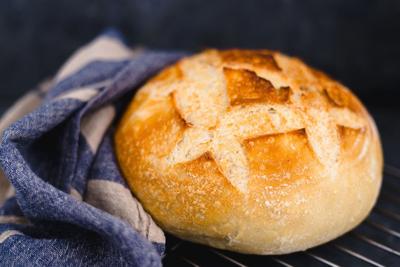
Haeler recently developed agluten-free sourdough recipeusing her flour blend. She says the goal was to recreate the texture and tang people associate with traditional sourdough.
“People think gluten-free bread can’t have that true sourdough texture and flavor, but it absolutely can,” Haeler said. “This recipe is all about bringing that experience back to the table.”
Research suggests fermentation itself may also play a role. The 2026 review found that sourdough fermentation is among the approaches being studied to improve the structure and flavor of gluten-free bread.
Still, the flour you choose is only part of the equation.
One Simple Step Can Improve Gluten-Free Texture
One of Haeler’s simplest tips for gluten-free bakers does not require buying anything. It requires waiting.
She recommends letting gluten-free batter or dough rest for 10 to 15 minutes beforebaking.
“This gives the flour time to fully hydrate and can make a big difference in texture,” Haeler said.
There is independent support for that advice. King Arthur Baking recommends giving gluten-free cake and quick-bread batters a 10- to 15-minute rest so the starches and xanthan gum can fully hydrate. As they absorb liquid, the batter thickens.
Haeler also recommends measuring gluten-free flour carefully and using a kitchen scale when possible.
Most importantly, she encourages home bakers to experiment.
“My biggest tip is not to overthink it,” Haeler said.
That may be easier to do today than it was a decade ago.Gluten-freebaking still requires understanding what the ingredients are doing, especially when yeast and bread are involved. But better blends and better techniques are giving bakers more options.
And perhaps the biggest change is the standard itself. Agluten-free loaf, cake ordoughnutno longer has to be judged by what is missing from it.



Commented
Sorry, there are no recent results for popular commented articles.